The alarm sounds at 4:15—it is time to get up and head to the clay lick, Colpa Colorado! Darkness still covers everything, but the howler monkeys are already awake, filling the surroundings with their distinctive wind-like calls. I untangle myself from the mosquito net, switch on my head torch, and leave the room. Jānis is already awake, drinking coffee at the table in the dark. The generators have not yet been started because the only “early birds” are the researchers, who need to reach the colpa before dawn. On the way to the bathroom, I encounter more glowing heads like mine. We exchange quiet greetings and meet a few minutes later to walk to the boat together.
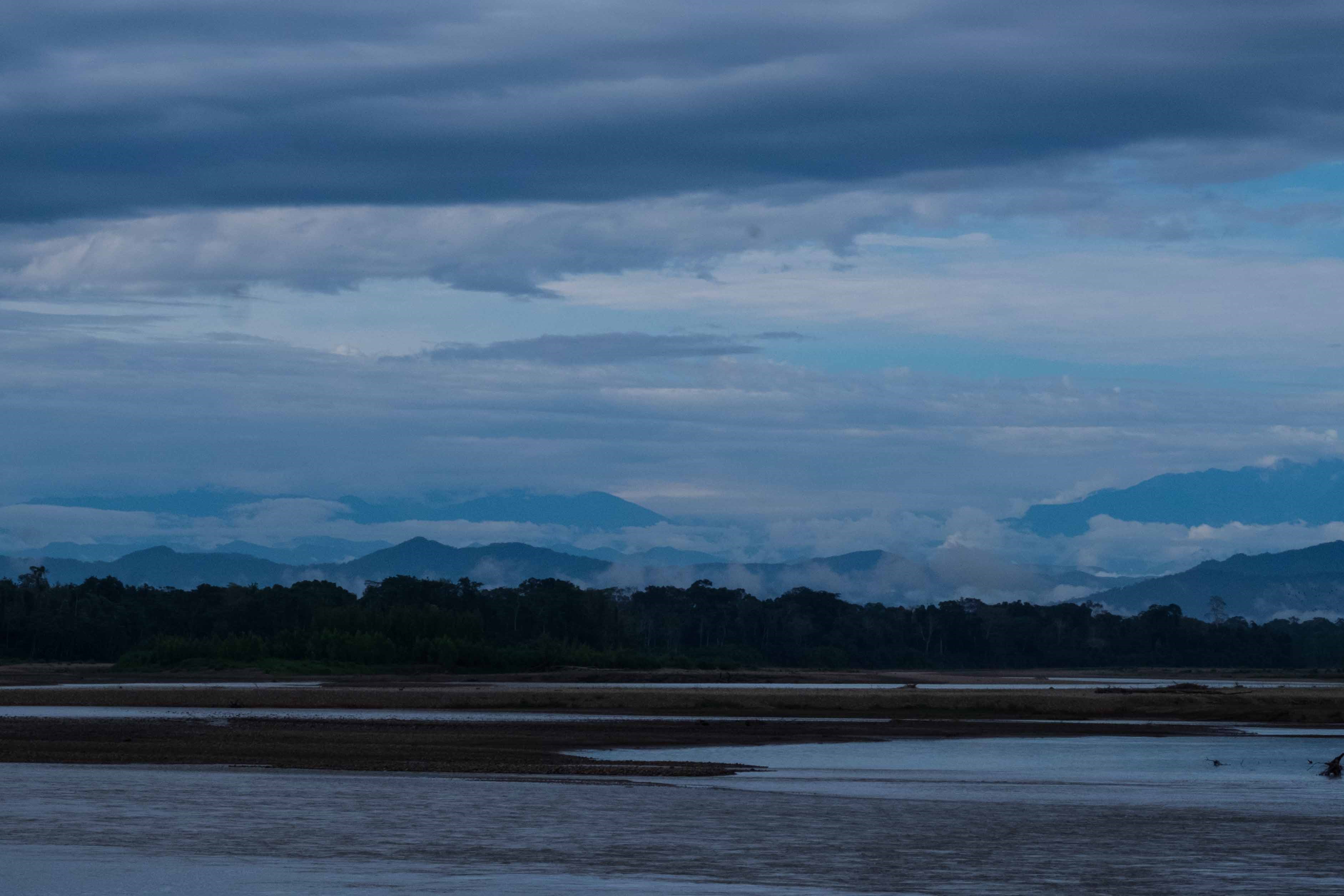
Did somebody bring the radios? One for the boatman too? Who has the protocols? The telescope is here, and so are the chairs. All right, we pull on our rubber boots and enter the dark rainforest. Ten minutes later, we reach the riverbank, where our boatman, Braulio, is already waiting. The ride is short. Soon, we are dropped on the shore of an island with a good view of the clay lick. Dawn is beginning, and the birds will arrive shortly, so we quickly divide among the posts and prepare to start the count.
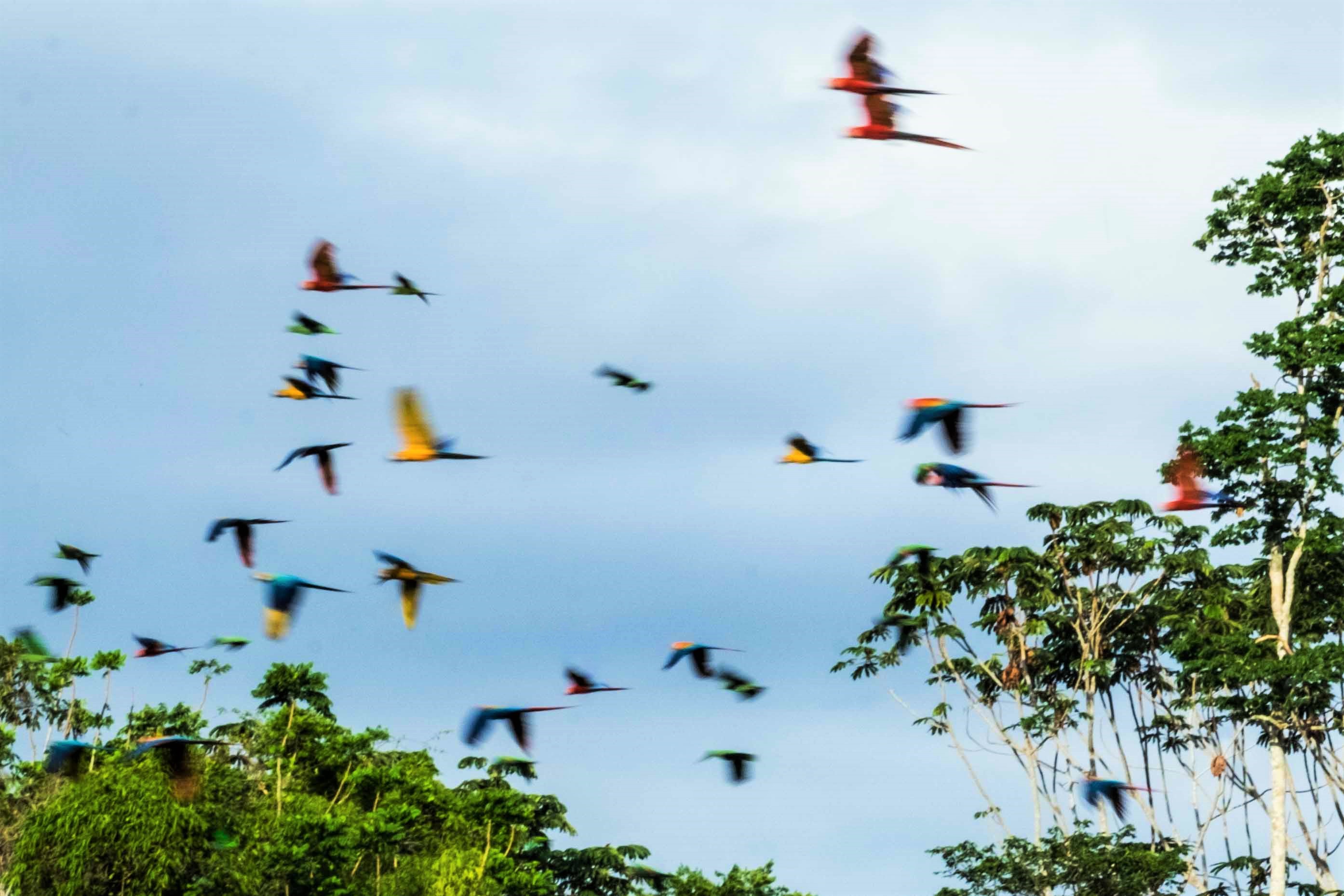
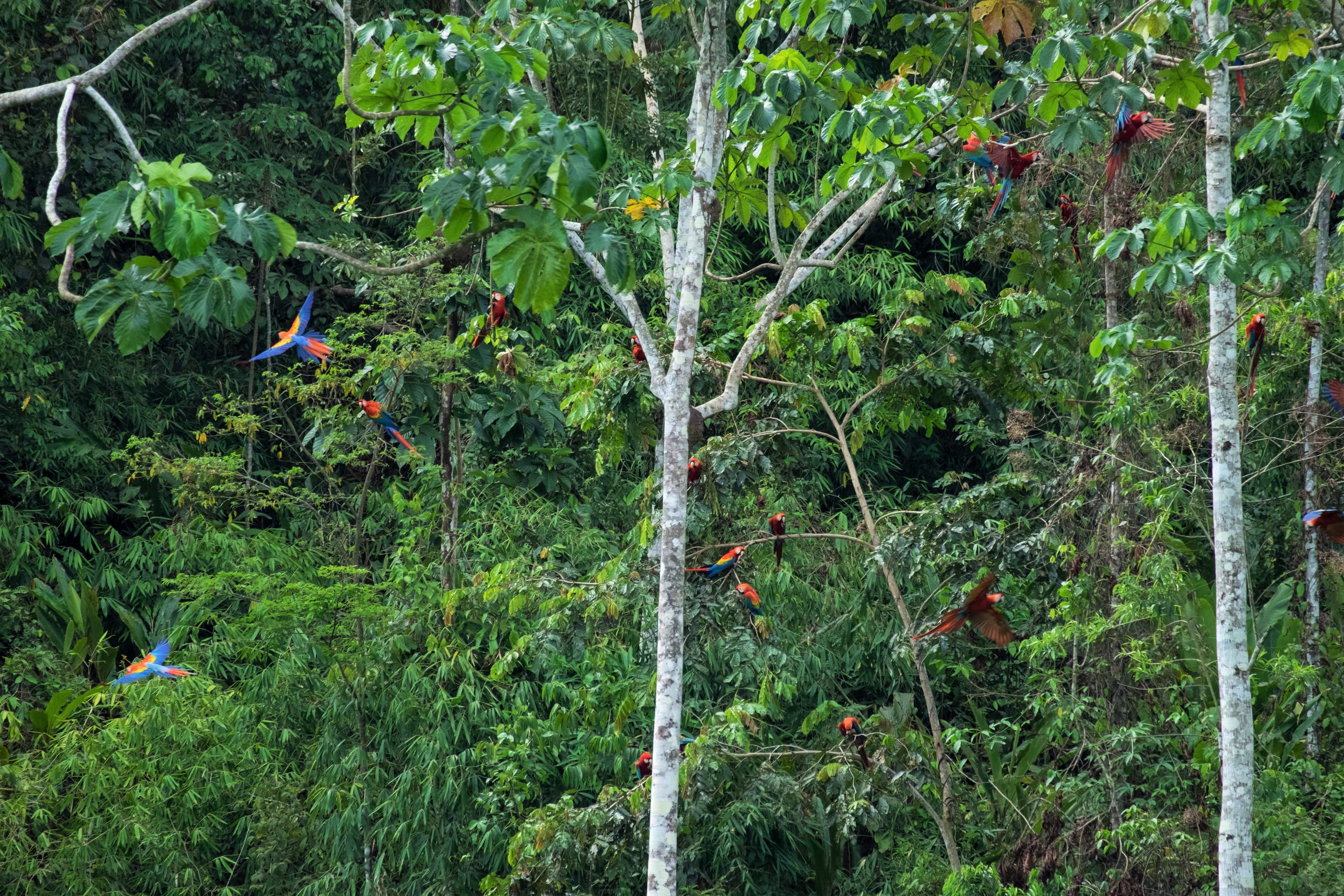
Igor, Dylan, Jānis, and I go to the clay-lick observation point, while Sophie and Lisa take a post on the riverbank to count arriving birds. The sun is almost fully risen, and birds appear from every direction. Macaws and parrots arrive and land in the nearby trees. The large macaws come in pairs, usually groups of two or three and sometimes even four. Igor records these family units in the protocol: whether a pair has arrived alone or with one or two young. The task is not easy because white cloud covers the sky this morning, making the birds’ colours impossible to distinguish, so Igor relies on their calls. The young birds are around a year old, born during the previous nesting season. Some begin finding their own food before reaching one year, but those whose parents continue to provide for them are happy to be lazy and remain with the family for as long as they are fed. In other words, the parents decide how long they are prepared to support a youngster. After twenty minutes or so, the trees are full of birds watching for predators before descending to the colpa. Jānis associates the scene with Christmas because the colourful birds look like decorations in fir trees.
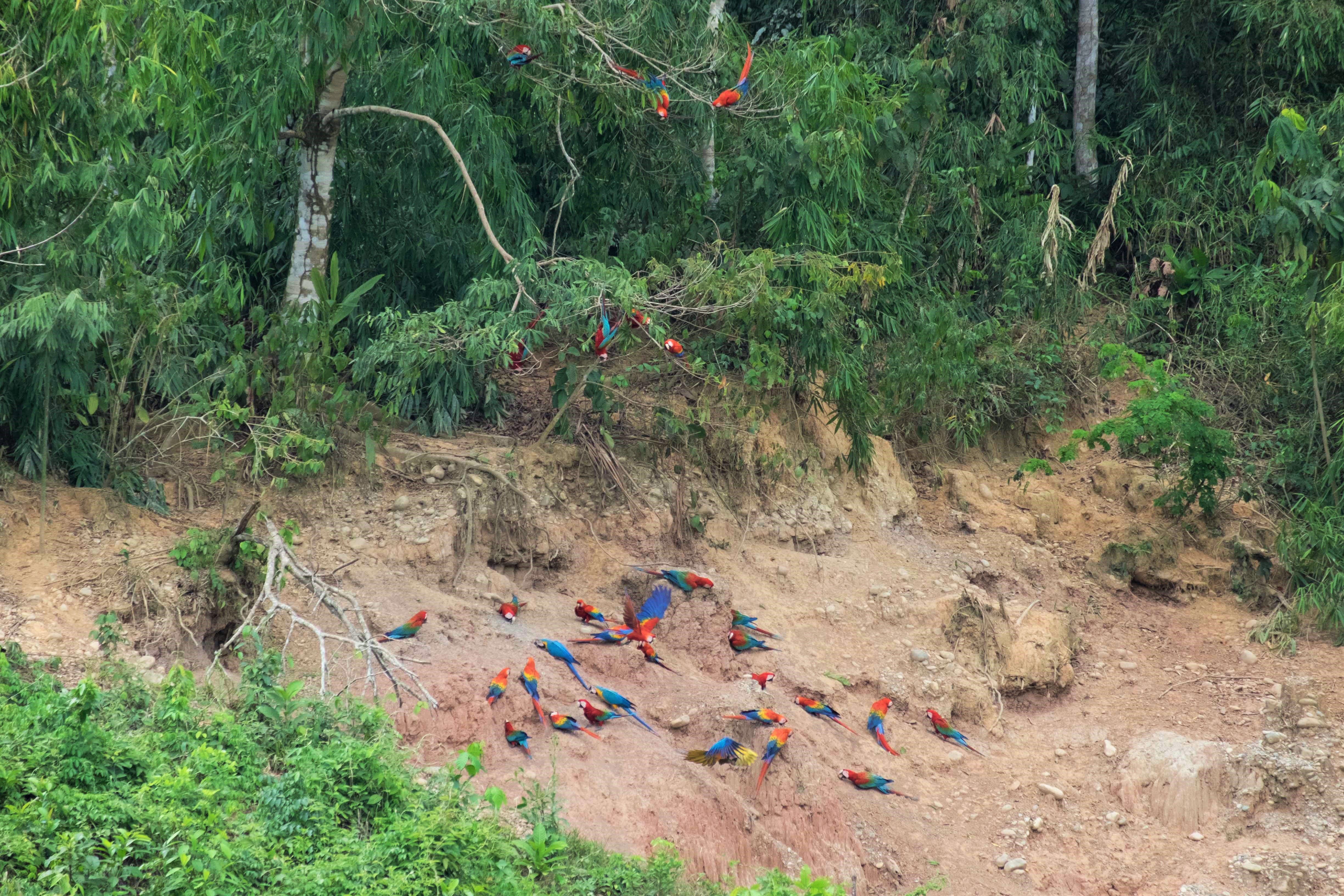
“First three Mealy Parrots at 3B1!” Dylan calls through his binoculars. The moment the first bird lands, the clay-lick count begins, and I am responsible for recording it. From now on, an alarm is set to sound every five minutes. The first brave visitors are smaller birds: Mealy Parrots, Yellow-crowned Parrots, and others. Soon, the macaws gather their courage and descend to the clay too. When another five-minute interval sounds, there are so many birds to count that the men divide the exposed clay into sections while I can do nothing but write. Jānis: “1A, White-eyed Parakeets 134, Mealy Parrots 17, Orange-cheeked Parrots 5.” Dylan: “3B1, Mealy Parrots 15, White-bellied Parrots 7, Scarlets 3, Blue-and-yellows 4.” That is approximately how it sounds. I must record the section of clay, the time, each species called out, and its number—for example: 3B1 MEPA 15, WBPA 7, SCMA 3, BYMA 4. At one point, Lisa announces on the radio that a Blue-headed Macaw is about to arrive. This species visits the clay lick relatively rarely, so knowing that the bird flew in our direction, it is important to record whether it lands to eat.
Throughout the observation, an animal “hums” behind us. To me, it sounds like a half-asleep bear wandering through the forest in the early morning—if I were making a children’s cartoon, this would be the perfect sound for a bear’s humming. Igor recognises it as a curassow. In one of the five-minute gaps, I quietly go to see what it looks like and find a rather large black bird with a soft, square-shaped bill. Later, a guidebook identifies it as a Razor-billed Curassow.
At around 7:00, we call the boat on the radio and head for shore. On the way, we see a tiny bird running back and forth across the stones directly in front of us, as though blocking our intended route. Igor recognises not only bird calls but their behaviour. He says that eggs or small chicks are probably hidden in the pile of branches ahead, so the bird is drawing our attention away to keep us from going there. How altruistic—it could just as easily have been facing a predator that would gladly eat the tiny creature. We make a wide detour to avoid distressing the bird and continue to the boat. Meanwhile, Lisa replaces us at the colpa. She will record birds until noon, when another researcher takes over. The colpa must be watched throughout the day on at least fifteen days each month. Birds gather most actively in the morning, so the whole research team attends then; for the rest of the day, one observer is sufficient.
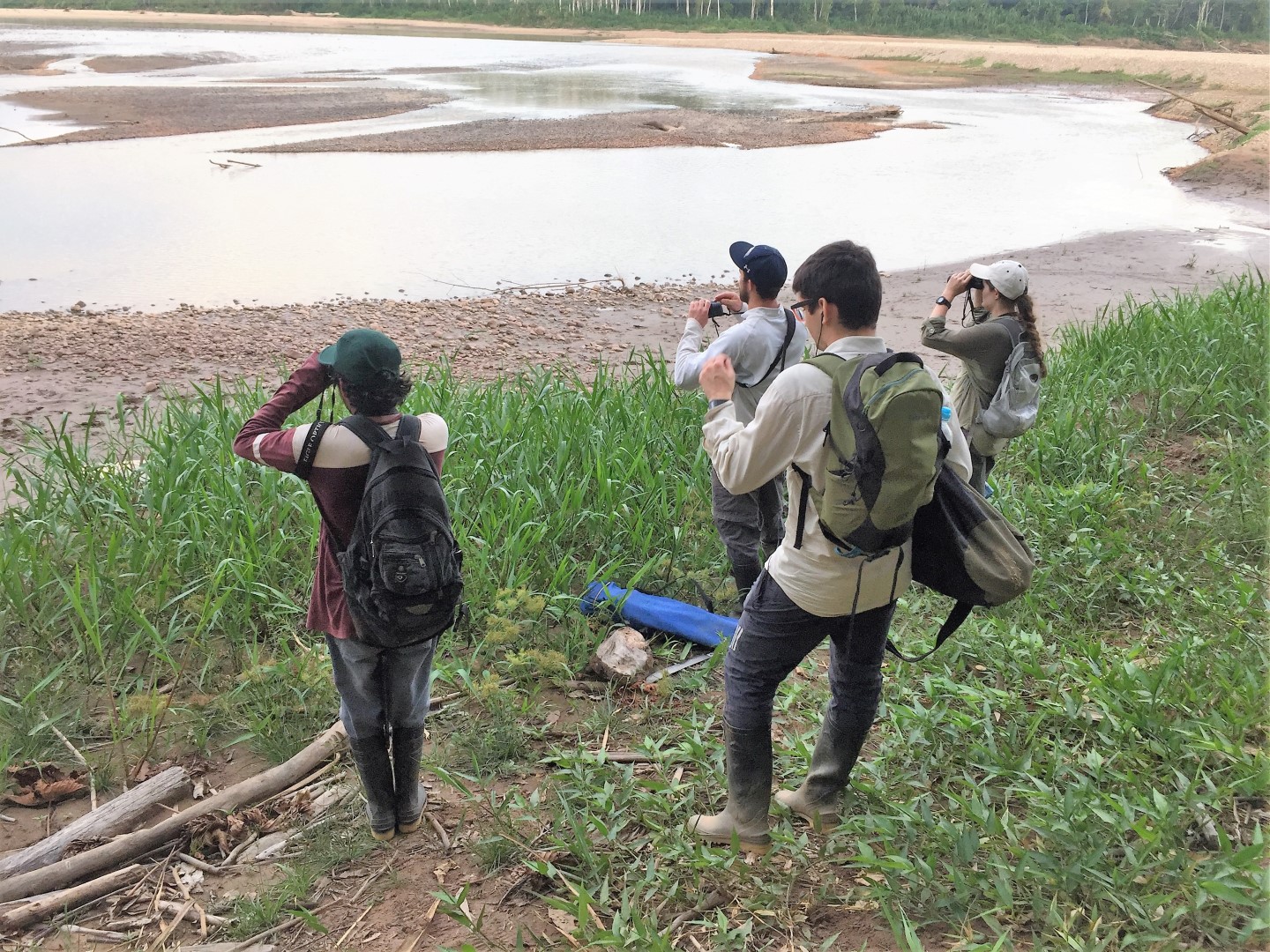
My next scheduled activity today is a Foraging Walk with Igor. After breakfast, we return to the boat and are taken to Lost Island on the far side of the Tambopata River. Fresh jaguar tracks welcome us to the shore. Could the animal still be on the island? I ask Igor whether he has ever seen a jaguar or puma. He says he was lucky once. He was collecting samples from a plant in the jungle when a jaguar walked past directly in front of him. Crouching behind a bush, he went unnoticed. The wind was probably also in the right direction, preventing the big cat from smelling him. Igor reminds me once more of what I read in the training material: if you see a jaguar or puma, do not move. Climbing a tree will not help because these animals do it much better than people; jumping into the river will not help either because they are excellent swimmers. After all, the jaguar must have reached this island by swimming. The most foolish thing you can do is run, because that will encourage the cat to hunt you, if only out of curiosity.
We reach the beginning of the trail, note the time, and start the two-kilometre walk. A Foraging Walk gathers data for studying the diet of parrots. Moving very slowly along a set research route, we record every parrot seen or heard from the trail. Birds flying overhead are not counted, only those perched on branches. If, for example, we see a Scarlet Macaw in a tree, its behaviour must be described—an angry call, a gentle call, playing, grooming its mate, or one of more than a dozen other behaviours. If the bird is feeding—something very rarely encountered away from a clay lick—the process is documented on a separate protocol. Parrots are vegan; their diet consists of fruit, seeds, leaves, and flowers, with the exact menu varying by region. Tambopata’s parrots, because of the plants they consume or perhaps one that is absent, supplement their diet with clay. The Foraging Walk protocol is another step towards understanding this remarkable clay-eating behaviour.
It appears that the parrots are gathering at the colpa in large numbers today, because on Lost Island we hear and see only a few in flight. Since we must move very slowly, we use the time well by watching other birds and photographing the jungle. Igor always carries a camera for bird photography. It is a difficult task, but he has mastered it so professionally that I can only marvel. His ornithological knowledge is invaluable: hear a call, identify the bird from its voice, know whether the species moves on the ground or stays mainly in the canopy, locate it quickly with binoculars, and take the photograph. Igor shows me fantastically beautiful images of hummingbirds feeding on flower nectar, along with many other rare and common birds. I tell him they are a treasure and that he should consider how to put them to good use. Igor also advises me on photography and on adjusting my camera settings to jungle conditions. Afterwards, I really do manage to take several better bird photographs, something that initially seemed impossible. (Much as I would like to surprise you with one of Igor’s photographs, I am sticking to the principle that every image on this blog was taken by Jānis or me, sometimes with a camera and sometimes only an iPhone.)
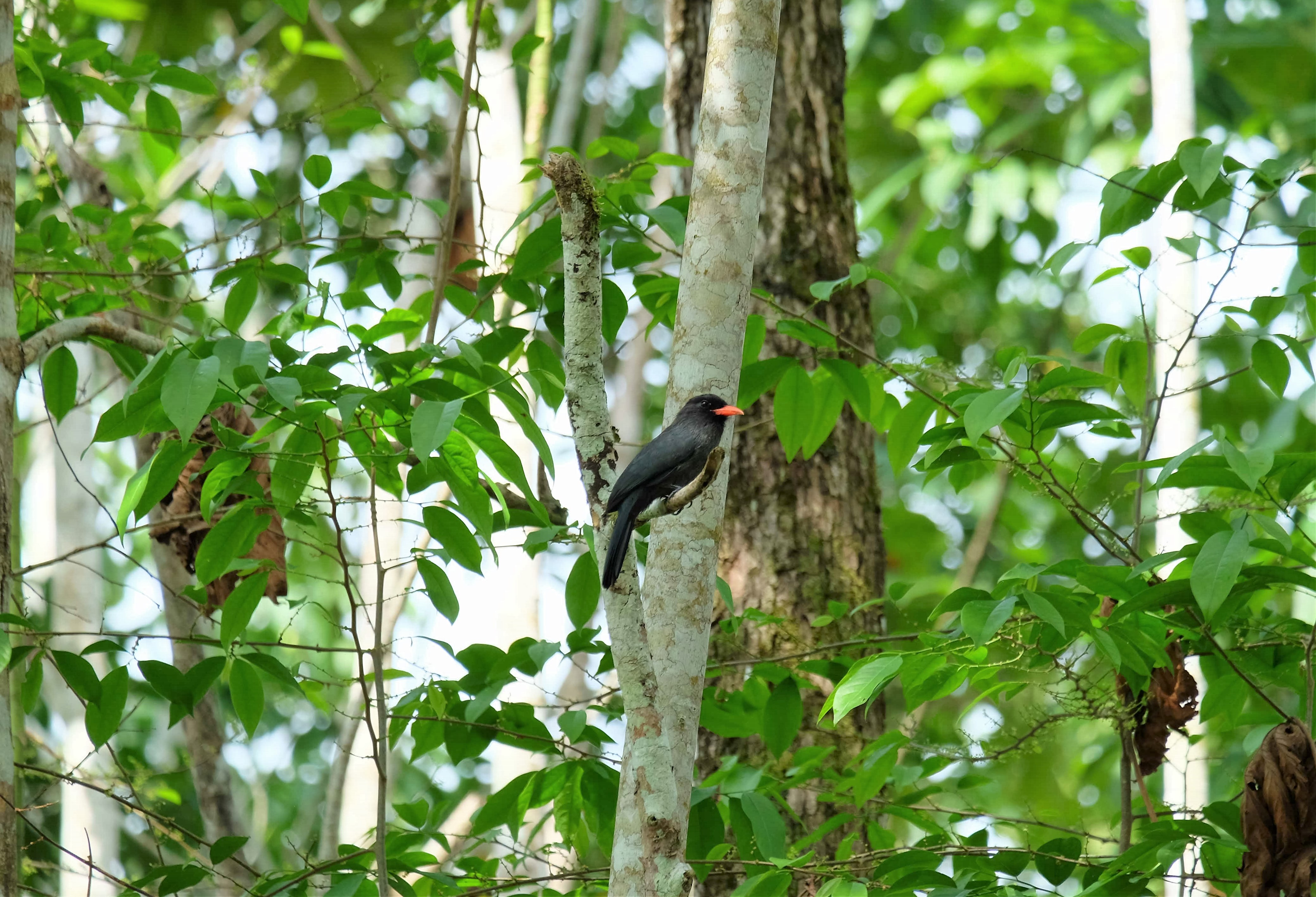
Igor trained as a biologist and began his career in ornithology. He studied coastal birds, participated in projects across different rainforest regions, and is now working for several months in the Tambopata Nature Reserve. His passion for ornithology inspires me. Here is a living example of somebody exactly where he belongs. Igor walks a few steps ahead and, when he hears a bird, takes several quick strides towards the sound and searches with his binoculars. Then he waves me over and points out where to look. We have several episodes like this during the Foraging Walk, and Igor can name each species from its appearance. If he is uncertain, he opens a bird guide on his phone and checks. We are nearing the end of the route when Igor stops and says, “Hummingbird!” Sure enough, the beat of its wings—like a large dragonfly, only louder—reveals a bird somewhere nearby. Yes, there it is, drinking nectar only a few metres away. While Igor creeps closer, I switch on the camera and begin shooting. There is no chance to apply my newly acquired knowledge of bird photography because everything happens too quickly to think. A hummingbird is not the most convenient subject anyway; it is so small and lively! It flies away as Igor approaches, before he can identify the species. Nevertheless, during this walk, Igor has recorded three lifers—the moment when a birdwatcher sees and identifies a particular species for the first time. Across his time in Tambopata Nature Reserve, he has had around 140 lifers. Peru’s bird diversity is almost beyond comprehension: one fifth of all the world’s birds occur here.
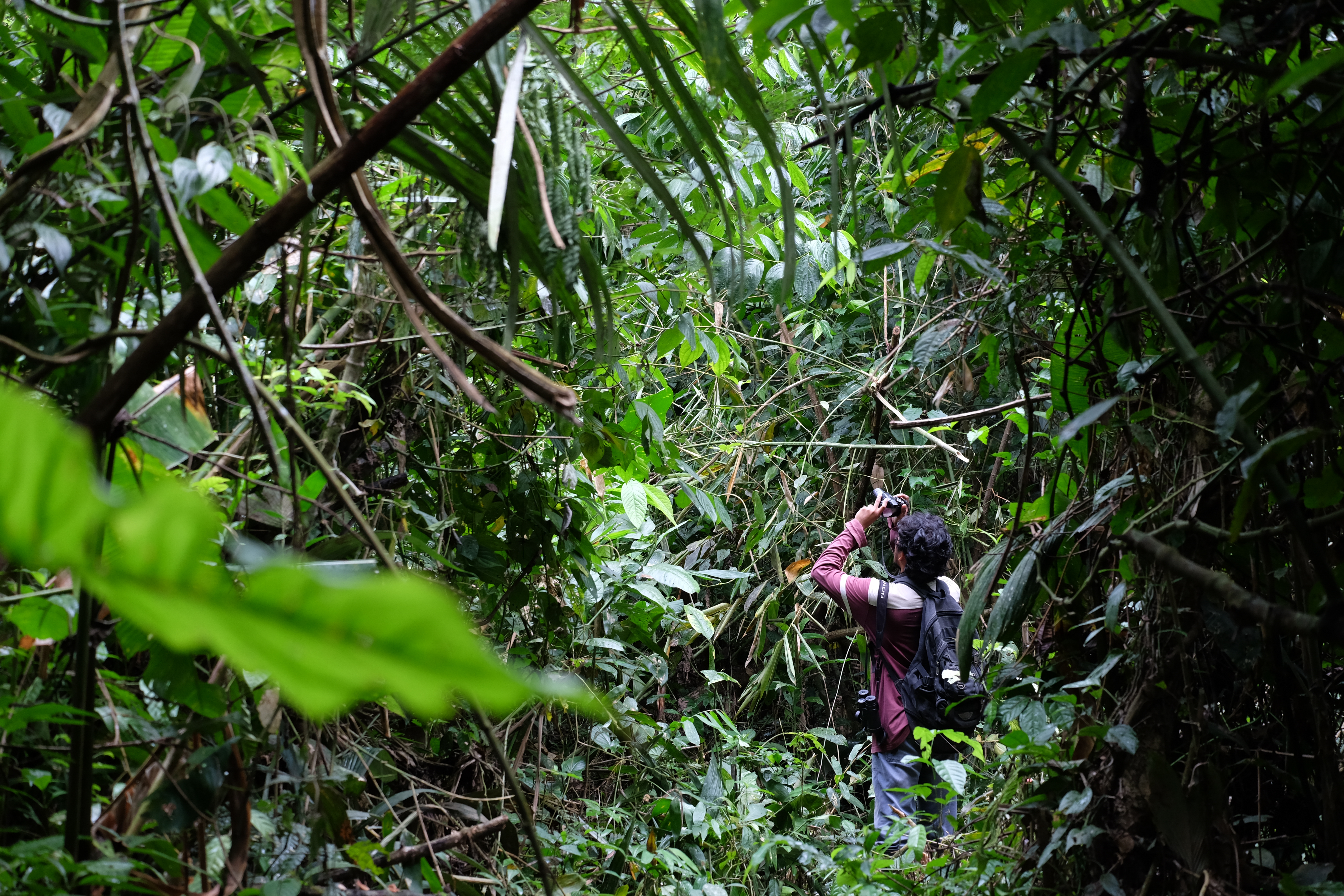
After two hours, we reach the riverbank where the route ends. While we wait for Braulio, I spot a bird on a branch and have time only to study it through the binoculars. It is a Blue-grey Tanager! “You just had a lifer,” Igor says with a smile. Watching Igor at work and gaining my own first lifer has inspired me to begin birdwatching. When I return to Latvia, I have a task: buy good binoculars and a guide to Latvian birds.
After lunch, the day’s final activity is scheduled with Sophie. We will record Nest Fight. It is October, the beginning of macaw nesting season. Researchers know the locations of natural nests around Tambopata Research Center, and artificial nests have also been installed; all must be checked every day. Macaws are demanding about the nest where they will raise their offspring for the coming months, so pairs often fight over a desirable one. Recording Nest Fight helps identify the sites with the most activity. A researcher follows a fixed route, remains beside each nest for ten minutes, and records the macaws’ behaviour there. Greater activity or fighting means egg-laying is closer, which in turn determines when the research will require another task: checking the chicks. That involves climbing trees to heights of around thirty metres. There are not many suitable giant trees with cavities large enough for these birds, so a single tree can hold two or even three nests. Near TRC, for example, an enormous tree contains two natural nests—hollows in the trunk—and one artificial nest made from a special material and hung about thirty metres high. Three macaw families coexist in this tree quite happily during the season.
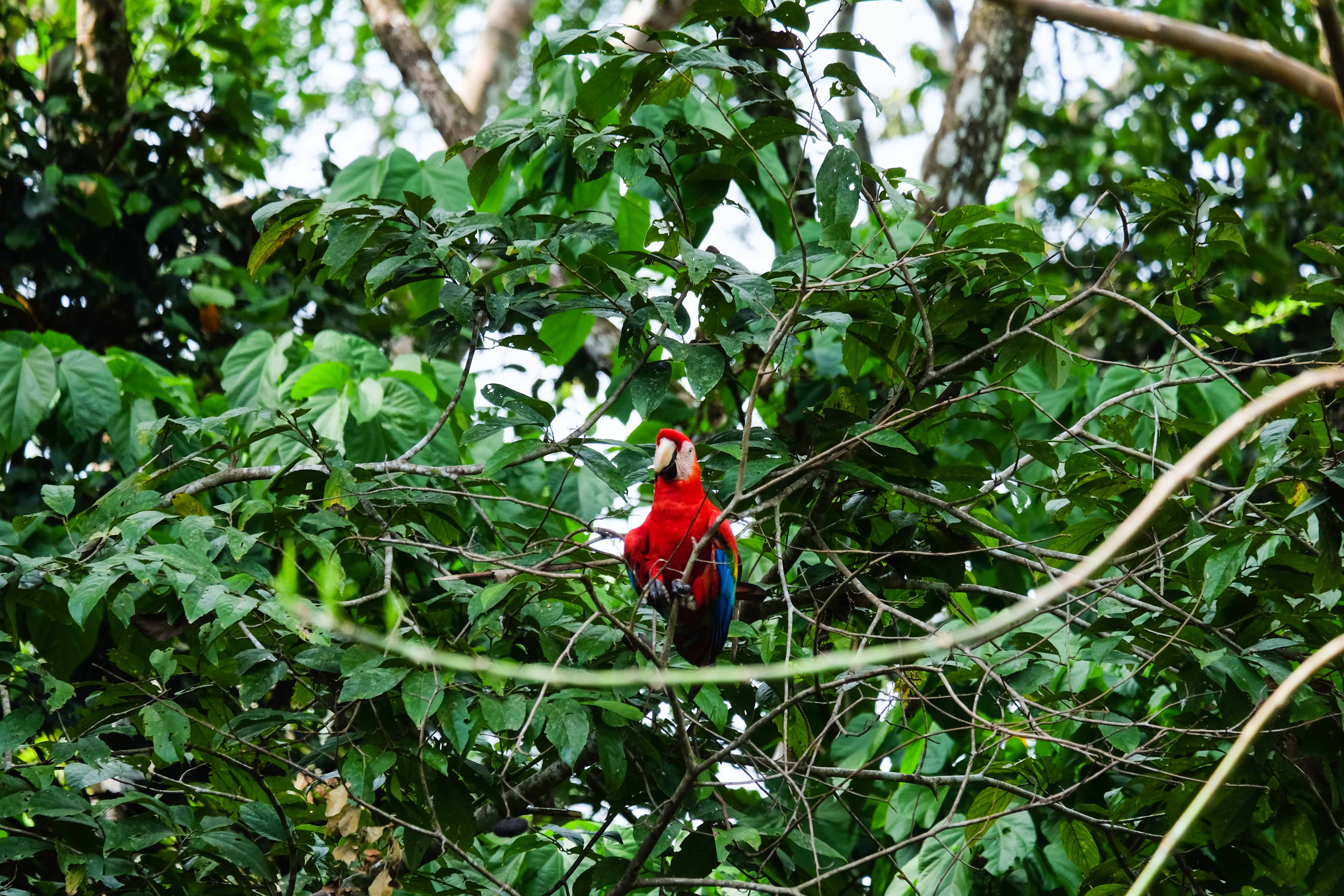
For now, the Nest Fight surveys are still quiet. On previous rounds, the team recorded nothing more than two macaw heads looking down from several nests. To save time, Sophie suggests dividing today’s route between us. I take a protocol, route map, machete, and radio, then set off for my assigned trees. Incidentally, map-and-compass navigation is essential in this work. There is no activity at the first nest. Two Scarlet Macaws sit on branches of the second tree, which I record. The third tree has two nests that I can observe simultaneously, meaning one ten-minute interval for both. There is no activity in the tree, although several macaws fly overhead and I hear angry calls in the distance. They come from the direction I am due to follow. It is the tree with three nests. I approach along a barely visible path, and the noise intensifies. On arrival, I start the clock and look for the troublemakers. No macaws occupy the nest tree, but several sit in nearby trees and others fly back and forth. All right: if there is no activity in the designated tree, I will at least note in the comments what is happening around it, which clearly indicates that the nests are being watched. Oh, I also see a spider monkey leaping through the branches. Around the seventh minute, two macaws fly into a nest, and I begin writing. Before I can even raise my head, a tremendous clamour erupts above me and a fight begins in the air. I count eight macaws involved! Amid the chaos, I try to distinguish how many are Red-and-green Macaws, since they resemble Scarlet Macaws. A moment later, all the birds scatter and settle on the nest tree and surrounding branches. Their warning calls suggest that the fighting will continue. When something like this happens, you remain longer than ten minutes. I report a Nest Fight on the radio and ask whether somebody can come. Sophie answers that she is on her way. She arrives and helps document the commotion. Sophie remains beside the tree while I hurry to the final site nearby. When I return, she too has witnessed her first nest fight. Two macaws grappled in the air and fell rapidly from the sky. One landed in the crown of a small tree and is still sitting there only a few metres from us. After a while, it flies away, although very unsteadily. We have spent more than an hour beside the tree and decide to return to TRC.
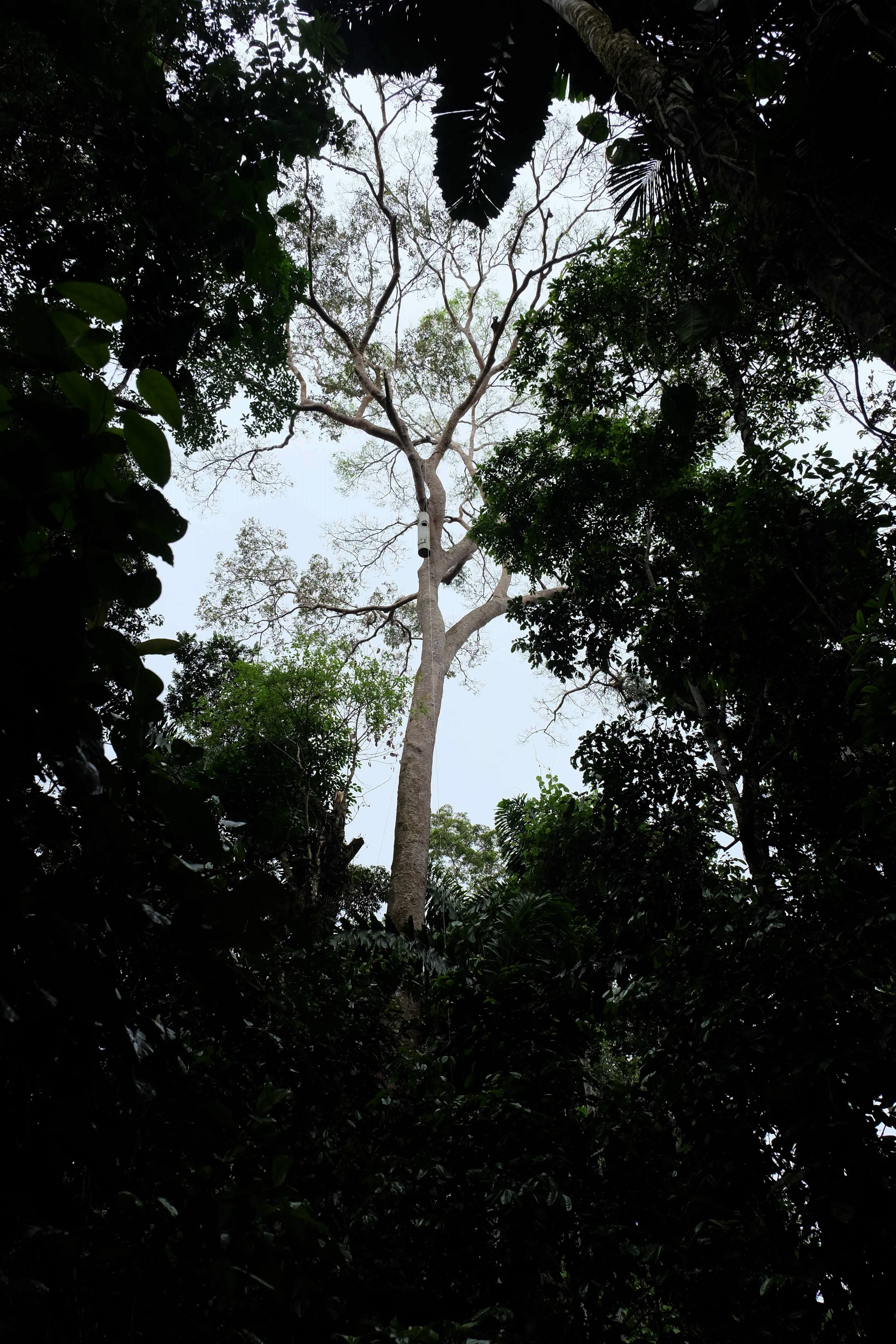
There is about an hour before dinner, so Jānis and I sit in the tourist lounge for coffee. Before long, a man approaches us. “You’re researchers, aren’t you?” We explain that not quite—we are more like research assistants and are volunteering here. The Australian man sits closer, and his wife joins him. We talk about the macaw project. Then he asks where we are from. When he hears Latvia, we are astonished by his reply that he would like to visit soon; the Baltic states interest him. He even knows that Latvians are highly educated, with a large proportion of the population holding university degrees. We move on to travel, and a father and son from Alaska join the conversation. People always tell us that we are the first Latvians they have met. This time, we can say the same to the Alaskans, and they answer likewise. The Australian couple have travelled widely. At one point, Israel is mentioned, where the woman studied. We say that we visited Israel and neighbouring Jordan. The man is delighted: he was born in Jordan. A mutual exchange of compliments follows because we truly have much good to say about Jordanians, their kindness, and their hospitality. Later, the conversation turns to animals seen in the reserve, and the Australian couple proudly announce that they saw a jaguar. During a caiman-watching boat trip, it was lying on a washed-up tree trunk on the beach. Our circle has grown by now, and everyone is shown the jaguar photograph. It must be said: the image is worthy of a National Geographic cover. Indigenous Amazonian people are said to believe that when they find a tortoise with fourteen spots, they ask for a wish to see a jaguar; if the wish does not come true, they kill the tortoise. The Australians say their tortoise fulfilled the wish.
Dinnertime arrives. The researchers eat with lodge staff in a separate room from the tourists. For the employees’ entertainment, it contains a pool table and television. Tonight, Animal Planet is showing a documentary about Colombia’s wildlife. How interesting to watch the table of researchers staring at the screen without blinking. When a flock of parrots appears, several people’s eyes light up and somebody cries, “Ooh!” Ornithologists’ jokes follow, with the birds on television being counted: “46 WEPA, 77 CWPA...” Lisa laughs at everybody. “We’re in the middle of the jungle, we see hundreds of parrots every day, and we’re getting excited about the TV.”
Today is boatman Braulio’s birthday, so after dinner, we do not disperse. We wait for him and sing Feliz cumpleaños. There is a cake, and after the candles are blown out, part of it is pressed into Braulio’s face. We return to our rooms on a happy note. At 22:00, the generators are switched off, and the sounds of the jungle lull us to sleep.
That is one day in the life of a bird researcher!