The day has come to leave Arequipa. We spend the morning at Spanish school, receive our certificates and hugs, then I rush home to pack and reserve a hotel for the night. Today, we are travelling to Puno on Lake Titicaca. The city stands at 3,830 metres, so to reduce the risk of altitude sickness we began drinking large quantities of water and coca-leaf tea yesterday.
We are lucky to find seats on the smart Cruz del Sur bus. The six-hour journey passes in comfort, with a greater likelihood that our large backpacks will still be waiting at the destination.
We arrive in Puno at about nine that evening. A taxi carries us to the hotel, where we book a two-day tour of Titicaca’s islands. I had read that Amantaní is not yet as touristy, so we choose to spend the night there.
On Saturday, as agreed with the hotel owner, we are at the breakfast table by 6:30 because a minibus will collect us at seven and drive to Puno’s port. Breakfast is late, and our bus arrives at the exact moment we begin eating. We are prepared to abandon our half-eaten bread and half-finished coffee, but the owner arranges for the driver to return later. If that is possible, then fine—we continue breakfast in peace. In the end, a different bus arrives at eight with four other passengers aboard.
At the harbour, we finally see Titicaca in daylight. The lake is enormous! Yet the water visible from Puno is only a bay; the open lake is not even in sight. On the way to the boat, I buy water. The seller suggests buying coloured pencils as gifts for children on the islands. Done.
Our boat slowly fills with passengers, and soon we set off across the world’s highest navigable lake, 3,812 metres above sea level. Amantaní is four hours away, but first we stop at the famous Uros islands.
The floating Uros islands
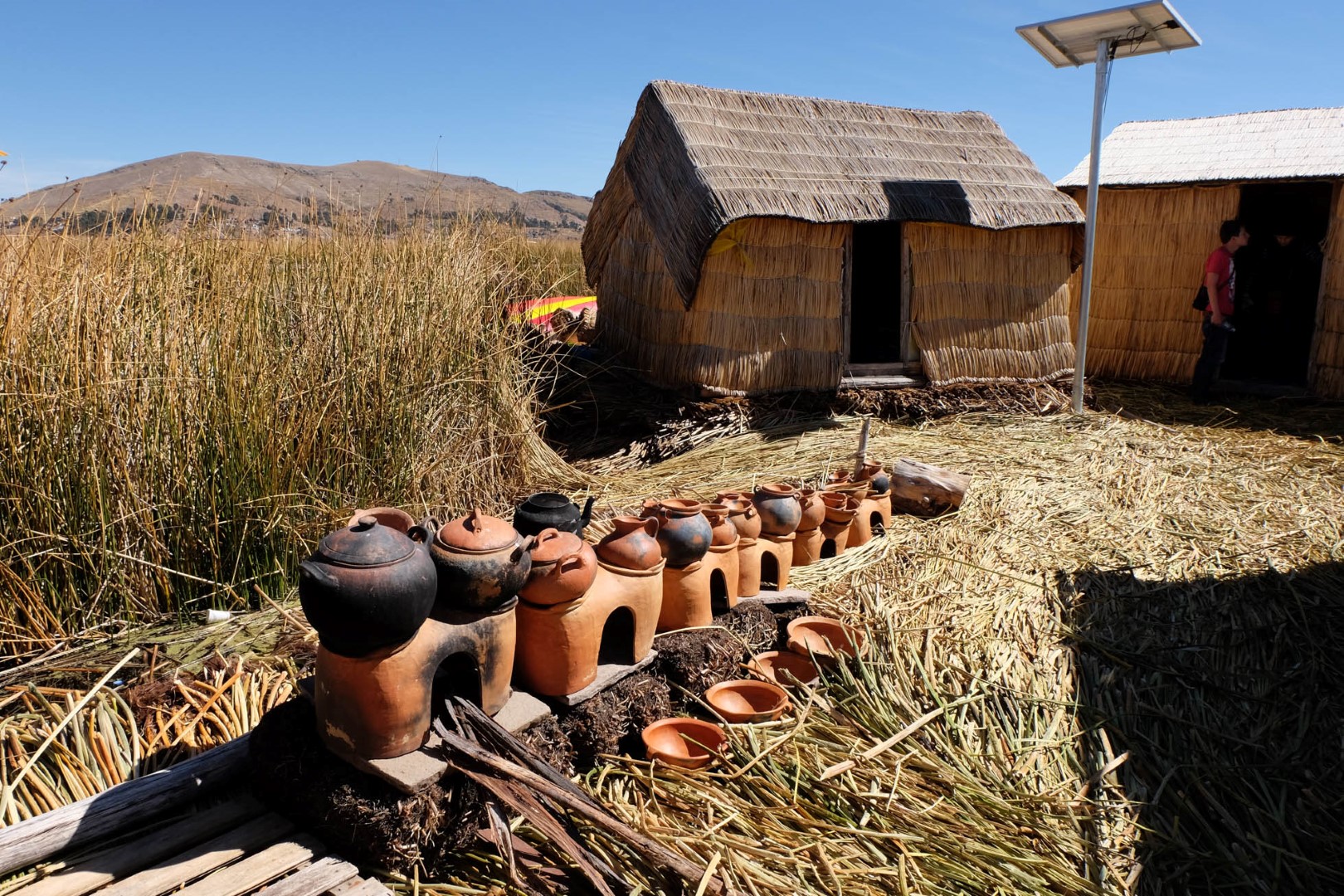
The floating Uros islands lie seven kilometres from Puno. They are artificial islands built of reeds and remain home to the Uros people today. One island can last for as long as thirty years, although maintaining such an unusual home requires a great deal of work. As the island gradually settles into the water, its surface must be renewed with a fresh layer of reeds every three months. Historically, the Uros began building and living on these islands to escape attacks from aggressive neighbours.
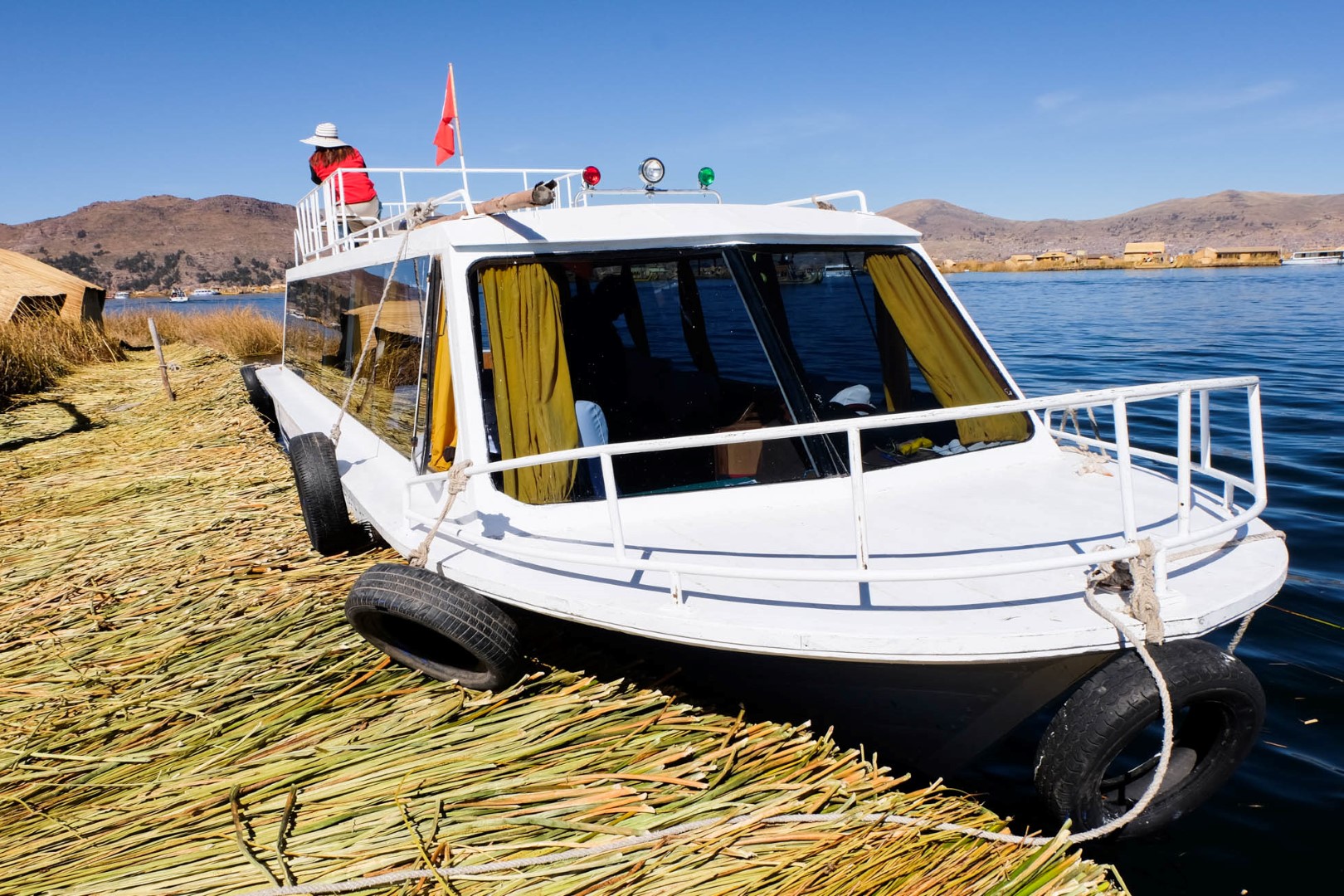
Standing on an artificial island is a strange sensation. The moment we step from the boat, our feet sink into the reeds. Every step gives slightly beneath us. The reeds are dry now, but wet feet must be guaranteed during the rainy season. The scene becomes more extraordinary when you realise that not only the island but also its houses, toilets, benches, and even boats are made of reeds. Among them stand local women in traditional clothing.
The mother of the family whose island we are visiting—yes, each family has its own—invites us inside to see how they live. There is a television and a computer, just like an ordinary home, thanks to solar panels supplied to Uros residents by the Peruvian government.
After a lesson on island construction, we have the chance to ride in a reed boat. During the short trip to the principal island, we meet a Polish group travelling with us. There are about fifteen of them, teaching English near Colca Canyon and staying in Peru for several months. As we talk, it emerges that some are from Poland while others are Poles who have lived in America for years. Our discussion of Latvia and Poland carries us almost unnoticed to the main island.
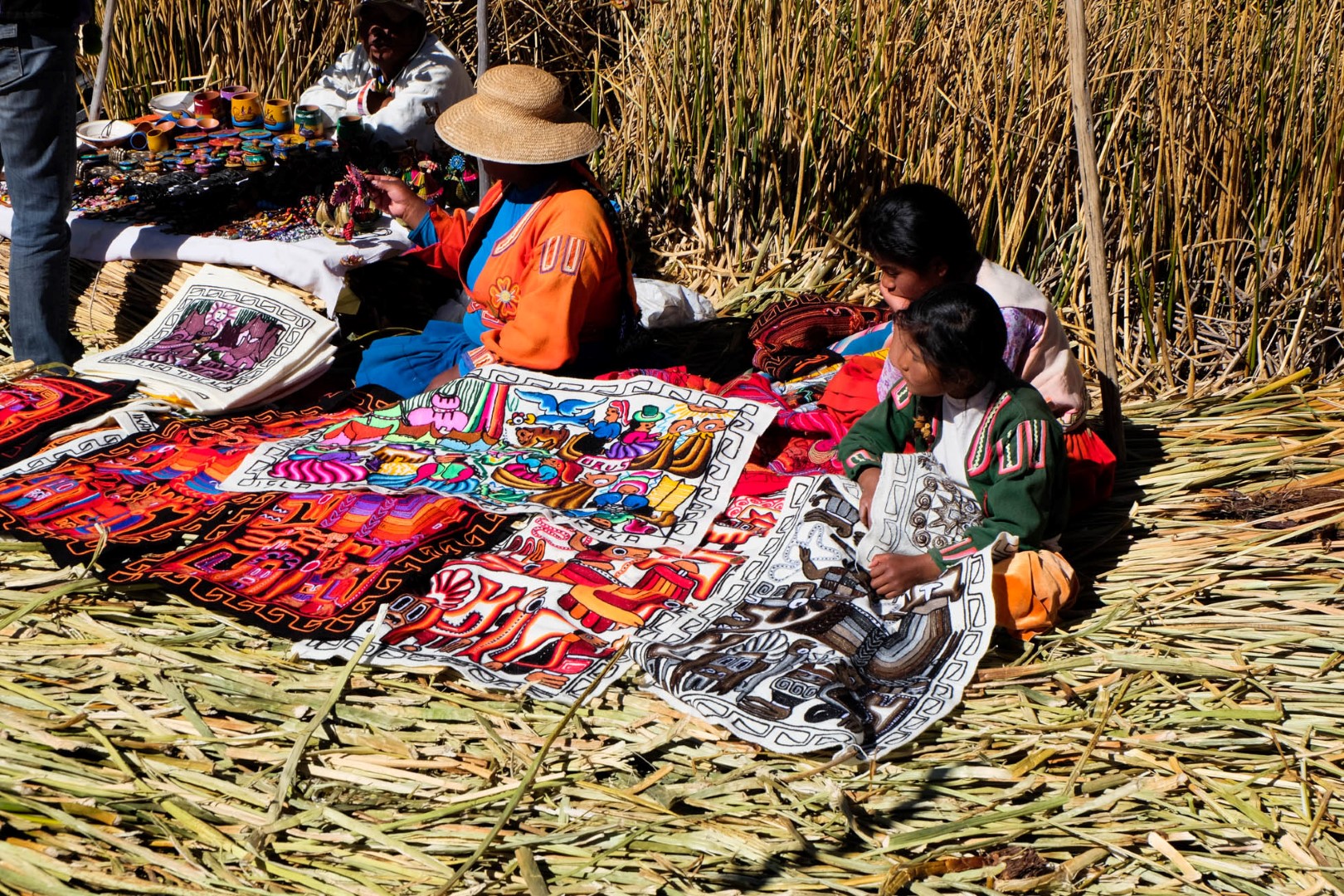
A crowd of tourists awaits, examining the goods at a handicraft market. At this moment, the answer to why the Uros still live on islands where nights are bitterly cold and wind blows through the houses becomes clear: tourism is their livelihood. We had already heard that daily life here is organised around visitors. That does not diminish our curiosity about the islands or the experience of standing on one. Incidentally, so many tourists create even more work. Residents must entertain visitors and sell handicrafts, while the island’s life cycle continues regardless and fresh reeds still have to be laid. The more intensely people walk across it, the more often it needs renewal.
Amantaní Island
We return to the motorboat and continue towards Amantaní. The journey is long, and the gentle movement of Titicaca sends passengers to sleep one after another. Like most of our companions, I sleep for more than half the trip. On waking, I admire the captain’s ability to remain alert while travelling these waters every day. We are now on the open lake, and it truly resembles a sea. A few clouds gather in the distance, somehow revealing that the water itself is at great altitude. It is difficult to explain, but visually the lake seems very close to the sky.
At the jetty, a group of local women in beautiful traditional dress awaits us. The guide assembles everyone and announces the plan. There will be a fiesta that evening, and attendance is compulsory. He has a sense of humour and adds that guests who skipped previous parties have occasionally been left on the island the next day.
Next, tourists are divided among local families. Amantaní has no hotels; visitors stay in family homes, and accommodation is an important source of income. A young woman takes us and two Italian women from our boat. We begin walking uphill towards the house, which is no easy task. We have not yet acclimatised, and although our pace is slow, it feels as though we are running the tenth kilometre of a race while short of breath.
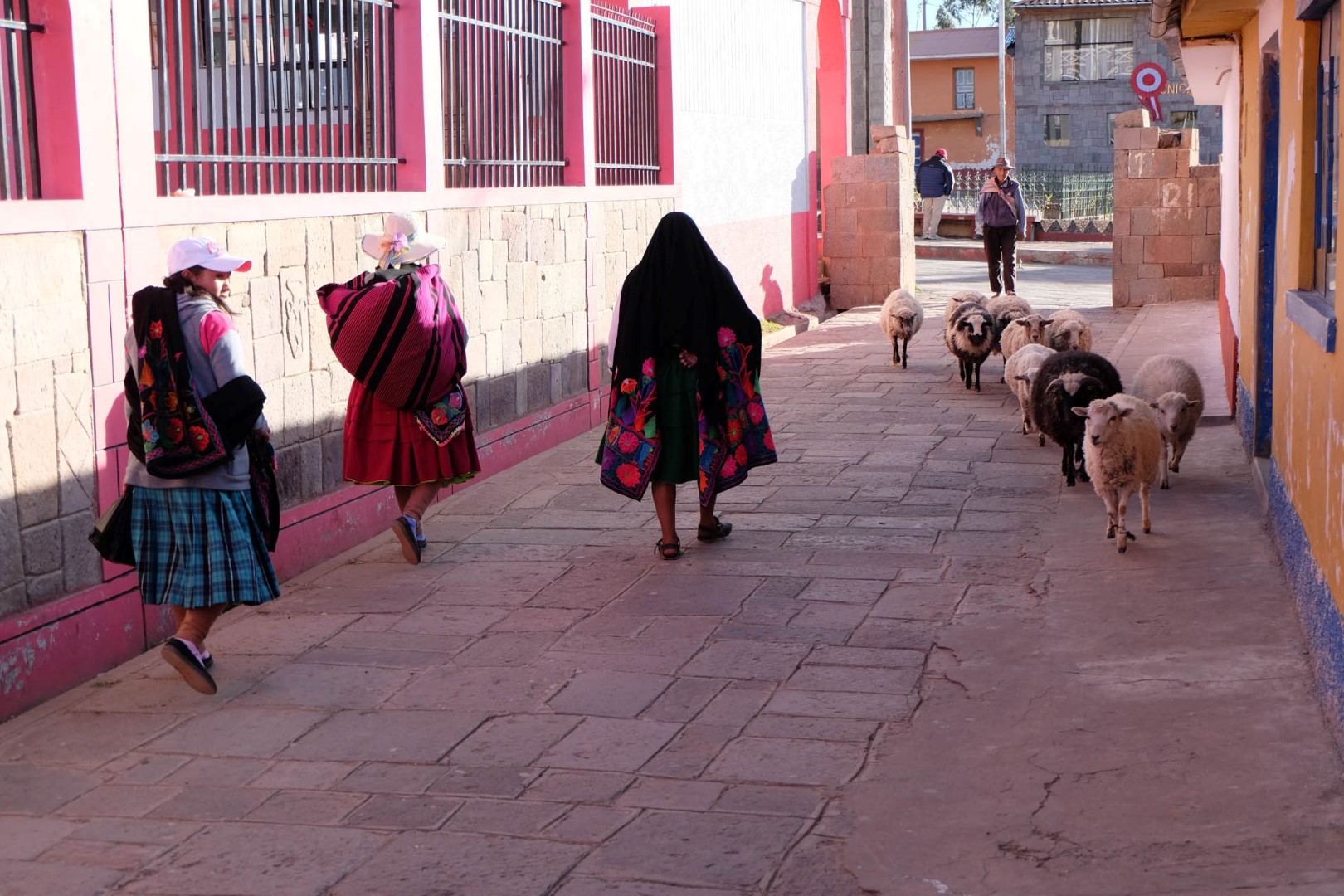
At the house, we meet our kind hosts, Félix and his wife Hilda. The woman who met us at the jetty and led us here turns out to be their twenty-six-year-old daughter. We will have to save the coloured pencils for other children. Here, an investigation into why every member of the family looks so young would be more appropriate.
Living conditions on the island are simple, but the view is extraordinary. There is no running water: after using the toilet, water must be scooped and poured manually, and hands are washed in a bowl in the courtyard. This family also uses solar panels, so there will be electricity in the evening. Until fairly recently, residents lived without it, and some families still do. Night-time temperatures fall to around seven degrees, so our beds are covered with four layers of llama-wool blankets.
We are soon called to lunch. Vegetable soup with quinoa is followed by rice and several kinds of potato. Peru is the birthplace of the potato, with four thousand varieties. Markets offer round, long, large, small, cone-shaped, and differently coloured specimens. Of those served on Amantaní, my favourite is a purple potato shaped like a slender fir cone. After lunch, we drink muña tea, which aids digestion and helps reduce the discomfort caused by altitude.
Amantaní itself resembles a mountain with two summits. One is Pachamama, Mother Earth, and the other Pachatata, Father Earth. Both contain ancient Inca and Tiwanaku ruins where ceremonies once took place. After lunch, the entire group meets in the central square and begins climbing. The route is technically easy, following a path and occasional steps, but the altitude makes us slow. After roughly forty minutes, we reach a point between the two summits where everyone can choose. Jānis and I select Pachatata.
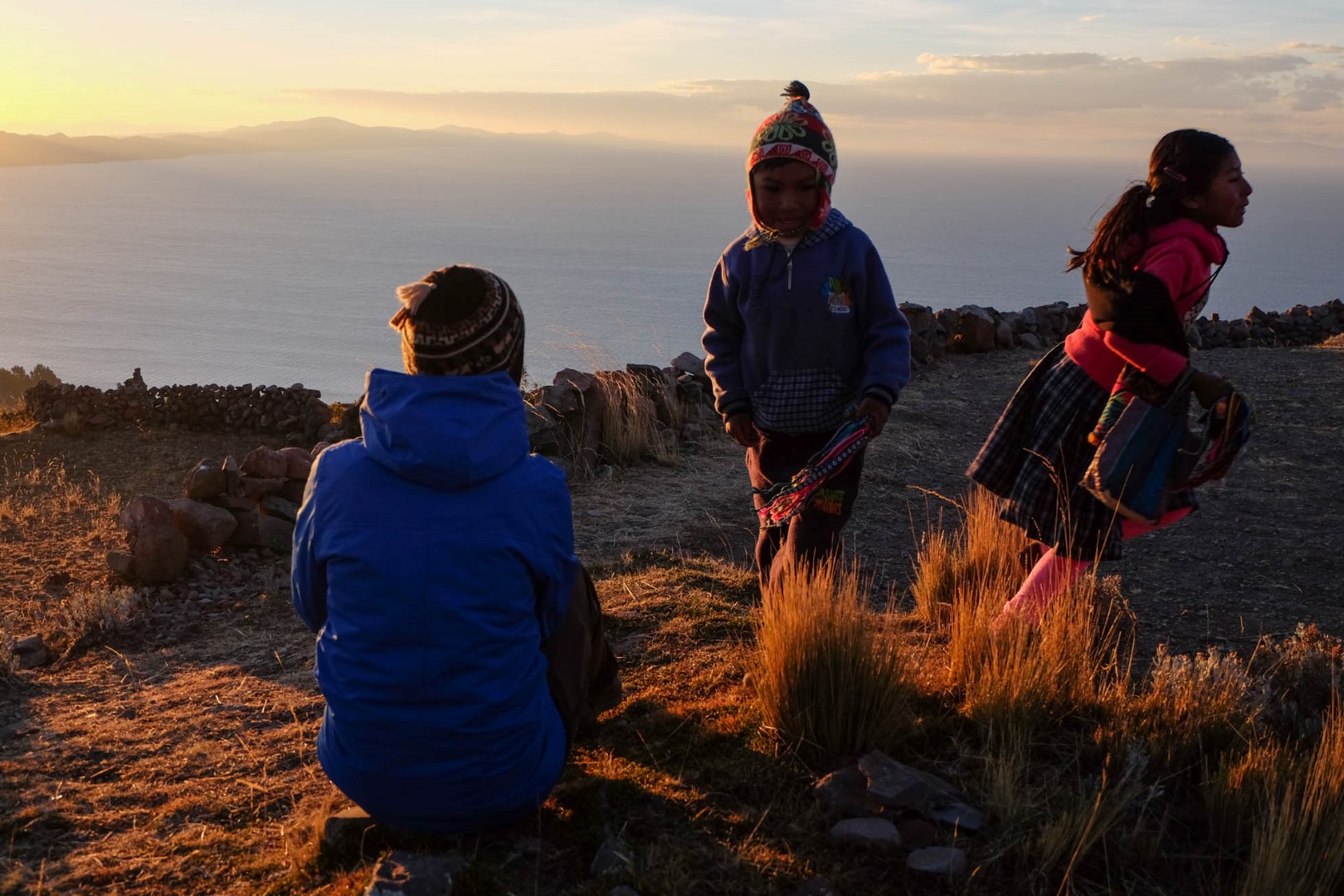
From the summit, Titicaca’s vastness becomes apparent. The Bolivian shore is visible to the southeast, with a tremendous storm unfolding on one side. A dark mass of cloud and flashes of lightning occupy one precise area. Beyond it, we can see the snowy caps of Bolivia’s Cordillera Real. We sit on the grass to watch the sunset when a man beside us drops to one knee and proposes to his girlfriend. How lovely to witness such an important moment! Everyone nearby applauds.
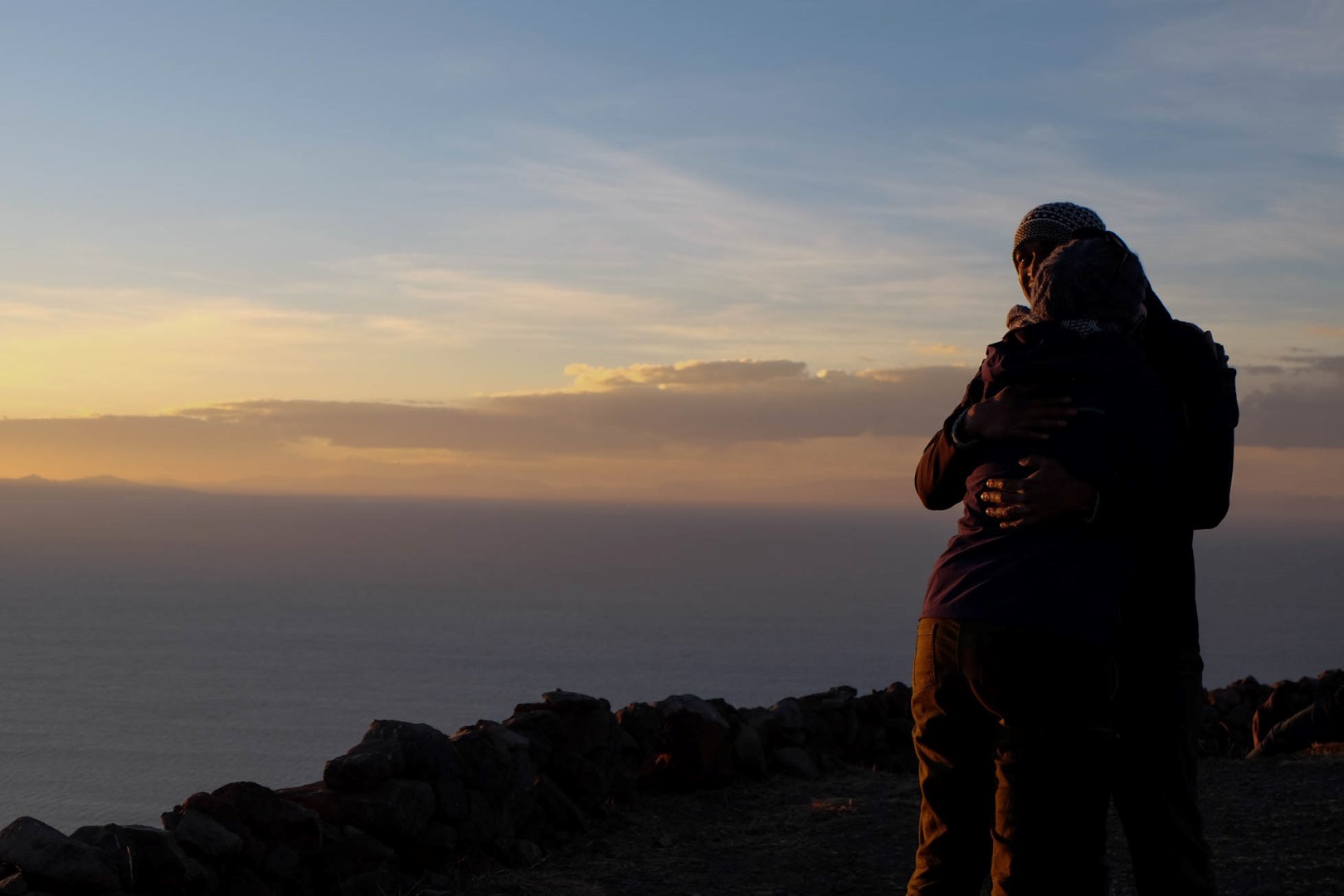
Once the sun has set, the air turns very cold. Everyone on the summit switches on a torch and follows the path down towards their host families. Back at the house, we are invited to dinner. I am not hungry yet and quickly ask for half a portion before the soup reaches me. Stefania and Miriana, the Italian women, do the same. We still manage to overeat on our half-portions. Afterwards, the daughter brings a bundle containing four knitted hats for sale. Jānis rescues us from an awkward situation by buying a handmade hat for twenty soles, about five euros.
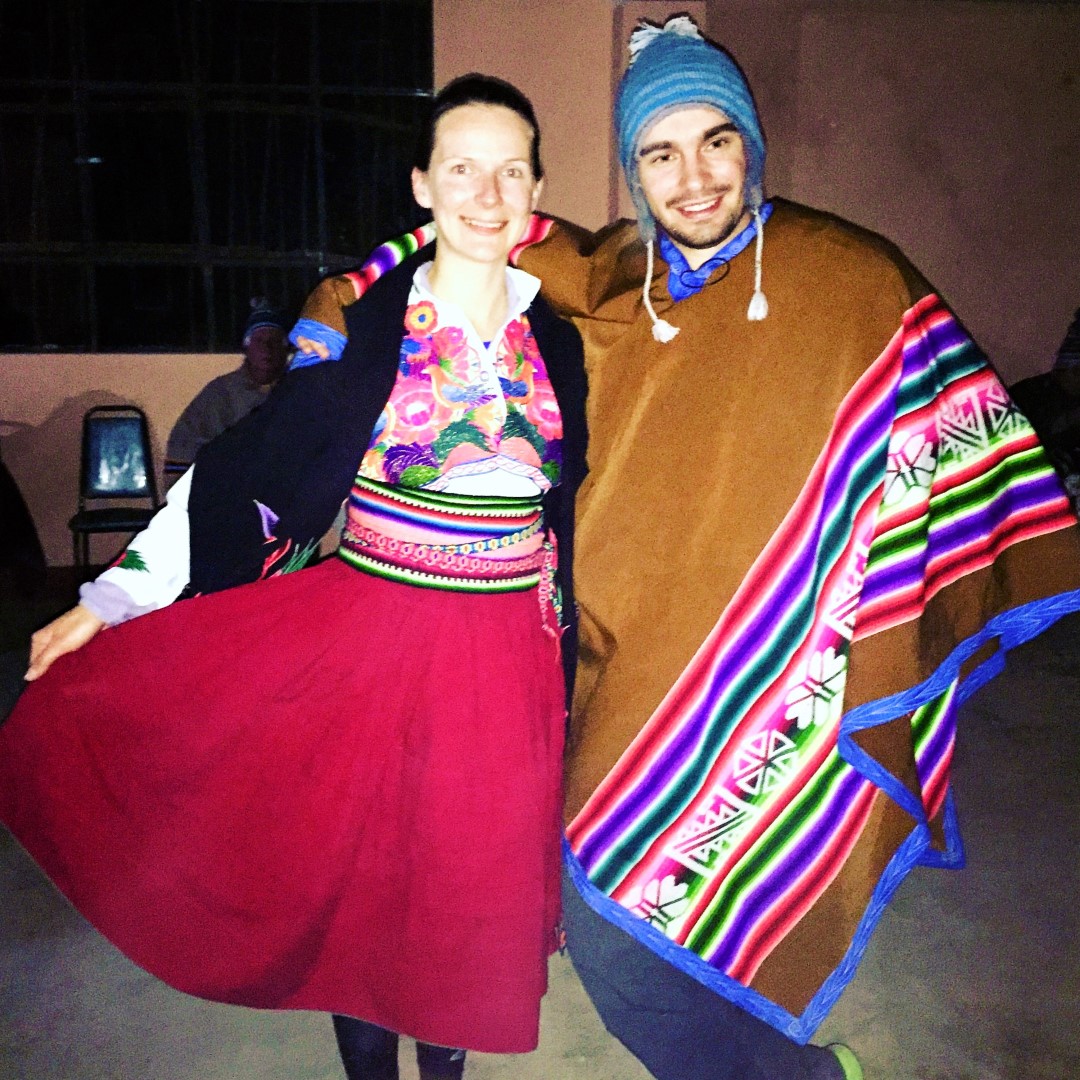
After dinner, it is time for the party. The Italian women tell the family they feel ill and will not attend. Jānis does not want to go either, but I persuade him. Hilda brings clothes and dresses us in the local style. I wear a red skirt, a white embroidered blouse, and a black wrap placed over my head. Jānis receives a poncho and wears his new hat.
With Hilda and Félix, we follow dark paths to the party. In a building resembling a village hall, we meet the other tourists and their families. Everyone looks wonderful in traditional dress. Musicians begin to play, and the cheerful Polish group starts dancing by the second song. Everyone joins hands. There are so many people that our circle fills the hall and loops twice more inside itself. Whenever the group breaks apart, we notice that our hosts are looking after us: they find us, take our hands, and lead us back to dance.
After the party, the four of us walk home. Moonlight and stars illuminate the path so brightly that no torch is needed. Along the way, Félix explains that his family’s language is Quechua and Spanish is their second language. Quechua was the principal language of the Incas and is still spoken by around nine million people across the Andean regions of Ecuador, Peru, and Bolivia.
At breakfast the next morning, Félix tells us that his family has only just begun welcoming tourists and we are their first guests. Their care and warmth were unmistakable. We thank them, and Hilda accompanies us to the jetty.
Taquile Island
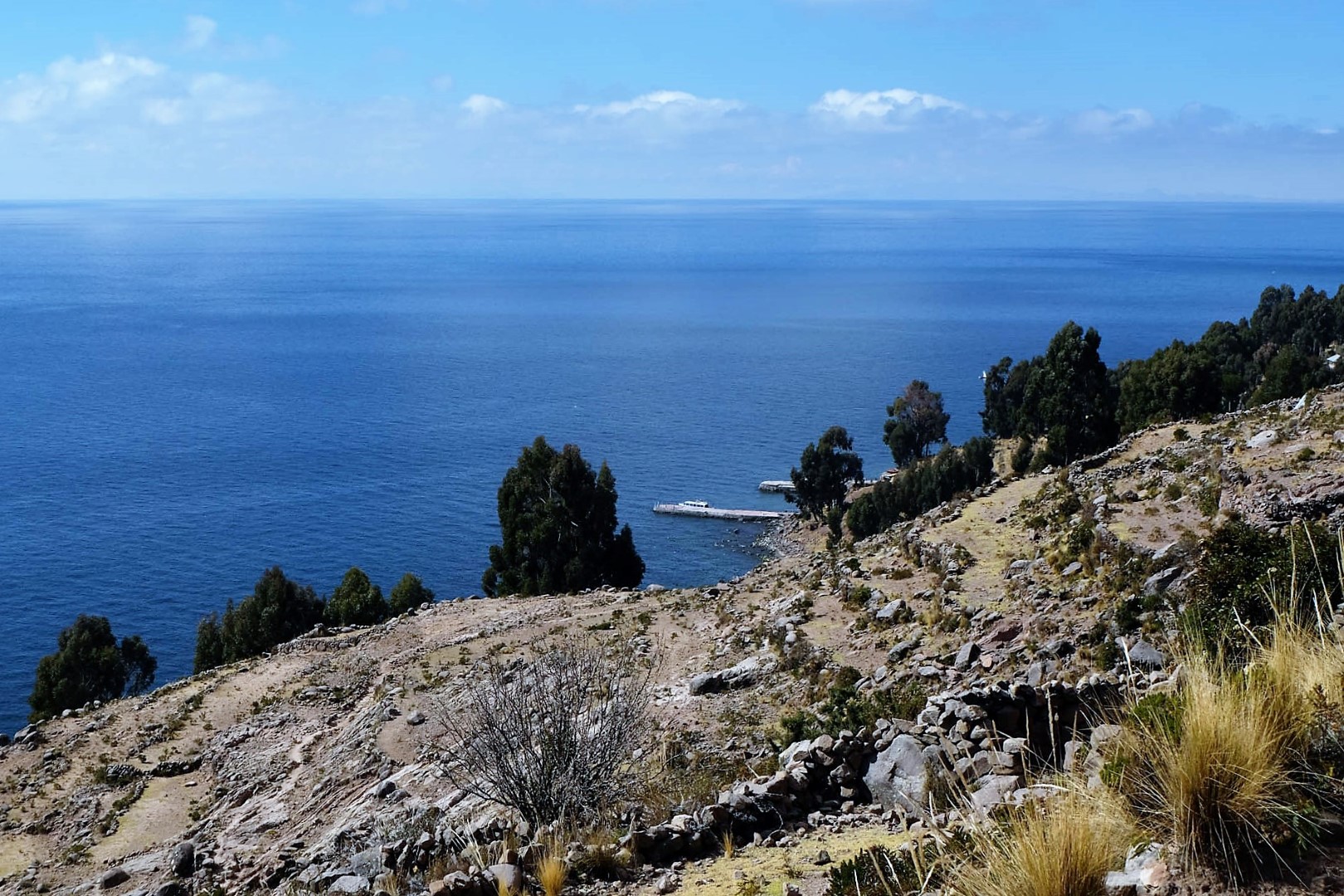
Next, we sail to Taquile. The boat drops us on one side and will wait on the other. We begin walking across the island through magnificent scenery. Along the way, we see eucalyptus trees and the muña plant, which I now recognise thanks to our tea. In the island’s “centre”, we eat trout from Lake Titicaca for lunch, then continue to the far shore for the return to Puno.
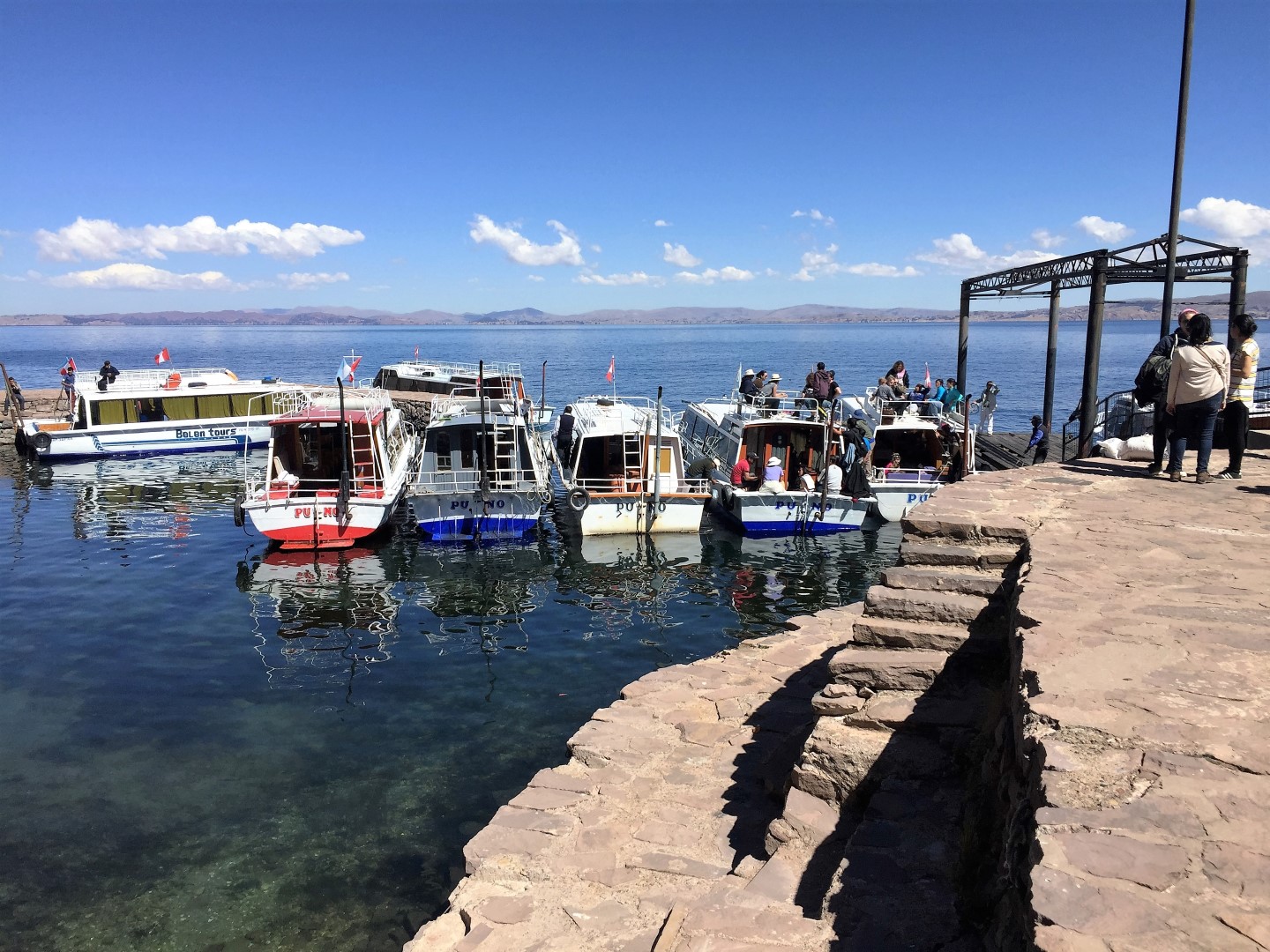
At Puno harbour, we say goodbye to the people on our boat, who have become friends over the past two days. We have shared a wonderful weekend on the islands of Lake Titicaca.