We began exploring Bolivia with the largest salt flat in the world: the Uyuni Salt Flat. As I have just done, travellers usually say that they have been to Salar de Uyuni. It is easier that way, because among people travelling around South America, the place needs no explanation. Strictly speaking, however, the Uyuni Salt Flat is only one of the first stops on our three-day route. So let us set off for southwestern Bolivia and take everything it contains in order.
Crossing the Peru–Bolivia border
While we are still on the Peruvian side, we make a plan to leave for Uyuni from Bolivia’s administrative capital, La Paz (3,660 metres above sea level). First, then, we have to cross the border and reach La Paz. We decide to cross at Desaguadero because it will save us a little time. The next morning, at Puno bus station, we are told that there is a strike at the Desaguadero border crossing today, so we will have to travel through the Kasani crossing and then via Copacabana. There is nothing we can do: instead of five hours, the journey will take seven.
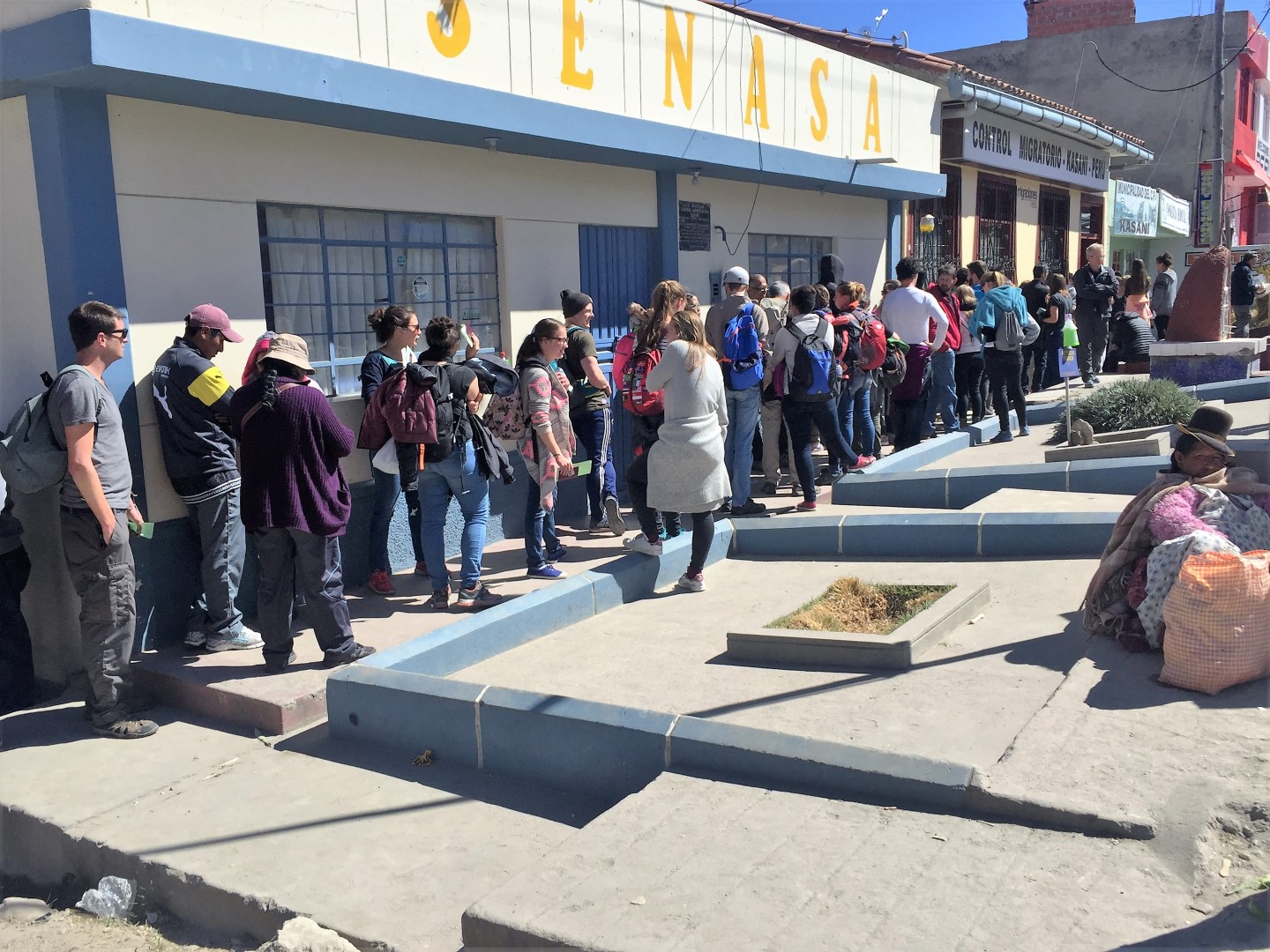
There is a long queue on the Peruvian side of the border, with the people waiting under a fierce sun. On the Bolivian side, the easy-going attitude is already apparent: without so much as looking at us, an official stamps the entry permit into our passports. We continue towards La Paz accompanied by picturesque views of Lake Titicaca. A few hours before La Paz, the bus’s violent shaking wakes me up. The road before this was hardly brilliant, but this one does not even deserve to be called a “bad road”. It is atrocious! At times, the jolting lifts my bottom a centimetre off the seat or pitches my head towards the chair in front. If the bus had seat belts, I would certainly use mine. Instead of the promised seven-hour journey, we finally roll into La Paz after eleven hours. Welcome to Bolivia! The next day, we buy tickets for the night bus from La Paz to Uyuni.
A frosty morning in Uyuni
We arrive in the little town of Uyuni shortly before 6:00. Forewarned by our Lonely Planet guidebook, we have prepared ourselves for harto frío—extreme cold. It is still dark, we have only just woken up, and we step off the bus in our winter coats. The guidebook is right: it is bloody cold! Right beside the bus, we are surrounded by tour companies, and we follow an English-speaking woman to her office to discuss a tour. We want to begin a three-day journey through southwestern Bolivia that very day. The route, the 4x4, the accommodation, and all the other details we ask about sound as they should. The woman quotes the standard price, and we even manage to negotiate a small discount. All right, we will go with this company and are due to leave at 10:00. (We would nevertheless recommend that other travellers check reviews on TripAdvisor or elsewhere before choosing a tour company. There are alarming reports of road accidents caused by drunk drivers or vehicles in poor mechanical condition.)
At around 10:00, other people begin gathering at the office, and it looks as though there will be three vehicles in all. Each car usually carries six tourists plus the driver. Then 11:00 arrives, followed by 11:30, and we are still waiting to leave. We have put the time to good use, however, and have met the other travellers. Our potential companions include a group from Brazil, a man from Germany, a Spanish-speaking family, and a lively group of friends who met while travelling and are now continuing together. When the drivers finally arrive with the jeeps, we are assigned to the last of these groups.
Three days off-road
Besides Jānis and me, our car carries the driver, Devonna from Canada, Fenella from the United Kingdom, Hanna from the United States, and Daniel from Peru. As soon as we set off, we are delighted to discover that the driver’s taste in music matches our own teenage favourites—which means we know all the words. We have not even left Uyuni when all of us are singing James Blunt’s “You’re Beautiful” in chorus. The most interesting thing about this international group of friends is that they met during their travels. Devonna spent several months working in Lima, where Daniel’s cousin introduced the two of them, and she persuaded him to visit Machu Picchu with her. They met Fenella in Cusco and later came across Hanna. They became friends and decided to continue the journey together, substantially changing their travel plans to accommodate one another. We have certainly been lucky with our group, and the next three days promise to be fun.
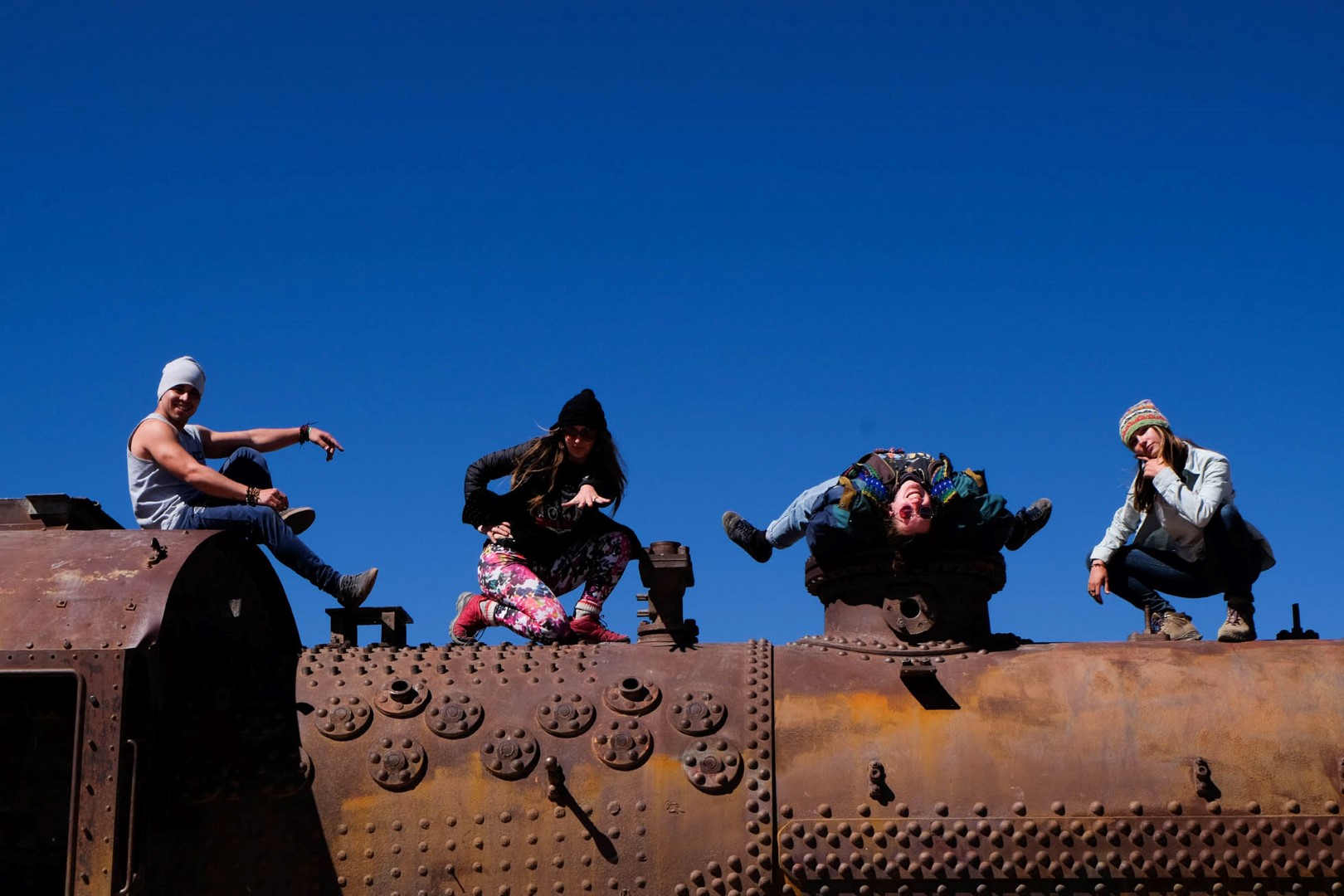
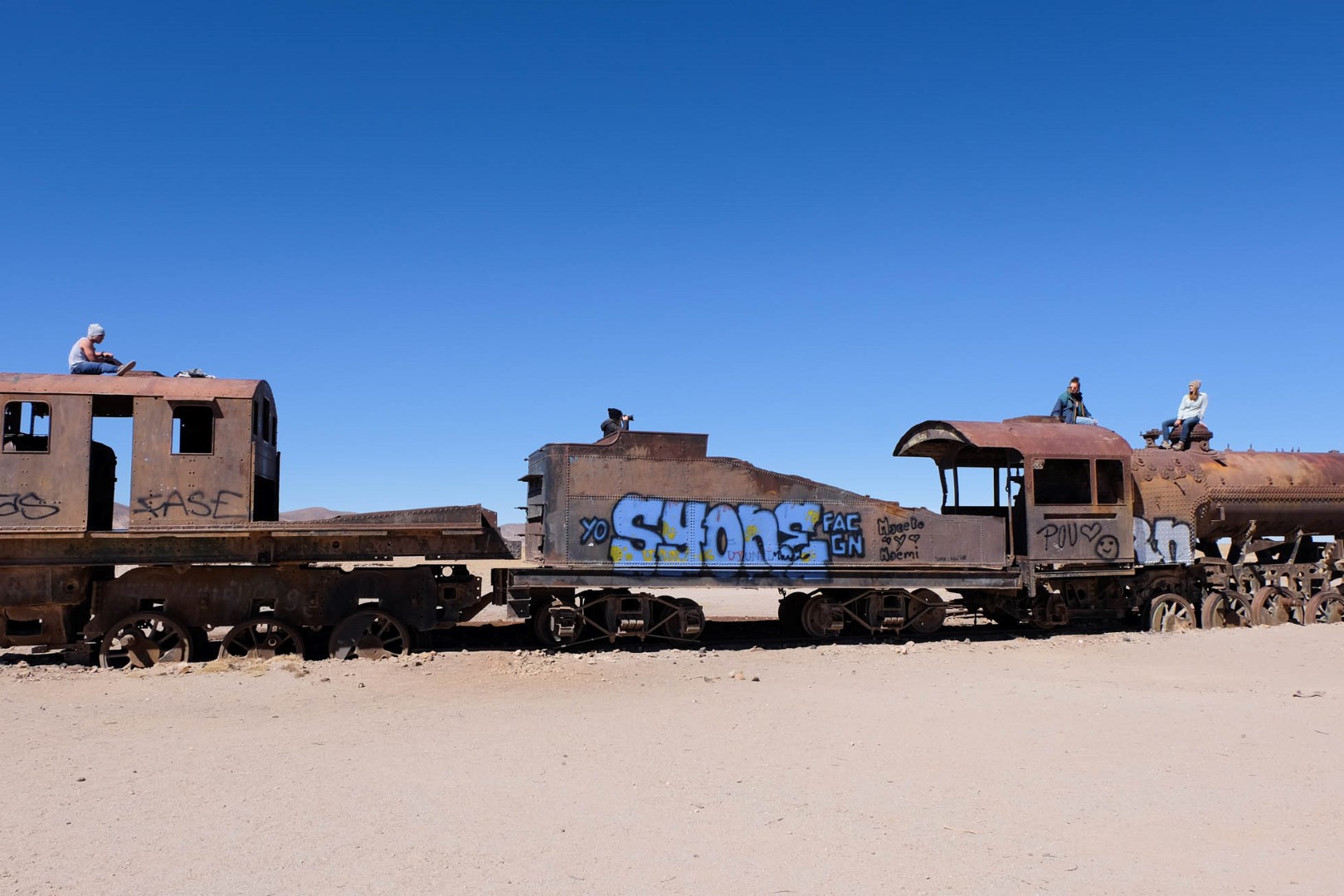
Our first sight is the train cemetery. It is a rather bleak and unusual scene: desert all around us, railway tracks running through its middle, and abandoned trains in the middle of nowhere. Because of its location, Uyuni was once an important transport hub in South America, linking several major cities. During the nineteenth century, there were plans to expand Uyuni’s railway network much further, but the project was abandoned because of technical difficulties and tensions between neighbouring countries. The trains and equipment that had been brought here were simply left behind. Most of the trains were imported from the United Kingdom. Under different conditions, their metal bodies might have survived better, but Uyuni’s salty winds have badly damaged their surfaces.
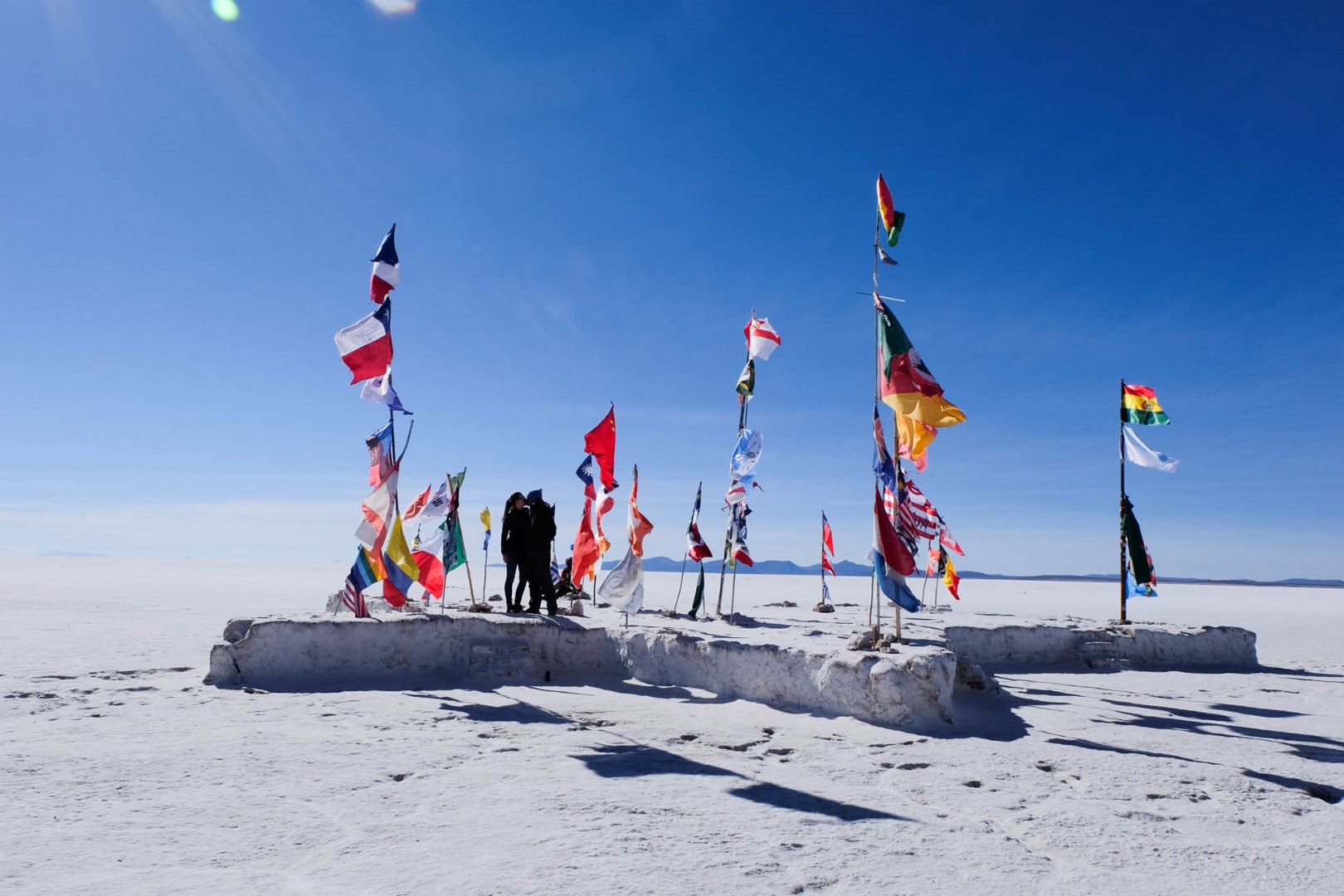
We continue through the desert landscape, and the ground grows whiter and whiter. We have reached the famous Uyuni Salt Flat! The earth is white in every direction, and the mind struggles to believe that beneath our feet is salt rather than snow. Formed from a prehistoric lake, the salt flat covers 10,582 square kilometres and is several metres deep. Its salt is particularly rich in lithium and holds 50–70 per cent of the world’s lithium reserves. The immense area, clear skies, and perfectly level surface make Salar de Uyuni an ideal place for calibrating Earth-observation satellites. Its flatness tricks the mind into thinking we are at sea level, although the plain actually lies 3,656 metres above it. Remarkably, across this enormous area, the height of the surface varies by no more than one metre.
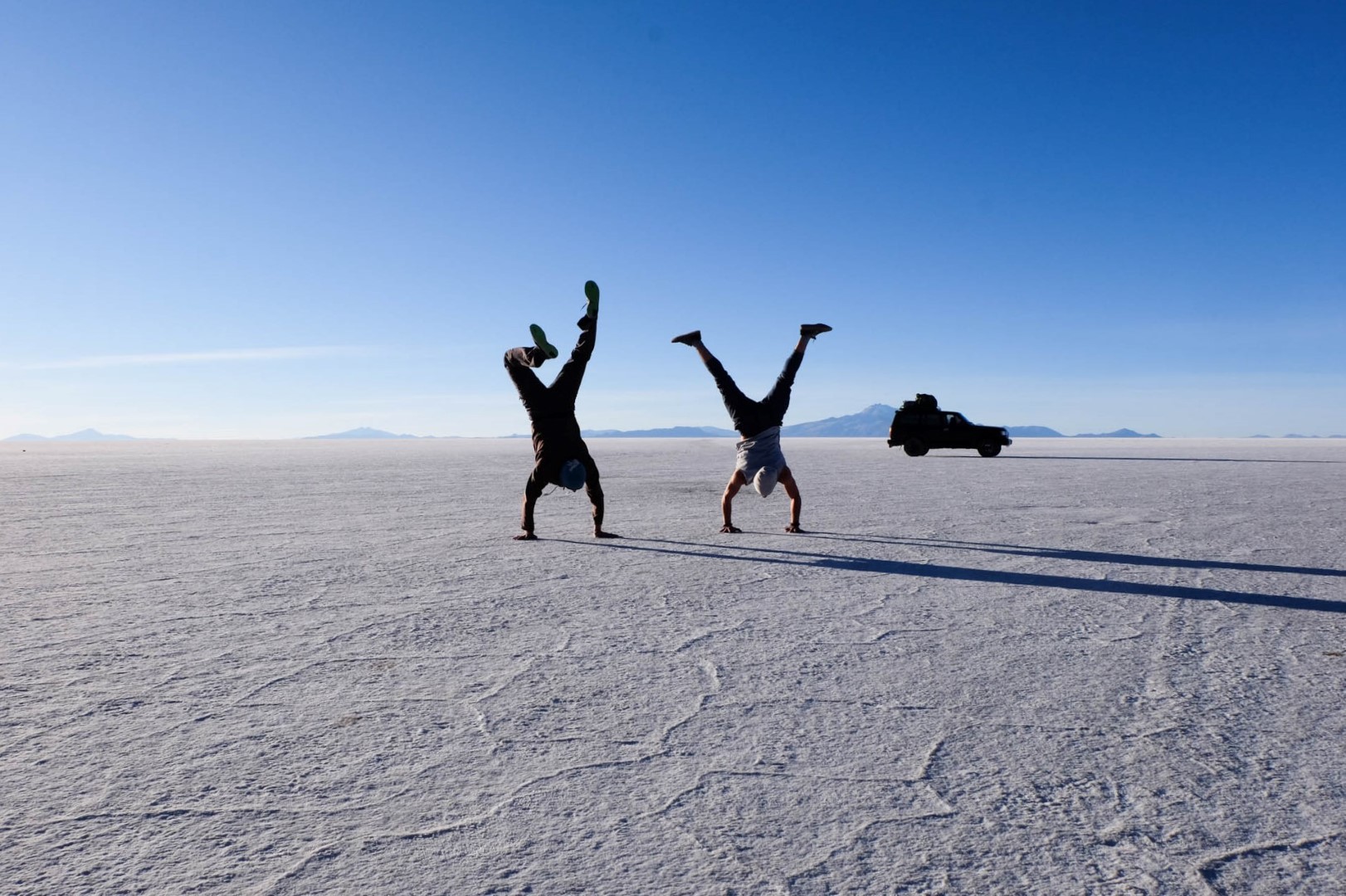
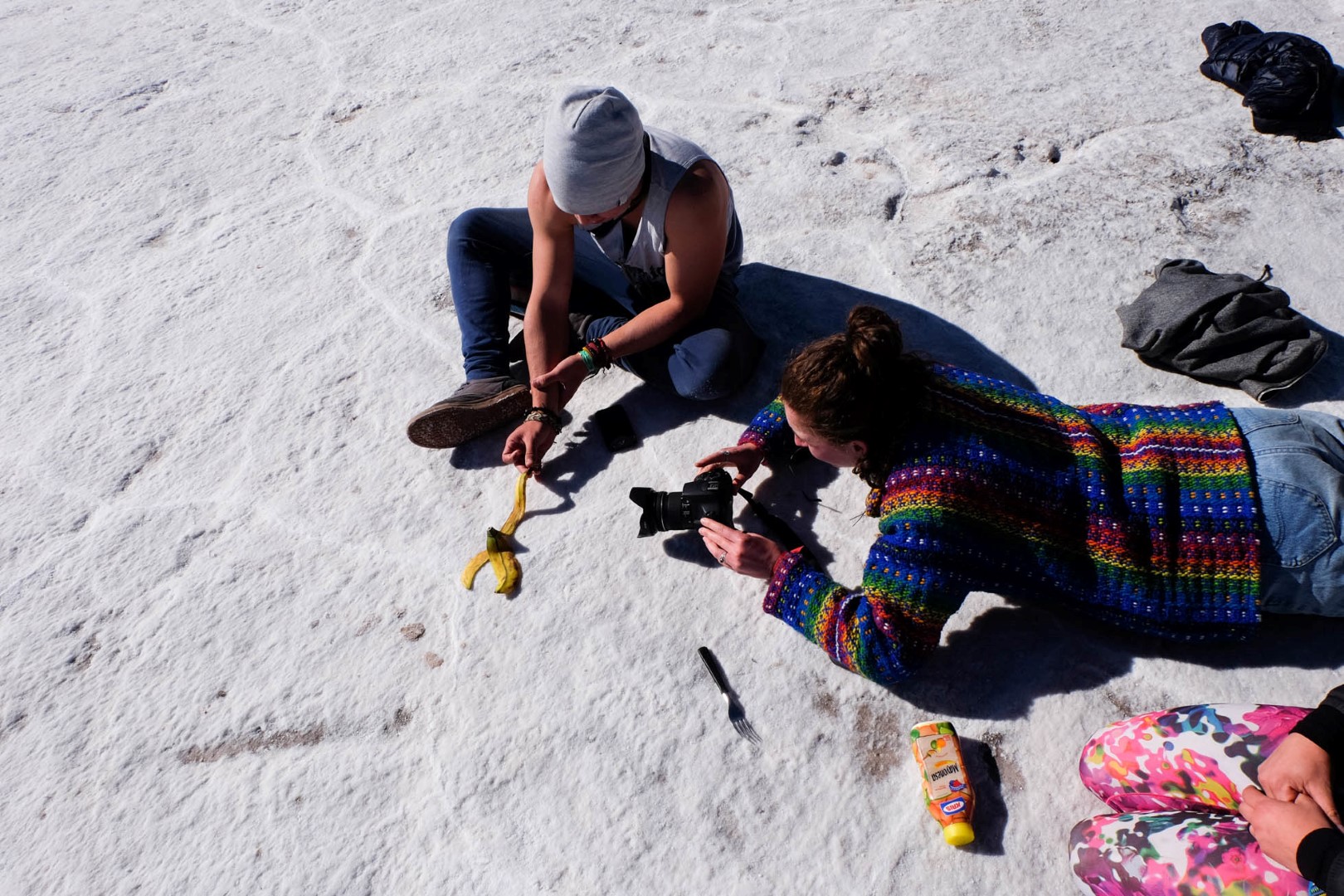
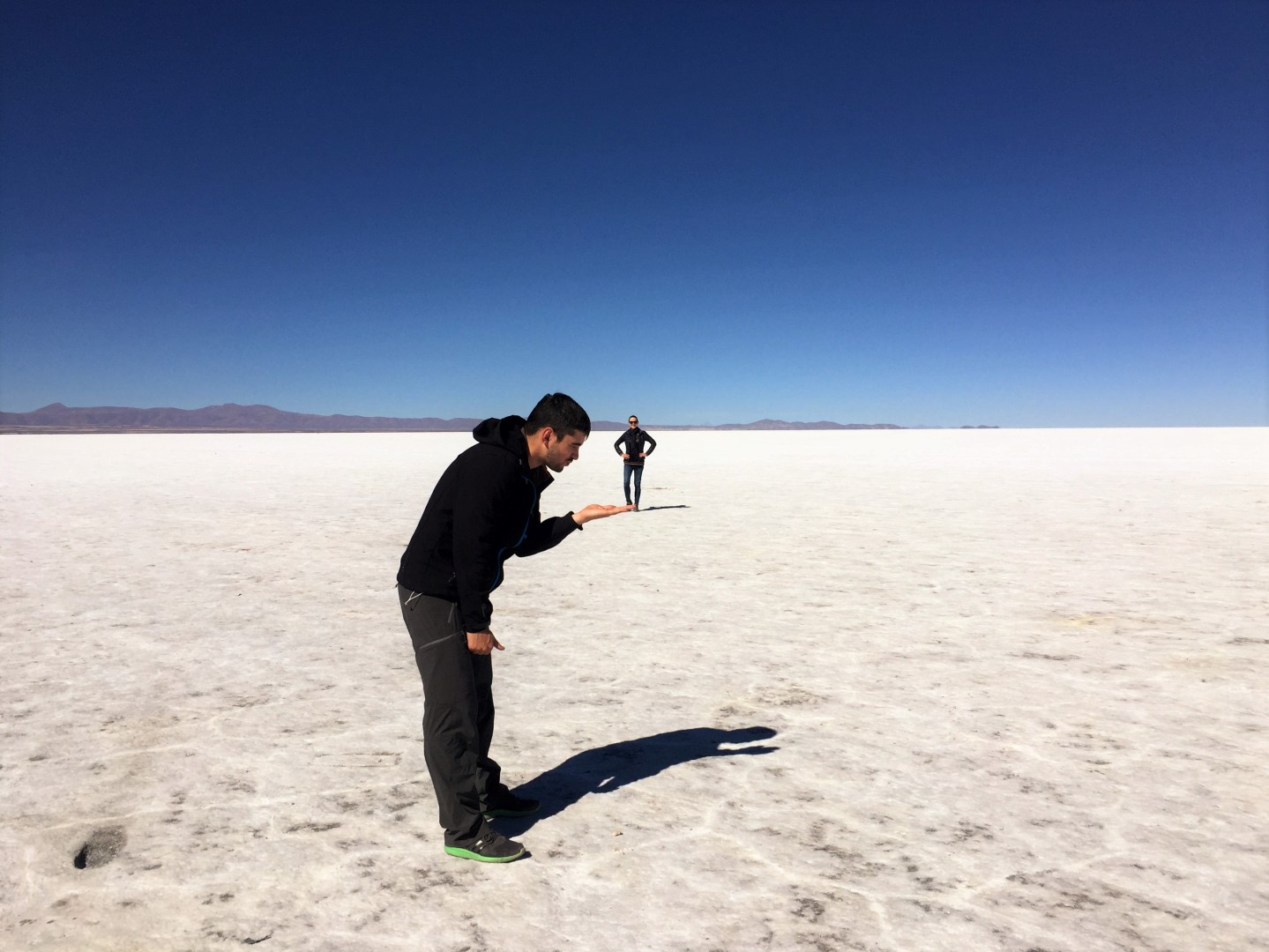
The most entertaining part is taking photographs. Thanks to the perfectly level ground, it is possible to create all sorts of optical illusions. Lying in a spoon, climbing into a hiking boot, or riding a banana—it can all be done here! After lunch in a building made of salt, we set off to take our own pictures and, following Devonna’s example, even taste a few crumbs of salt from the ground.
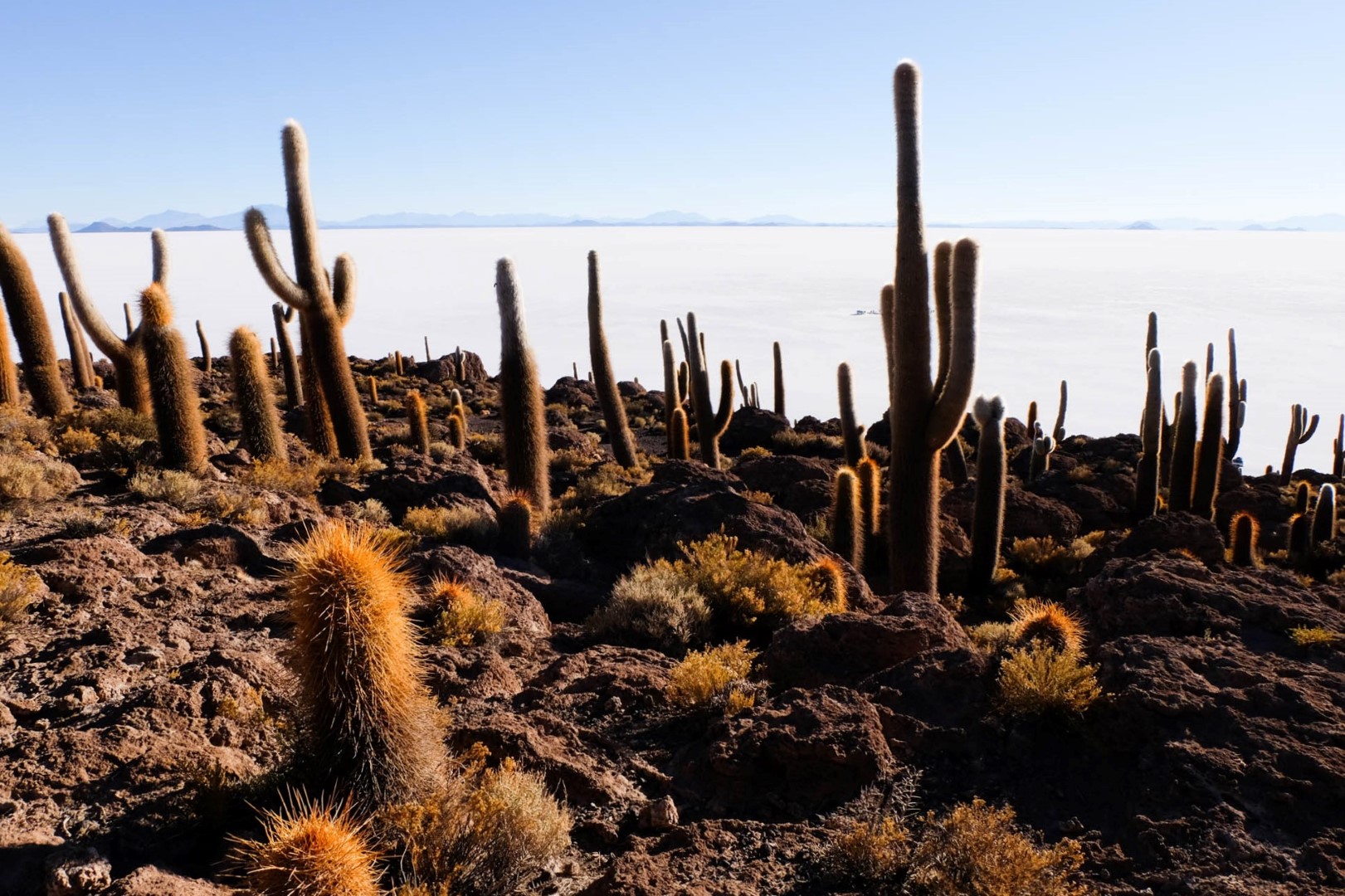
After the salt flat, we are taken to Isla del Pescado, or Fish Island. It really is an island rising out of the white expanse of salt, covered in gigantic cacti. Its name comes from the fact that, viewed from the side, it resembles a fish. The sun is already sinking towards the west, and Salar de Uyuni begins to demonstrate the cold we were promised.
We drive across the salt flat as though it were a brand-new motorway—it is a better road than the highway to La Paz. The moment we leave the flat, the car begins to shake violently, and the final kilometres to the hotel, combined with the altitude, make me nauseous. Something is also wrong with one of the wheels, and we watch anxiously as the wobbling tyre shakes both the steering wheel and the driver’s hands.
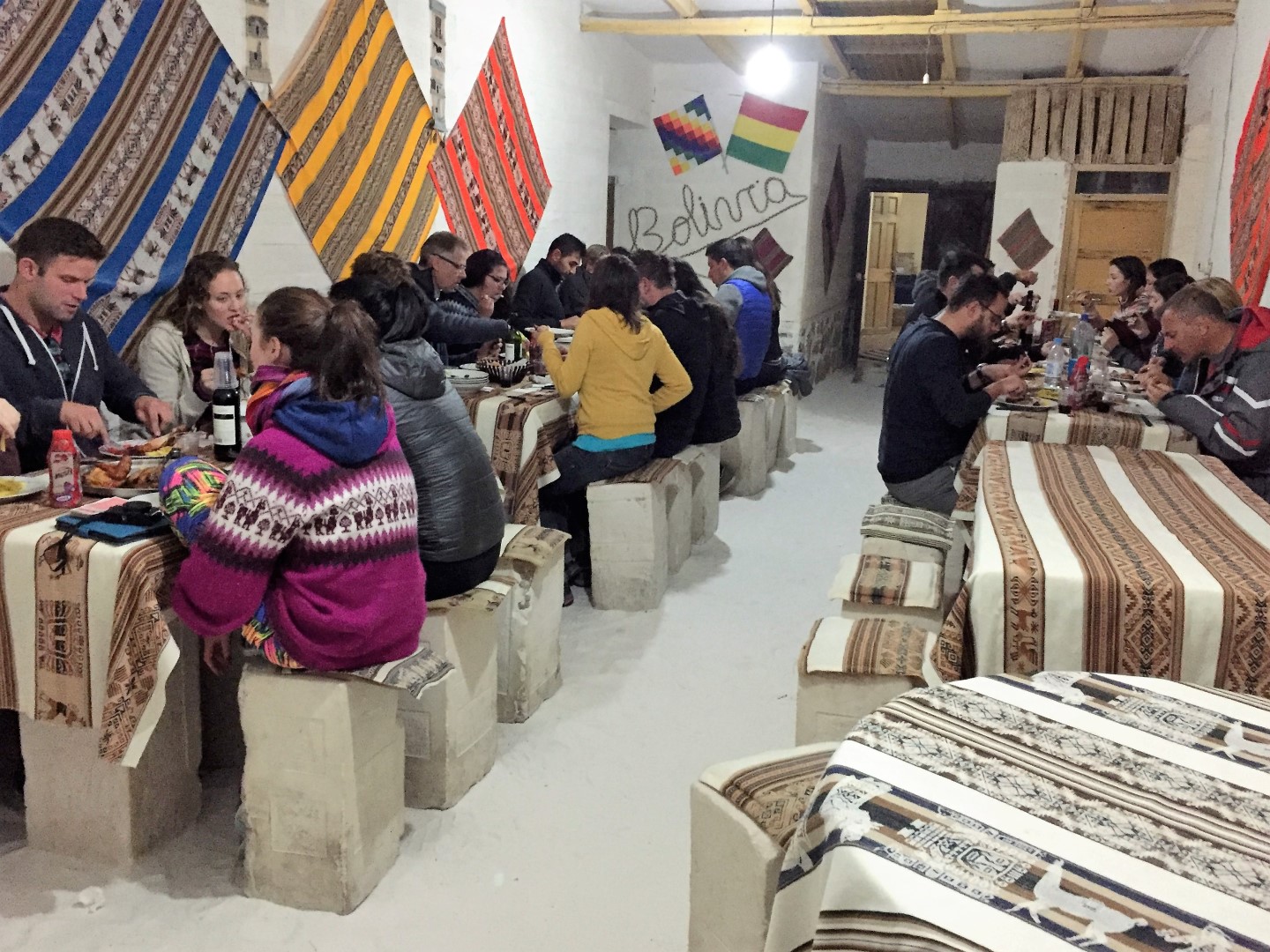
Tonight we stay in a hotel made of salt. The walls, the floor, even the tables—everything is salt. When you breathe with your mouth open, you can feel salt particles on your tongue. Our group spends the evening around a salt table, drinking wine and talking about our respective countries. Latvia is the most interesting to everyone because it is the least familiar, so we receive plenty of questions. Despite the bitter cold outside, we do not feel cold at night beneath several llama-wool blankets. Perhaps the salt building helps as well.
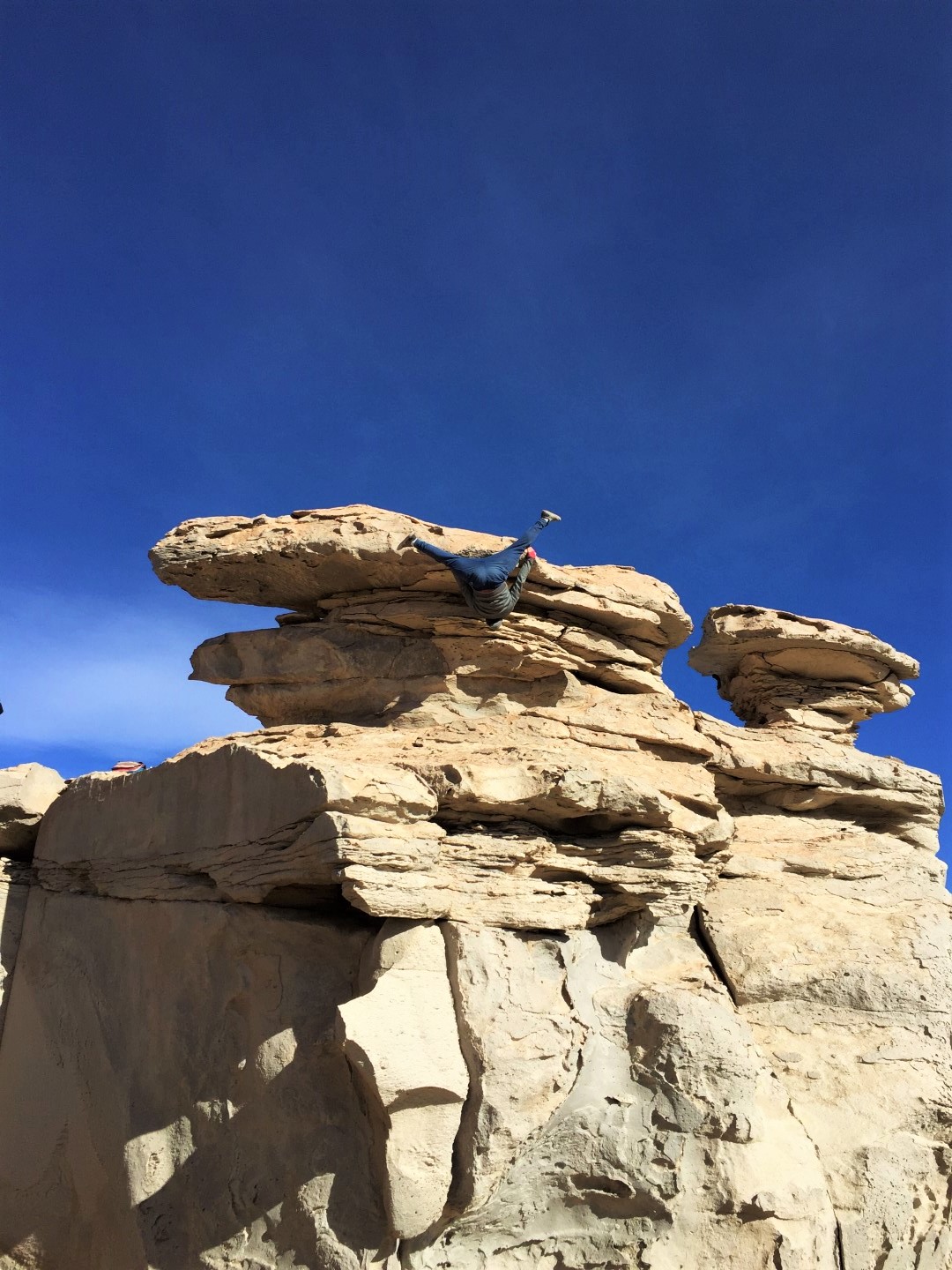
The next day, we set off at first light. Our first stop is at the foot of Ollagüe Volcano, directly on the border with Chile. The volcano is active, and smoke rises from its summit. An eruption once took place here, leaving behind intriguing formations. The women decide to do a little yoga, while Daniel demonstrates his athleticism by standing on his hands. We have a very sporty group indeed. Before we climb back into the car, another familiar, rhythmic hit begins to play, and Devonna and Fenella draw us all into a morning workout. While we are doing squats, a woman from another vehicle warns us that we are at a very high altitude and could have a heart attack by exercising like this.
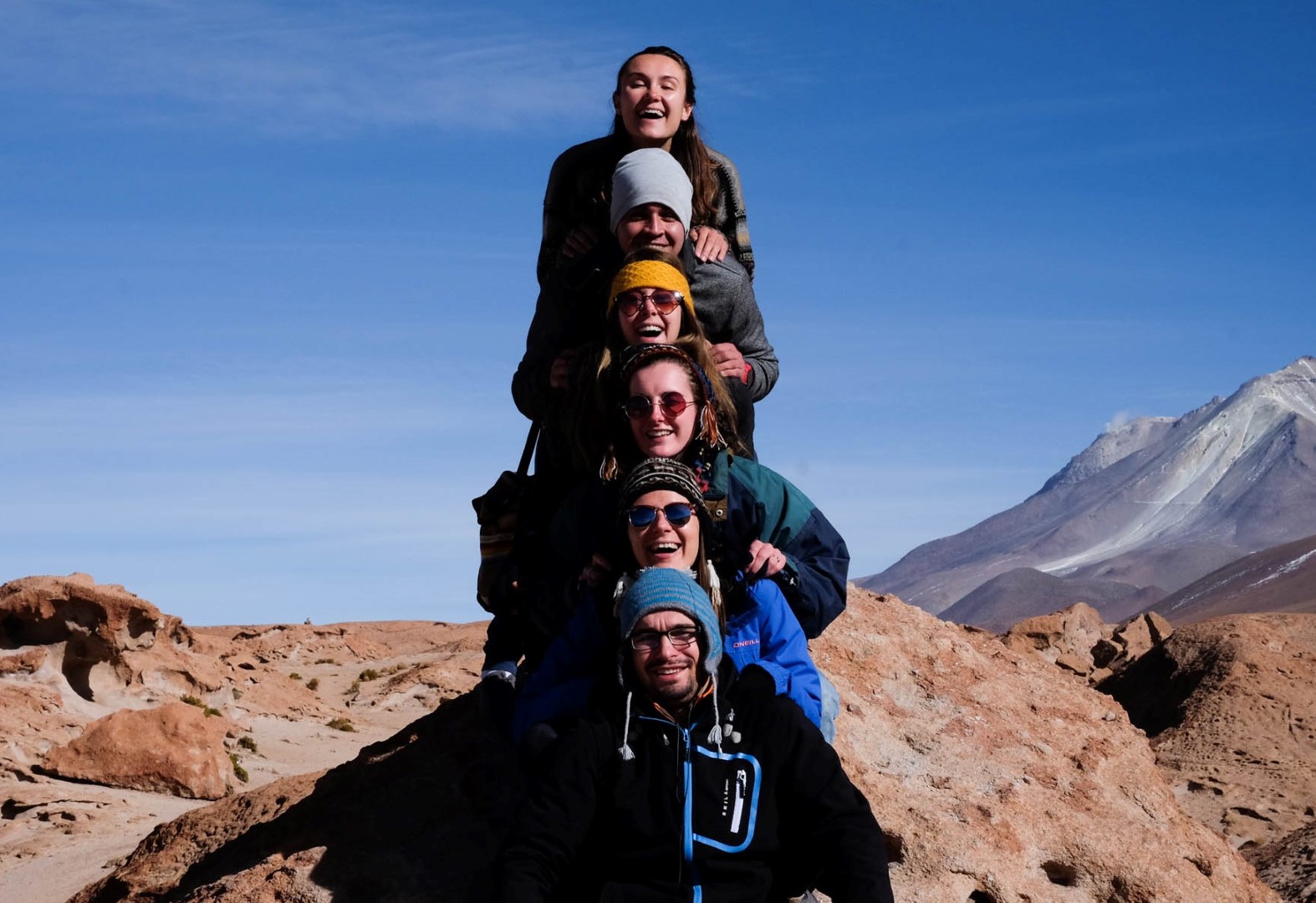
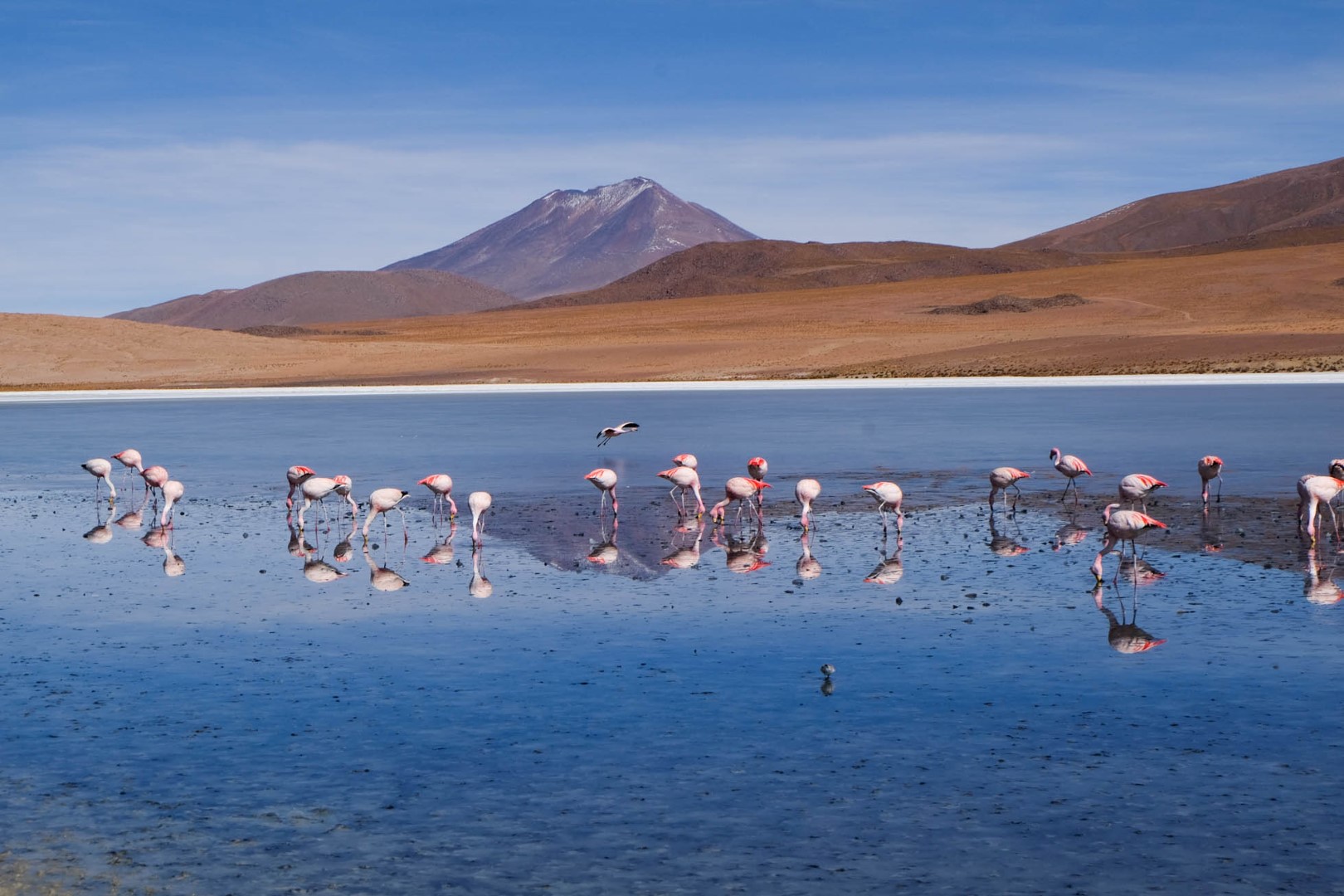
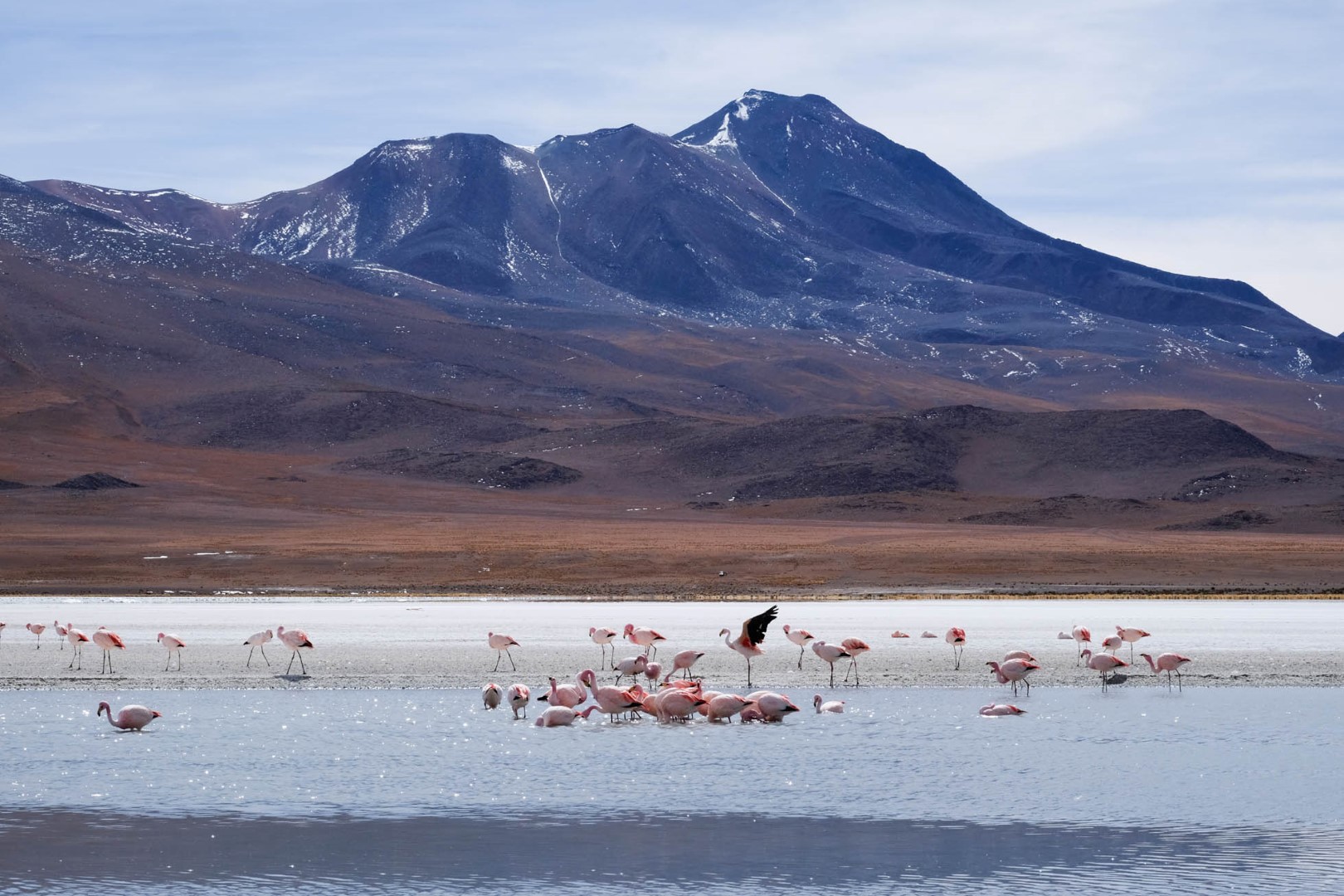
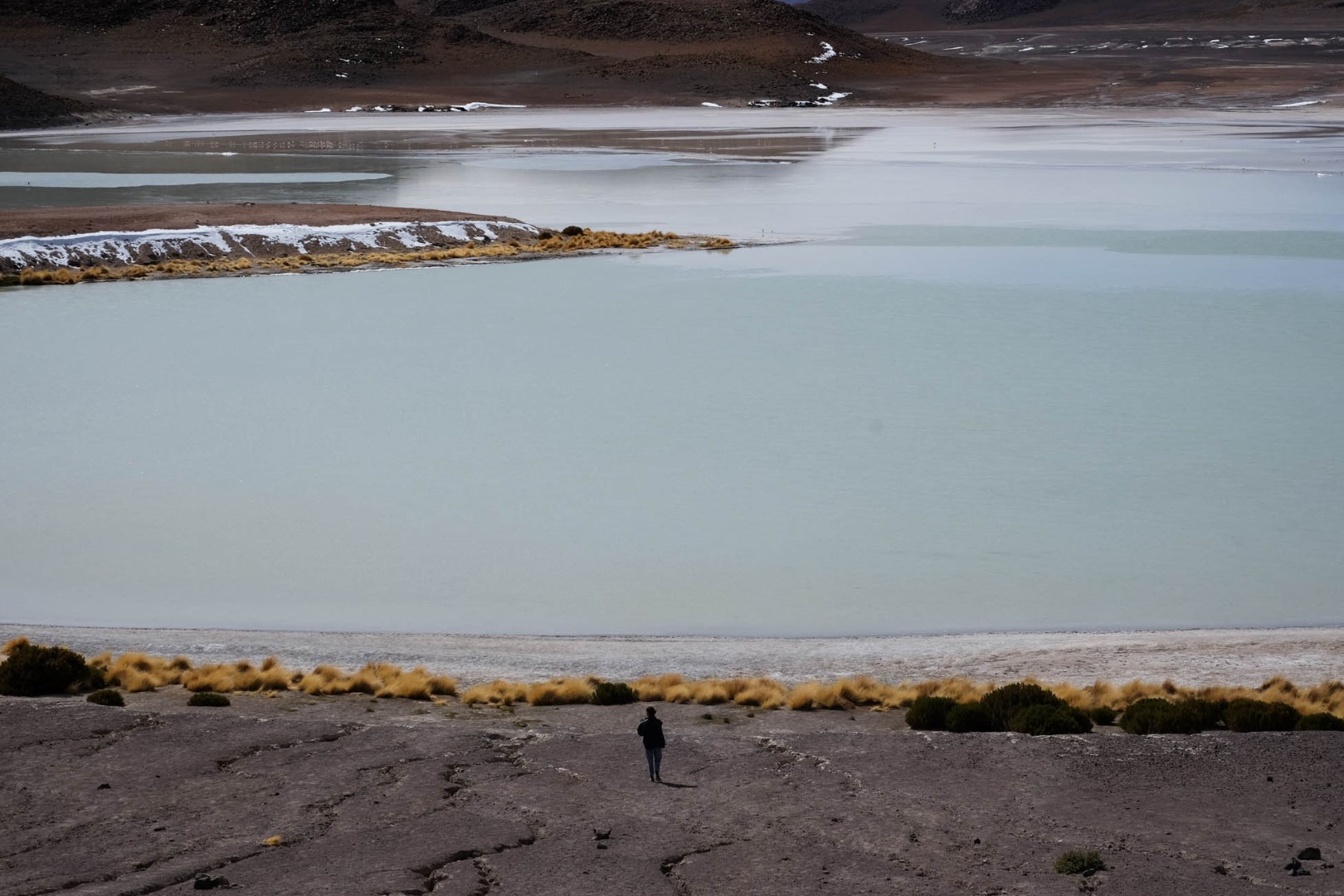
The next part of our route is devoted to lagoons. There are six altogether, so looking back at the photographs, I no longer remember exactly which name belongs to which one. What makes them interesting is that each lagoon contains a particular substance—sulphur, for example—as well as algae. Every lagoon therefore has a slightly different hue, and even its own smell. Laguna Hedionda stays with me most vividly. Its surface was as still as a mirror, and oh, the delight I felt when I saw flocks of pink flamingos! There was such peace here, and the view was so impossible to describe in words, that at times it was difficult to believe we were really there and that what surrounded us was real.
We carry on in the same spirit, visiting one lagoon after another, now travelling through terrain at an altitude of 4,300 metres.
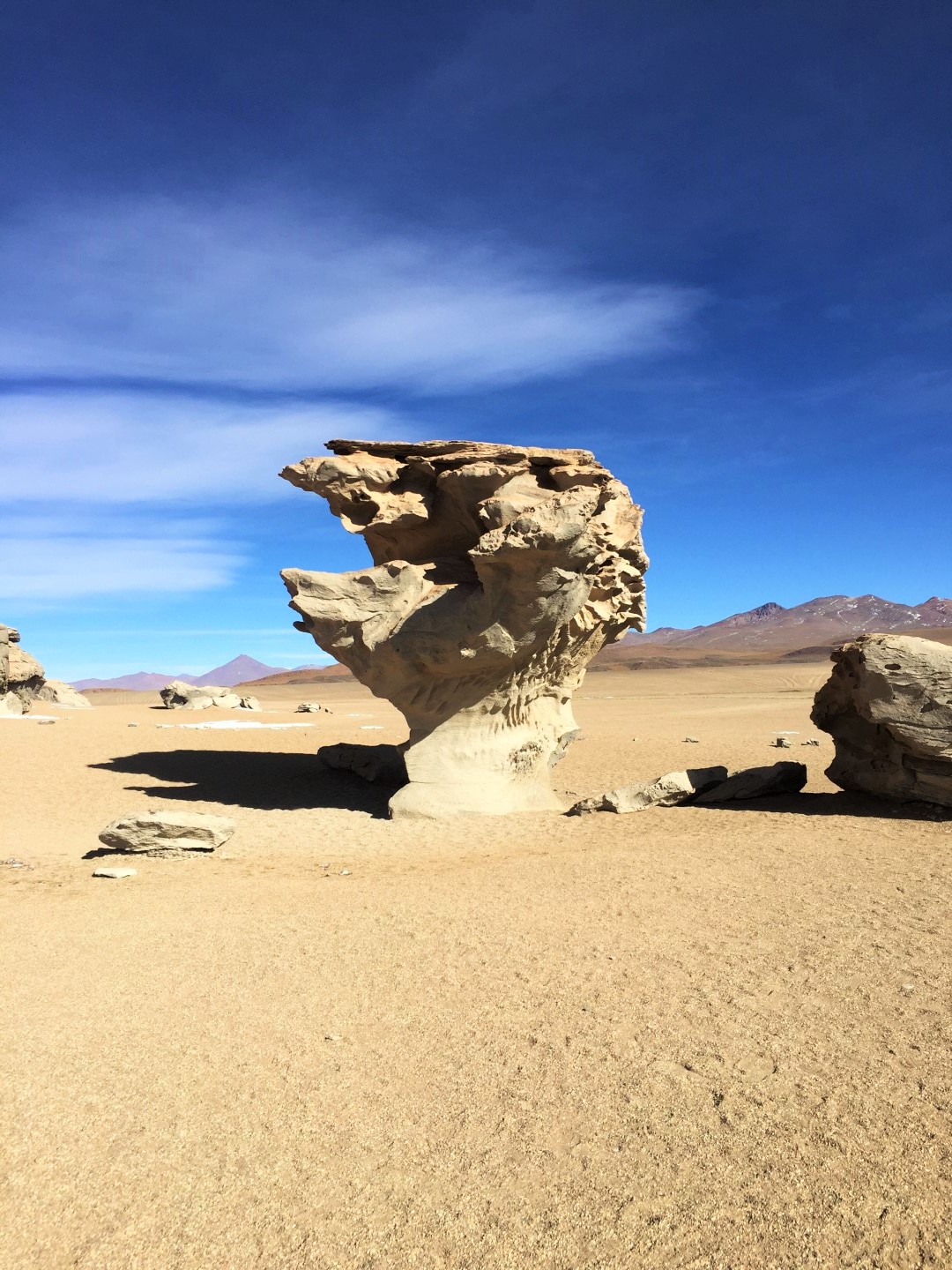
Our penultimate stop before heading to the night’s accommodation is the Stone Tree, or Árbol de Piedra. Even in daylight it has now become thoroughly cold, and, sheltering from the wind, we look at the shapes it has carved into the rock.
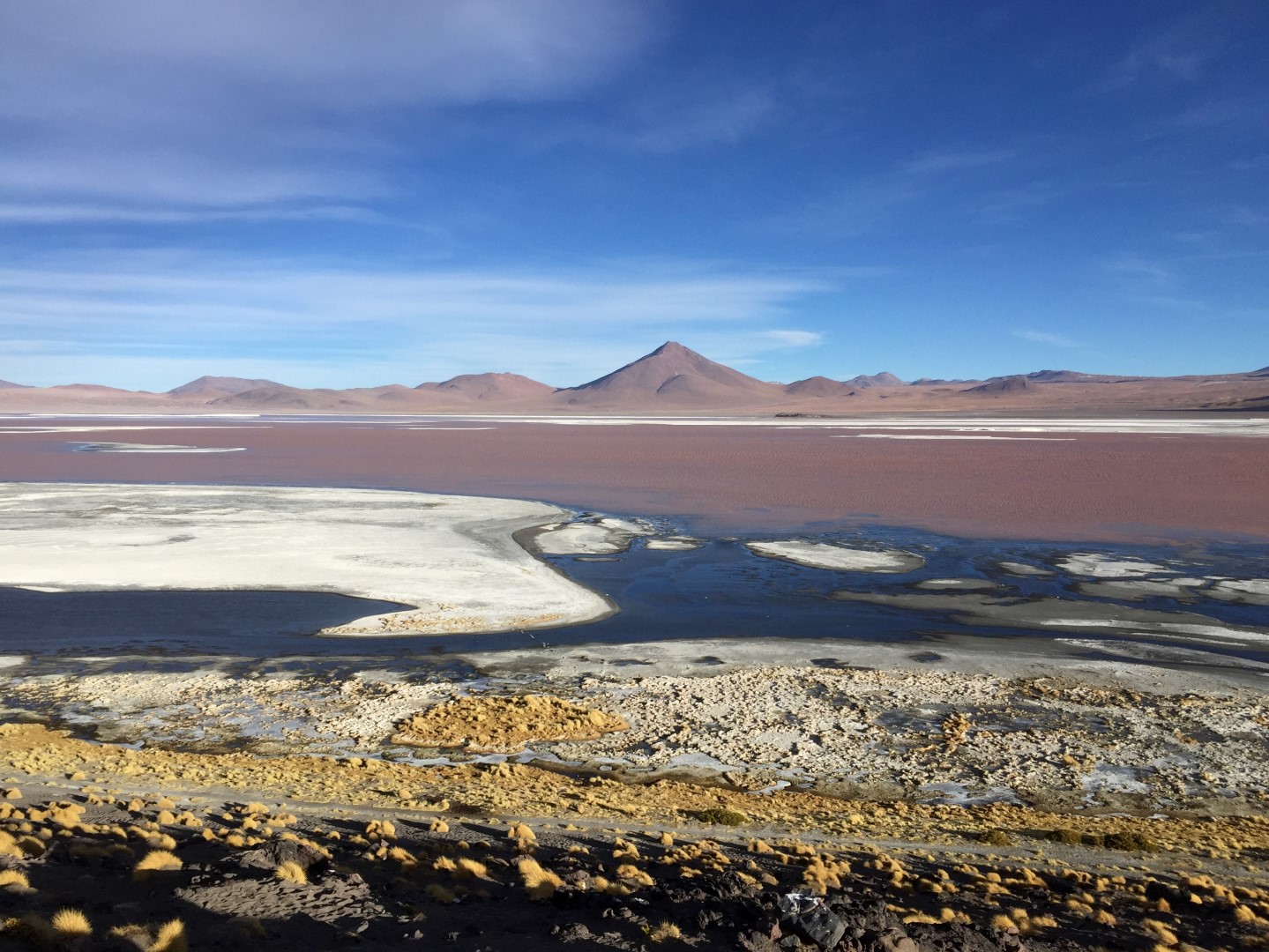
We also stop at the fantastic Laguna Colorada, but by now it is so cold and windy that we quickly take a few photographs and jump back into the car.
Tonight’s hotel is not made of salt, and it is noticeably much colder. We are given a large room with six beds, so our whole group will sleep together. It is so cold that we eat dinner in winter coats and hats. Afterwards, we begin sipping wine and playing a card game called “Spoons”. Its principle is the same as the Latvian game “Donkeys”, except that instead of slapping a hand down, you have to grab a spoon from the table. At night, we sleep in our hats and clothes, but despite the many blankets, it is bloody cold. When the alarm sounds at 4:00, summoning the courage to leave the bed for the cold is no easy task. Everyone is frozen, and we eat breakfast wearing gloves.
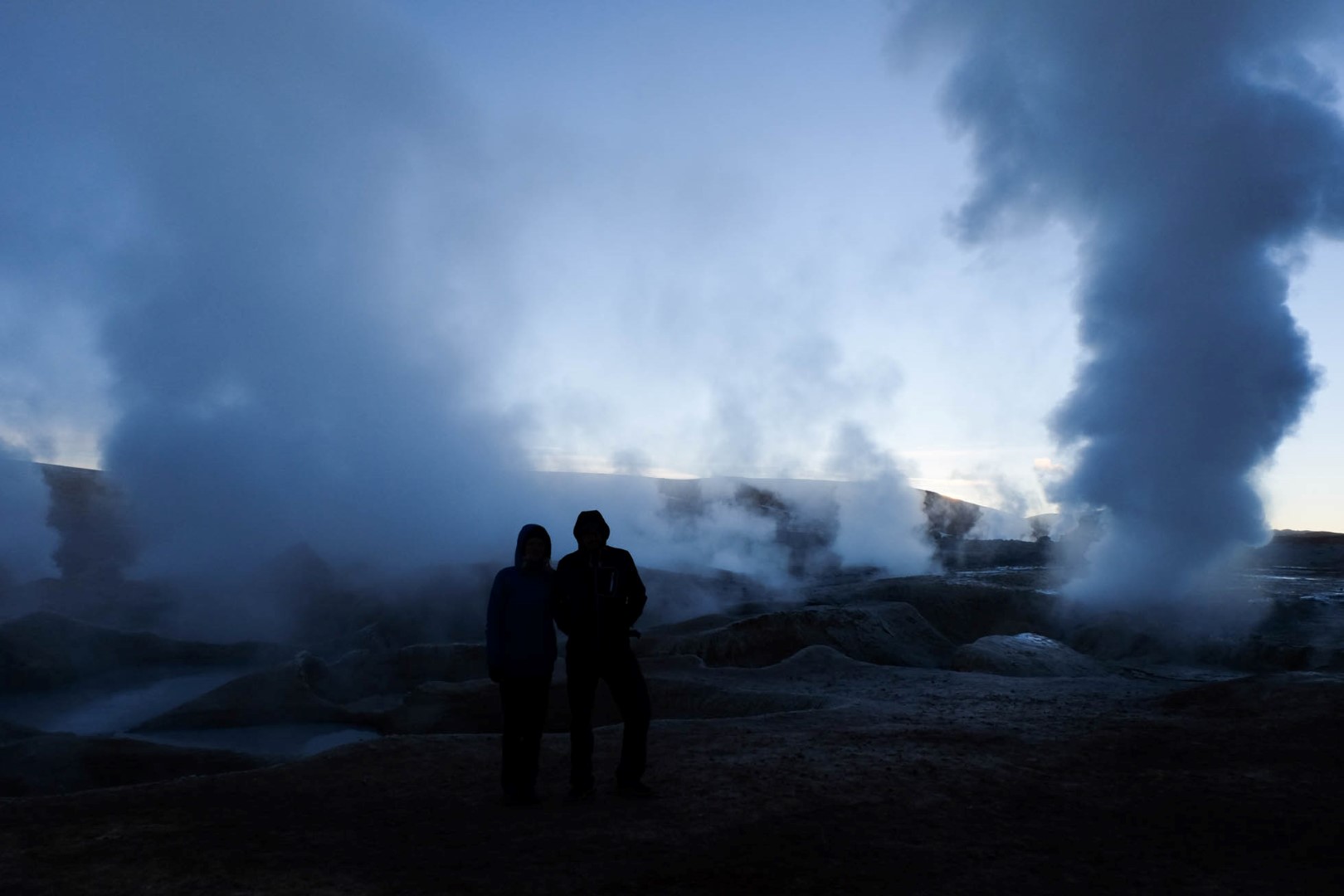
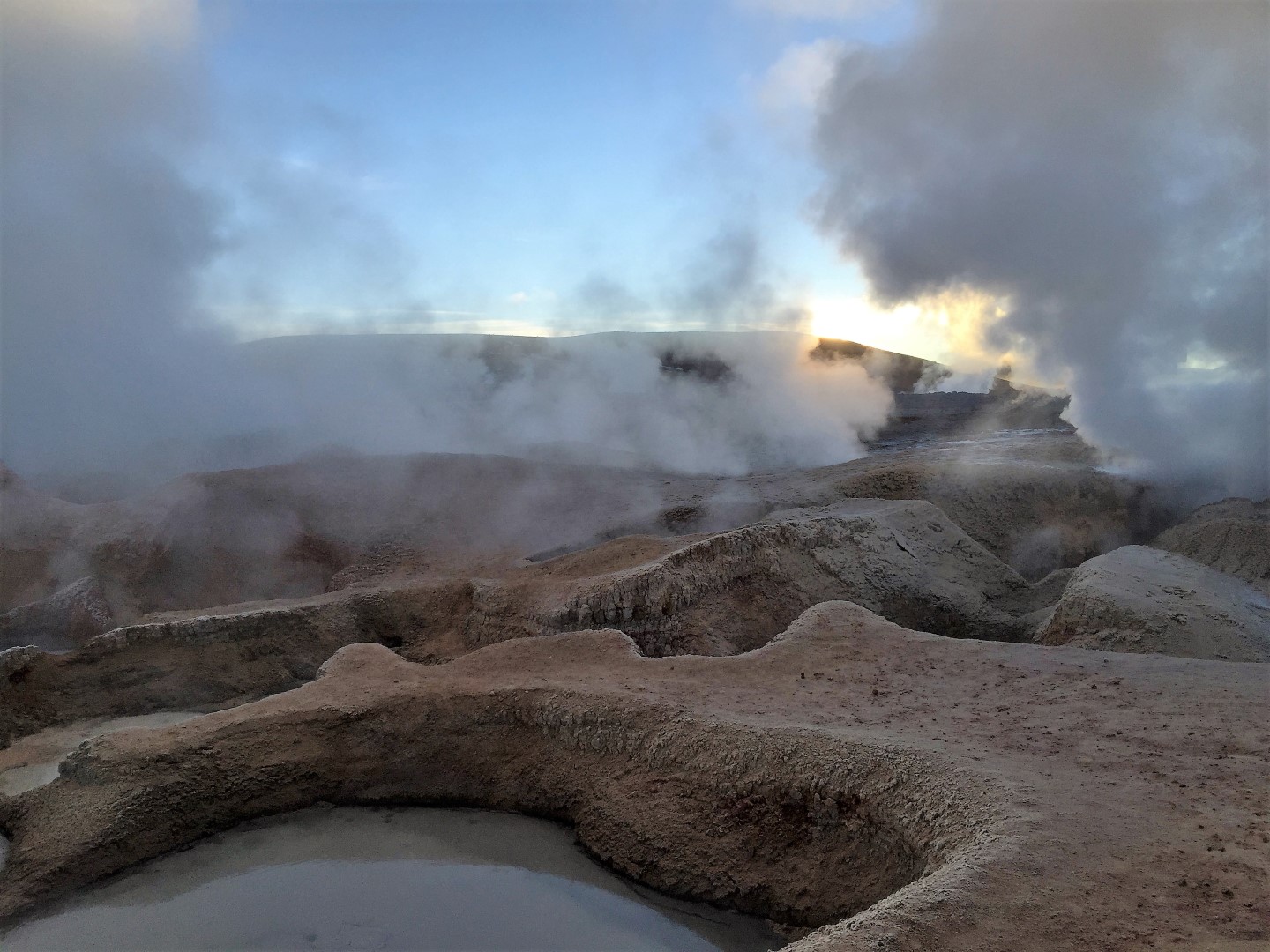
We are preparing to leave when we are told that each car will take one extra passenger because the jeep carrying the group from Brazil has broken down. In the end, we get two rather than one, with the man holding the woman on his lap in the front seat. Bouncing across the rough tracks and sympathising with the couple in front, we set off through the darkness for the geysers. By the time we arrive, the sun has only just begun to rise and I really must repeat myself: the view is fantastic! Steam billows from the ground, while the dawn heightens the otherworldly effect. It turns out that we are standing in the crater of an ancient volcano at an altitude of 4,850 metres.
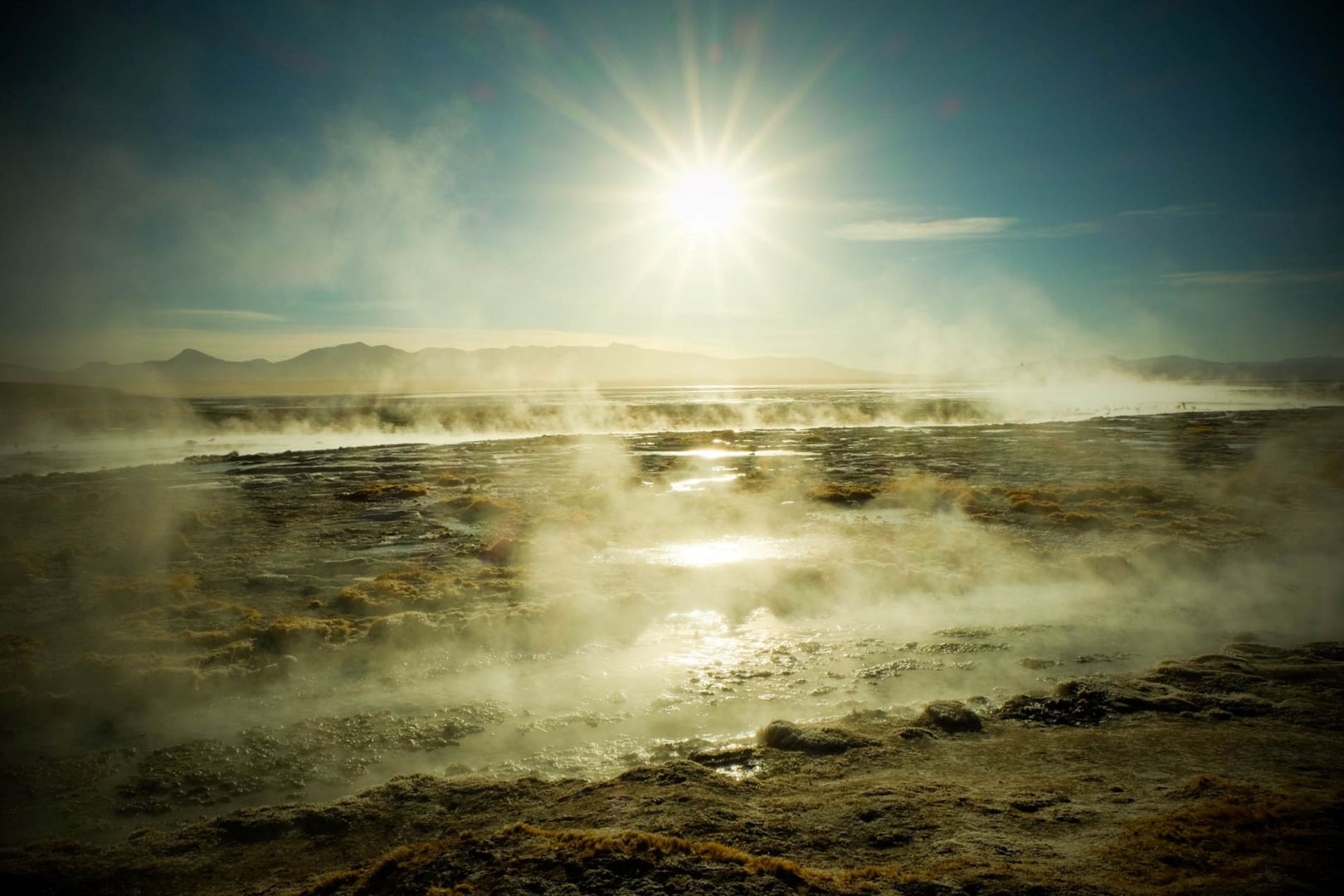
It is still early and we are thoroughly chilled, but now we are being taken to the thermal pools. When we arrive, the driver announces, “Thirty minutes.” First, it is difficult to contemplate taking off even a single layer of clothing; second, getting dressed after the pool will be freezing. Everyone agrees—except Jānis—and we decide to forgo the hot water. A little later, however, we stand shivering at the side and watch him sitting happily in the pool. He admits that it took about twenty minutes in the hot water before he finally warmed up.
Once our driver finally finishes drinking his alcohol, we continue in the same configuration, with the Brazilian couple sharing the front seat, to Laguna Verde near the Chilean border. Green is not the lagoon’s dominant colour today because it is frozen. This is a slightly sad moment, as we say goodbye to our cheerful group. They plan to cross the border and continue to the Atacama Desert in Chile. There are now five of us in the car, and the Brazilians can at last enjoy the journey in comfort.
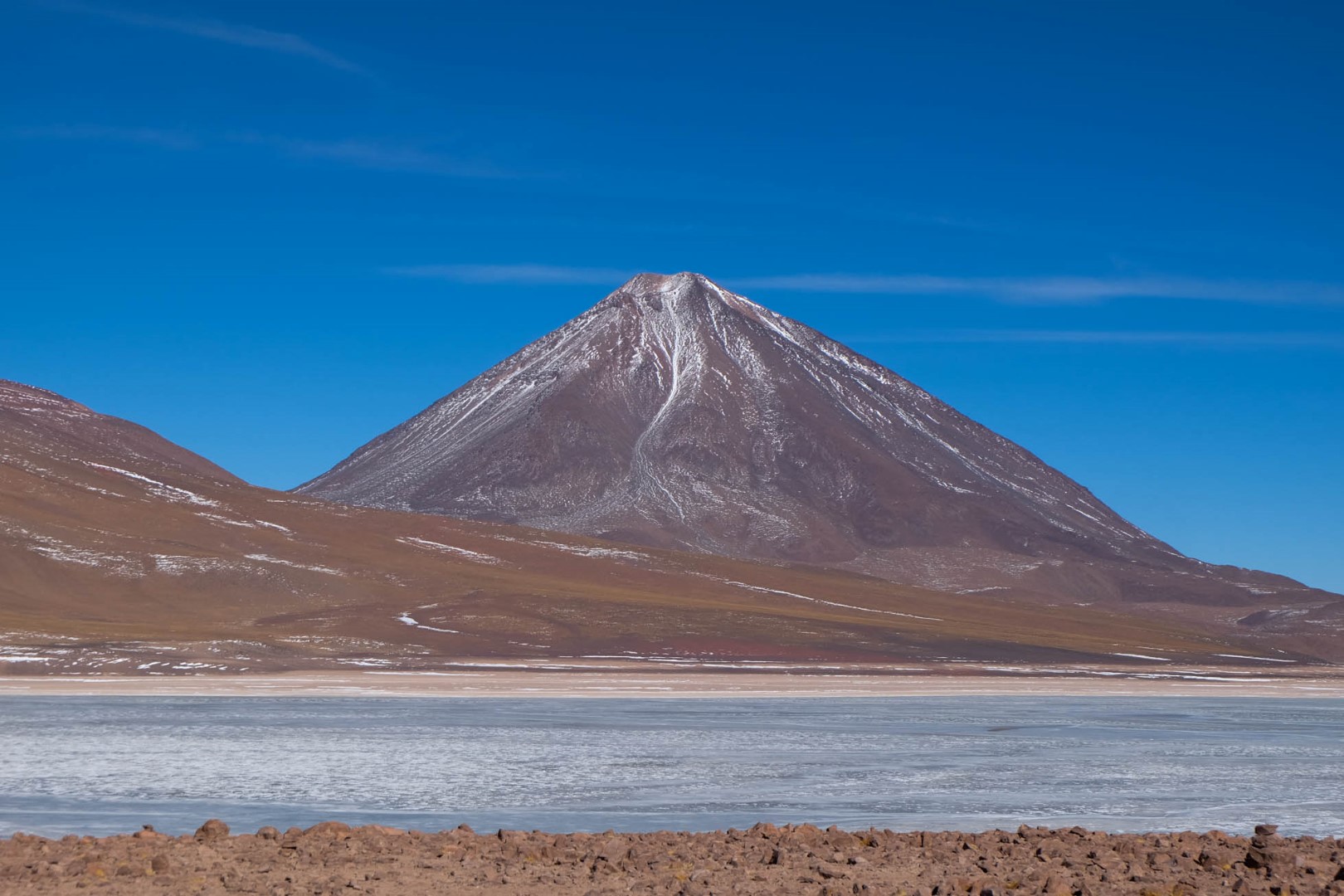
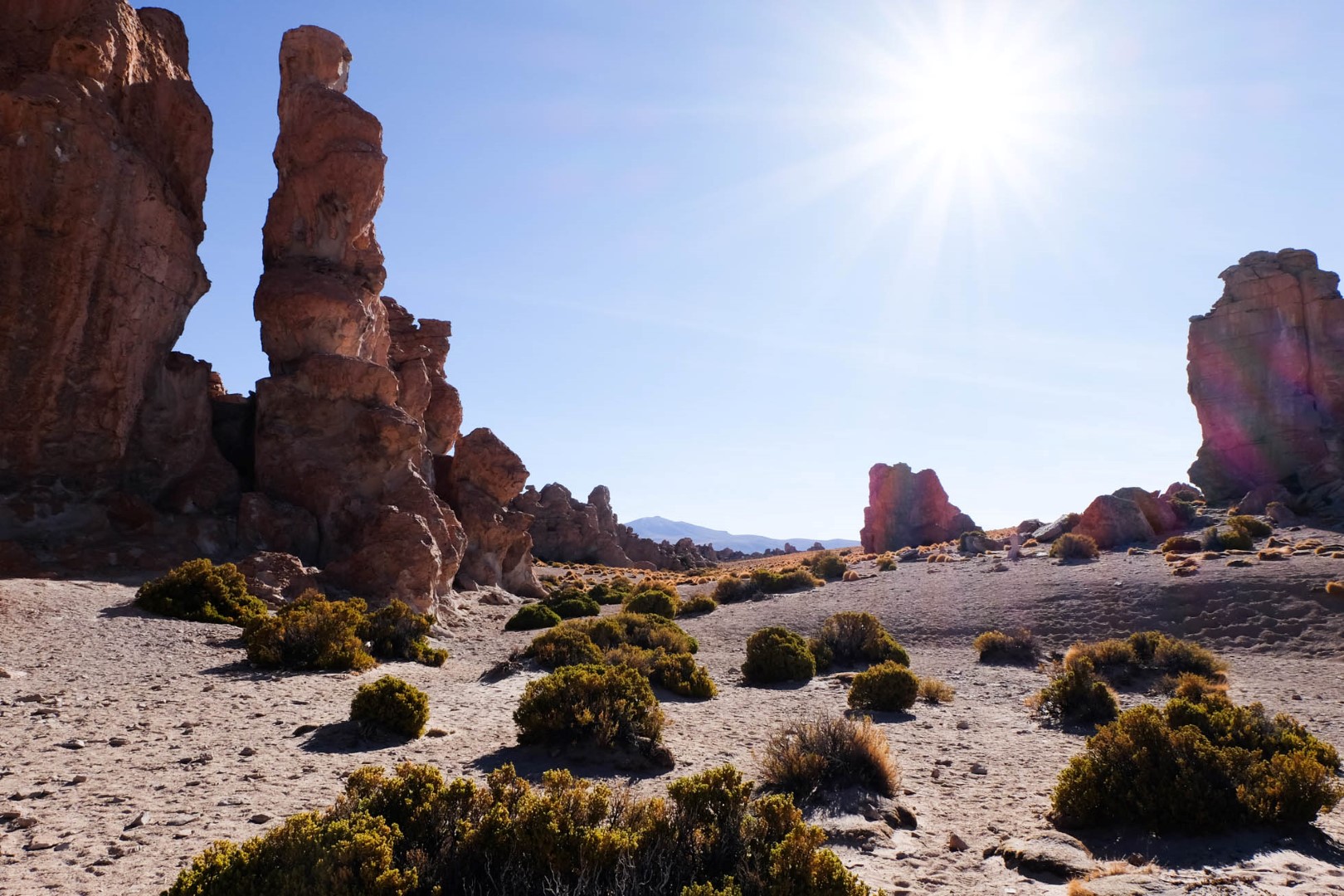
We spend the whole of this third day driving back to the town of Uyuni. On the way, we stop at the Valley of Rocks (Valle de Rocas), where fascinating formations rise like sculptures. Here another Brazilian couple joins our car.
For the long journey to Uyuni, we have found ourselves with extraordinarily interesting and enthusiastic companions. One of the men is a geographer, the other an English teacher. We discuss European countries, hear stories about Brazil, and listen as the English teacher explains the similarities and differences between Spanish and Portuguese. I have to struggle quite hard with the correct pronunciation of several Portuguese words, and he keeps teaching me until I get them right. The men, meanwhile, prove rather good at pronouncing Latvian, which they learn with great interest. The road passes almost unnoticed. At the end, one of the Brazilians says, “Ah, now I understand that all these problems with the jeeps have to be accepted as part of the Bolivian experience—and after all, these have been three unforgettable days.”
To sum up our three days in southwestern Bolivia: they truly were unforgettable! We covered 1,000 kilometres, most of them off-road. At times, our eyes could hardly believe how completely the landscape changed along the way. White salt earth, colourful lagoons, and volcanoes, volcanoes, volcanoes!
We will add a video of the tour soon!