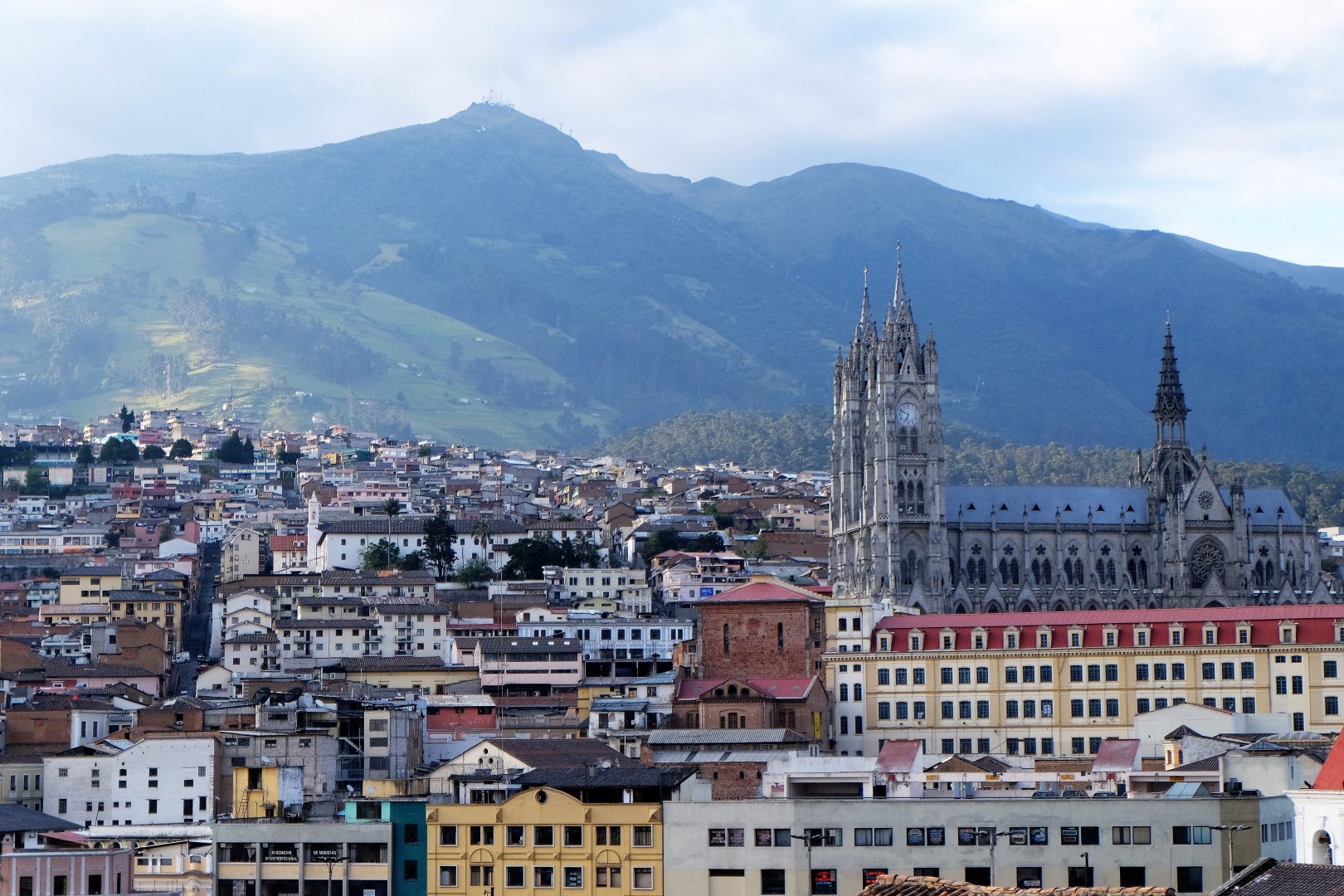
We say goodbye to our Pacific paradise in the village of Mompiche and set off for Quito, Ecuador’s capital. The city lies in an Andean valley at 2,850 metres and is home to 1.8 million people. Quito is not only one of the world’s highest capitals, but also the closest to the equator. More precisely, the imaginary line passes twenty-six kilometres from the city centre.
After a day on the bus, we reach Quito late in the evening. We are not fans of big cities, so we have allowed one full day to explore. For two nights, we have booked The Secret Garden, one of the most popular backpacker hostels in the historic centre. Women sitting beside a fountain on the ground floor gently inform us that reception is at the very top, on the roof. All right: carrying our bags, we climb a collection of staircases in varying widths. Somewhere in the middle—it is impossible to tell how many floors the building actually has—we lose our way and ask the next hostel guest where to find reception. The hostel occupies a colonial building whose labyrinth alone would justify a tour. Our reward for reaching the roof is a view across Quito at night, and delighted exclamations are unavoidable.
While I check in, a woman approaches the desk to ask the receptionist about her trip the following day. Something about the way she speaks seems inexplicably familiar. The man asks her name and she replies, “Dita.” I glance over and everything clicks: she might be Latvian. The other possibility is Lithuanian, which would still be remarkable, because in six months we have not met a single person from any Baltic country. I decide the mystery cannot be left unresolved. “Hi! Where are you from?” I ask. “Latvia.” “So are we!” Confused, I continue in English for a moment before gathering myself and switching completely to Latvian—which, to my surprise, makes me feel even more flustered. Although it is late, I invite Dita to sit with us in the café. She is exhausted after a long day on a volcano, however, and is staying at another hotel before an early flight to the Galápagos Islands. We say goodbye beside the reception desk and wish one another happy travels.
Interestingly, only a few days earlier I had wondered whether we truly would not meet a single Latvian. Being in precisely the right place at precisely the right time took six months. When you think about it, meeting another traveller from a country as small as Latvia, during a fleeting check-in at a hostel reception on the other side of the world, is a tiny miracle. And speaking Latvian felt so strange. Jānis and I naturally speak it together, but we understand one another from half a word and it is different. In the rush of events, I forget to ask Dita for any contact details.
The following morning, we have signed up for a free walking tour in the hope of learning more about the city than our Lonely Planet guide contains. Beforehand, we eat breakfast on the hostel’s rooftop terrace, where a message from Dita arrives. She asked the hotel reception for my full name and found me on Facebook. Wonderful! Meeting again in Riga would be lovely too.
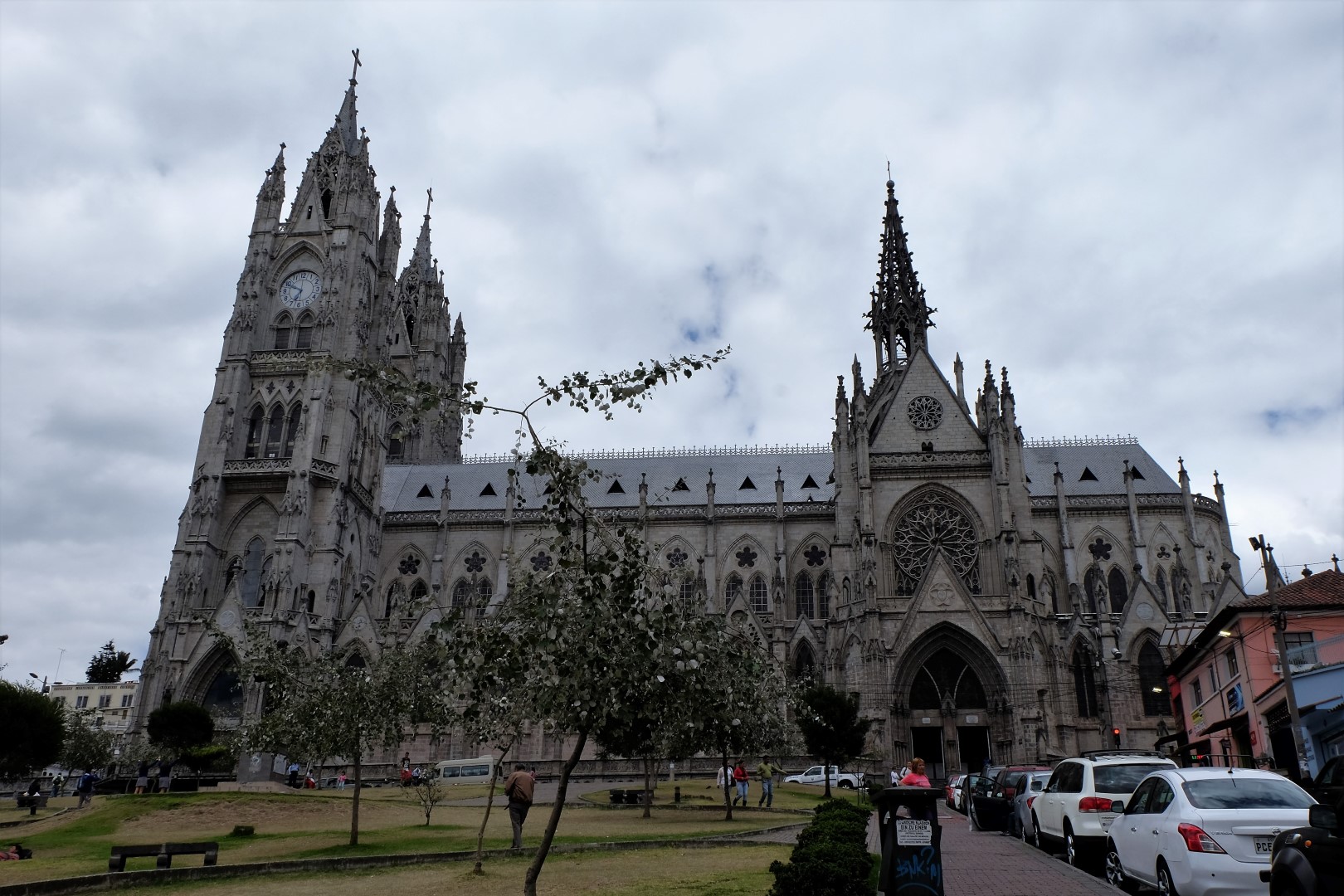
After breakfast, we gather at the hostel entrance and follow our guide into the old town, a UNESCO World Heritage Site. Its streets are covered in seventeenth-century façades, photogenic parks, and churches whose decoration combines Spanish, Moorish, and Indigenous elements. Our first stop is the Basílica del Voto Nacional. Construction of this neo-Gothic landmark began in 1926 and continued for several decades. It is the largest building of its architectural style in the Americas. The basilica is also known for its unconventional decorative motifs. Instead of typical Gothic imagery, its ornament depicts wildlife and plants from the Pacific coast and Galápagos Islands: turtles, several species of monkey, armadillos, seabirds, and other animals.
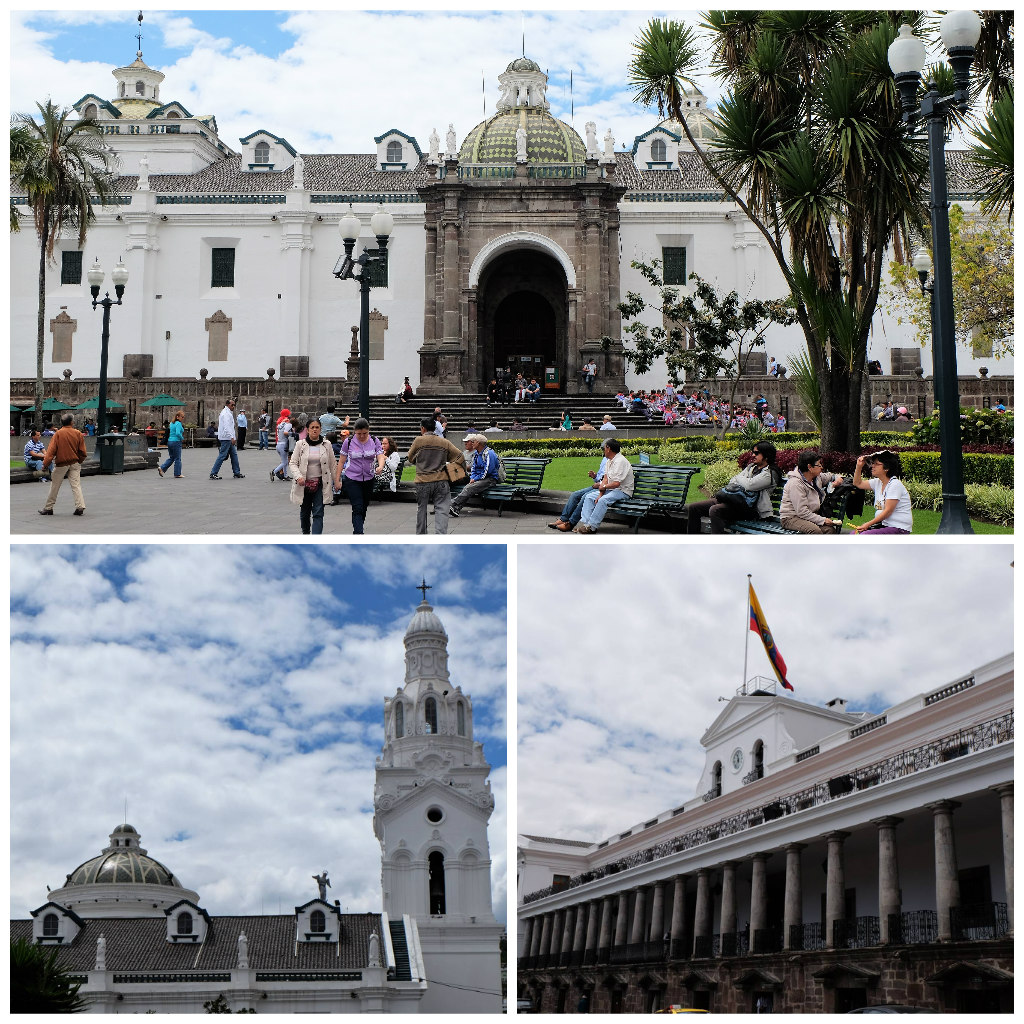
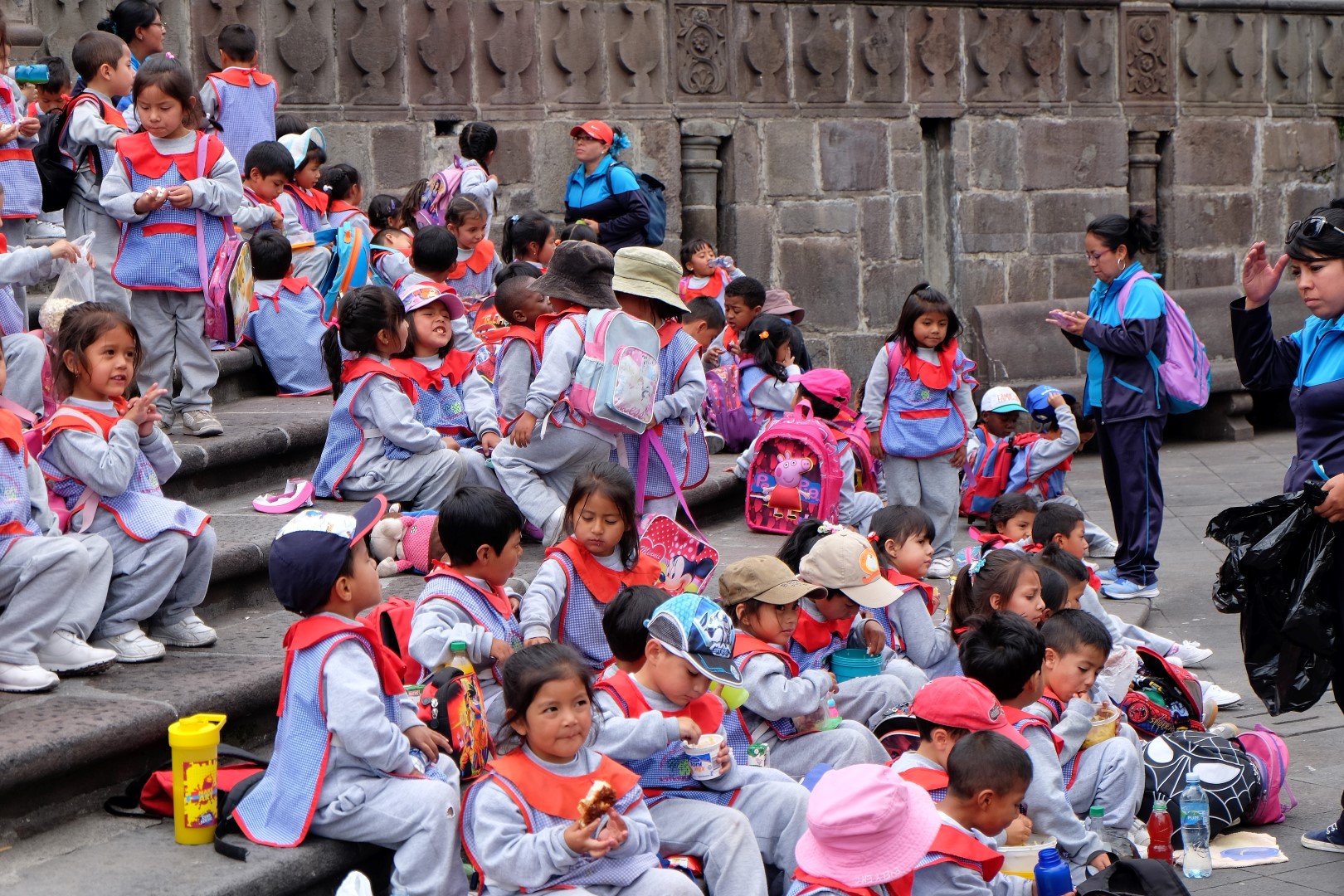
We continue to Plaza Grande at the heart of the old town. Quito’s most important buildings surround it, including the government palace and the Catedral Metropolitana, where religious art by members of the Quito School can be seen. While we are there, dozens of identically dressed nursery-school children sit on the cathedral steps eating their mid-morning snacks.
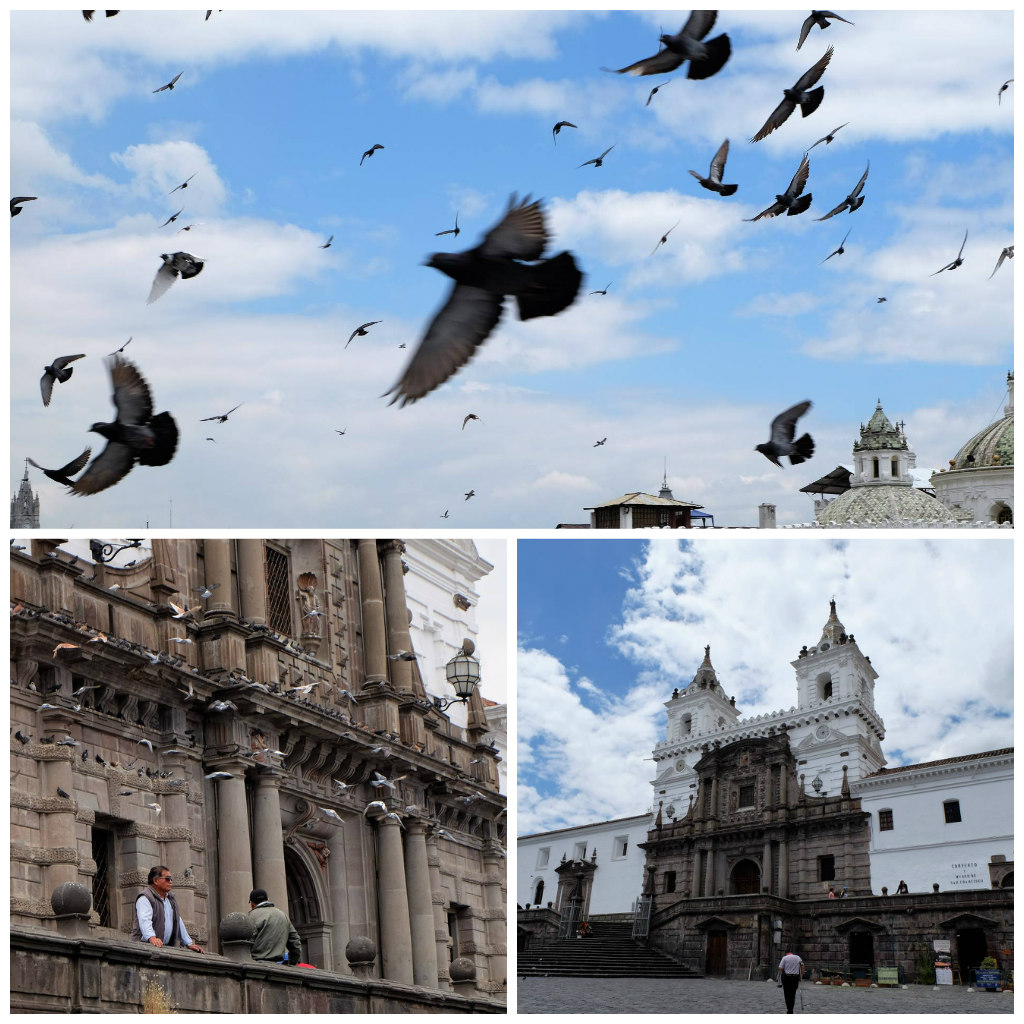
We also walk past the monastery and church of San Francisco, the city’s oldest church, built between 1534 and 1604. A great flock of pigeons gathers in the square. A magical moment comes when a little girl startles them and they rise into the air.
Quito’s old town bears little resemblance to the calm, quiet streets of Riga’s historic centre during the day. Here, activity never stops: street vendors with movable stalls, pedestrians, honking taxis and minibuses, and the whistles of traffic officers. Curiously, renting or buying a flat in the old town is considerably cheaper than in Quito’s newer districts. The explanation lies mainly in the layouts of the old buildings and the historic centre’s infrastructure. Local people find modern districts more convenient, with easy access to supermarkets, restaurants, and every other contemporary amenity.
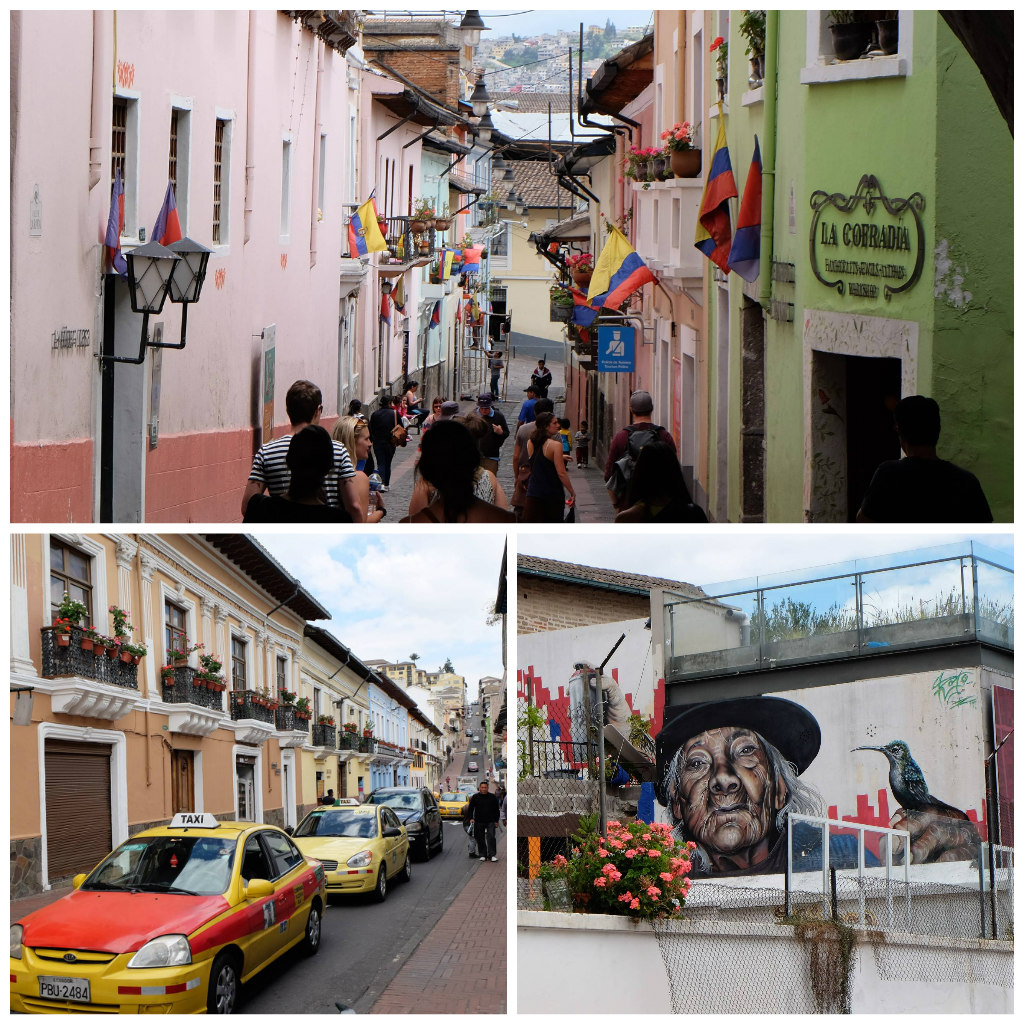
Our tour ends on one of Quito’s oldest streets, La Ronda: a narrow lane lined with beautifully restored colonial buildings that was once popular among bohemians and artists. Here, the group disperses in every planned direction. Following the guide’s advice, we sample Quito’s best ice cream at an attractive café on La Ronda. I cannot say the tour taught us anything unavailable in a standard guidebook; we have experienced better free walking tours elsewhere in the world. Even so, such tours are a good way to see a city’s essential places efficiently, pay the guide whatever amount you choose, and meet fellow travellers.
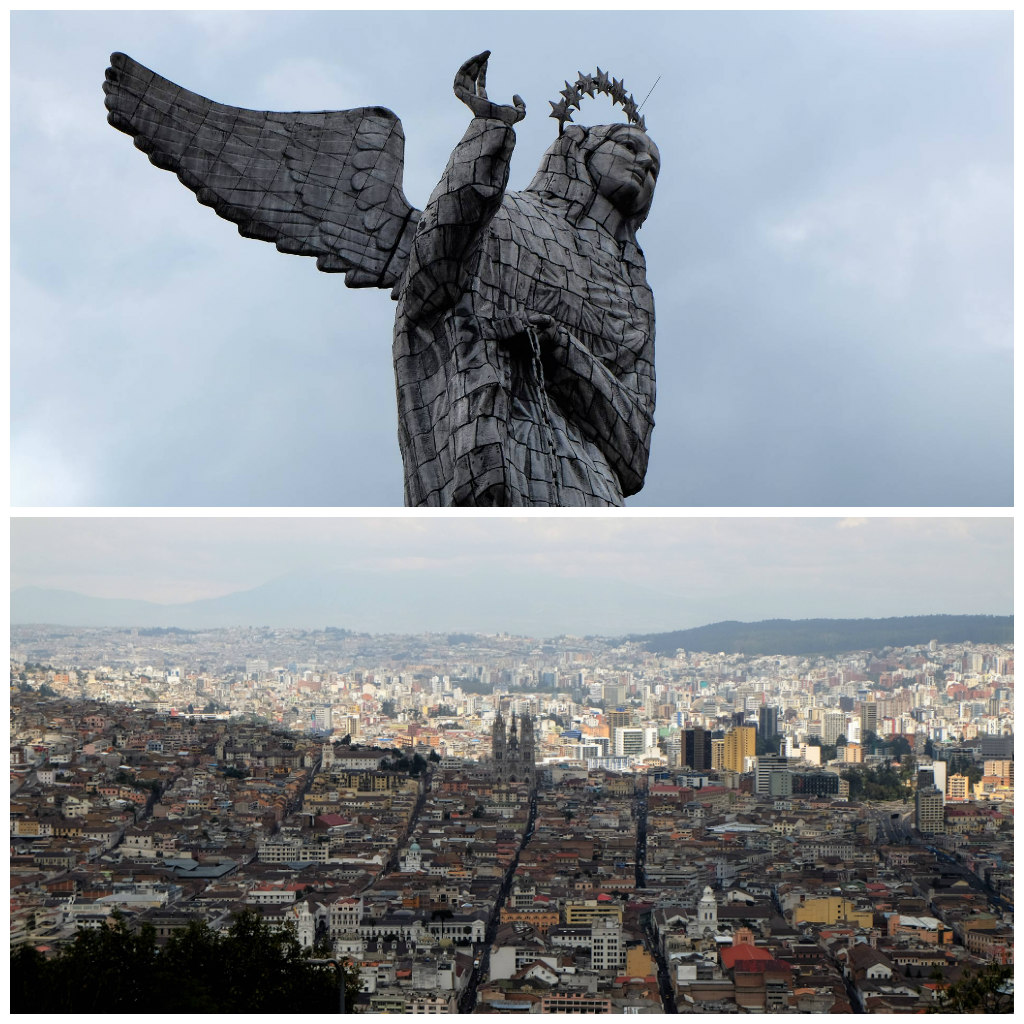
Later, we catch a taxi up El Panecillo, the hill at the centre of Quito. At its summit stands the Virgin of Quito, overlooking and blessing the city. From the foot of the forty-five-metre monument, its scale is especially striking. We admire Quito’s panorama from the hill: the valley is covered with buildings as far as the eye can see. Early morning is the best time to come, before clouds settle over the city; then the volcanoes surrounding the valley are visible too.
We consider walking down but have been warned about frequent theft in the area. Like every large city, Quito has neighbourhoods where there is no reason to take an unnecessary risk, so we choose a taxi. It proves to be an excellent decision. When the driver notices that we can speak Spanish, he becomes extremely talkative, and the journey feels like a second city tour. The young man knows a great deal about the buildings of the old town and tells us about local residents as well.
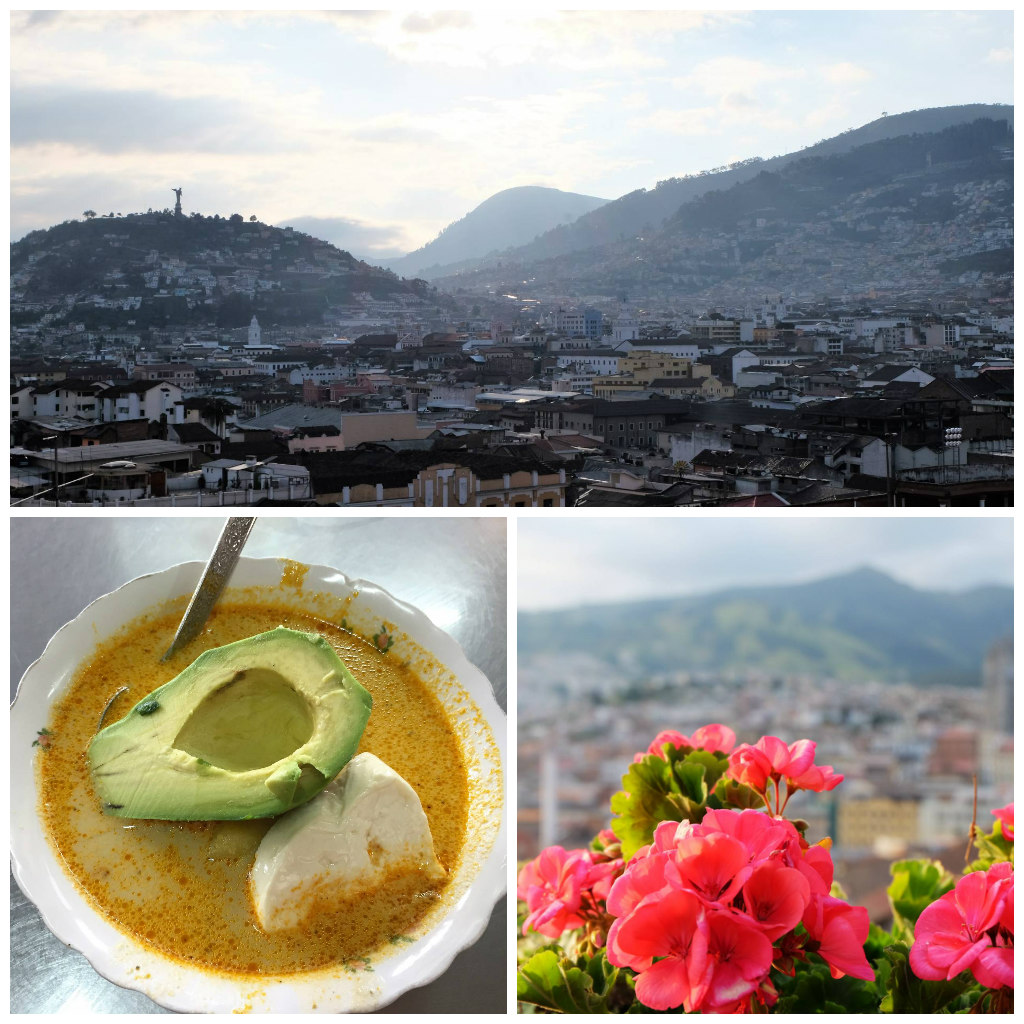
He drops us at the central market, where good, inexpensive traditional dishes can be found. We choose a vegetarian soup with avocado and fresh cheese called locro de papa. Despite its simple appearance, tasting it becomes an explosion of flavour. The creamy soup and fresh juice are so filling that they are quite enough. Our market-food tasting ends there, and we return to the hostel.
We spend the afternoon on the terrace talking with travellers we met on the morning walk. It seems at least half of everyone in Quito is heading directly to the Galápagos Islands. The other half have just returned or plan to explore mainland Ecuador’s tourist highlights: Mindo, Otavalo, Cotopaxi volcano, and others. We know that we should be in Medellín, Colombia, at the beginning of December. With only a few days left, beginning the journey north would be logical. On the other hand, nothing is set in stone, and I begin thinking that perhaps we should still rush around several more places in Ecuador so that I can leave with a peaceful mind. Jānis does not care for this idea. Earlier, we had agreed not to visit the Galápagos on this trip, but in Quito—where every traveller talks about nothing else—my resolve begins to change. Jānis suggests that I go alone, which would also give him a week’s respite from the endless activities I invent. I sit and think. If I am going, I essentially have to buy a flight and plan everything for the following day within the next two hours.
Now would be the ideal moment to visit the Galápagos. Any future trip would require returning to Ecuador, which would be much less convenient from Latvia. In the end, however, I decide our journey is already magnificent enough and that wanting everything does not mean needing everything. The usual consolation at moments like this: we will go to the Galápagos another time. So what shall we do tomorrow? Travel to Colombia. A few words with the people around us, and within minutes we have found a Swedish companion following the same route.