Bolivia is divided between the dizzying heights of the Andes and the jungle. In both regions, the landscapes are immense, making the country a wonderful destination for experiencing unspoilt nature. Bolivia is the only large country in South America without access to the ocean. It lost four hundred kilometres of Pacific coastline in the War of the Pacific against Chile (1879–1883). Bolivia also has the highest proportion of Indigenous people in Latin America, so admirers of culture and history will not be bored either. We spent six weeks in Bolivia, including the period when we worked at CIWY (our route is shown on the map). Two weeks would be enough for the popular western part of the country, including the Salar de Uyuni. If you also want to visit the jungle, allow at least three or four weeks.
Facts about the country
Area: 1,098,580 km²
Population: 9.8 million
Languages: Spanish, Quechua, Aymara
Currency: Bolivian boliviano (1 BOB = €0.13)
Capital: Sucre (constitutional), La Paz (administrative)
Interesting and useful things to know about Bolivia
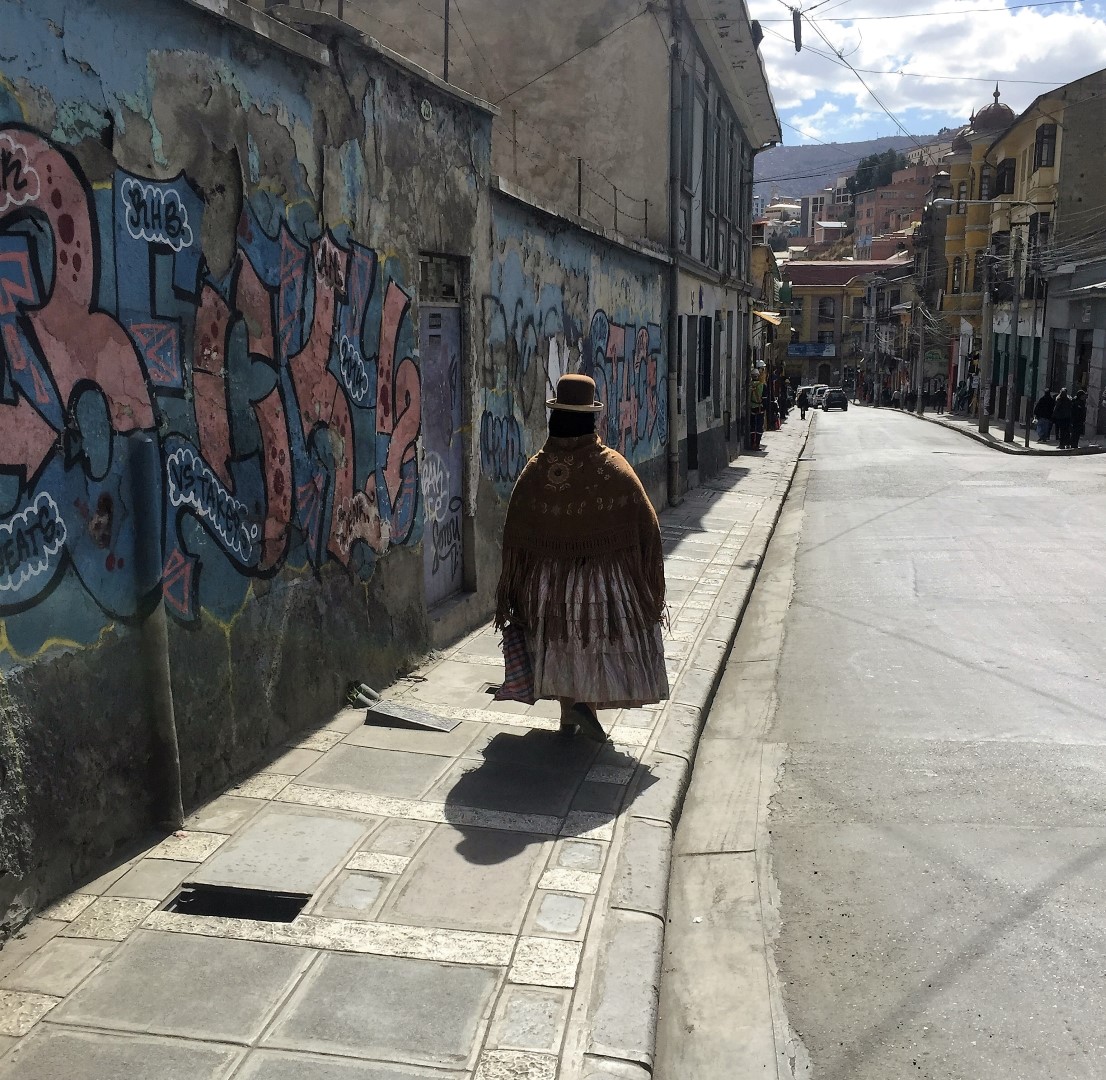
Cholitas. Picture modern Bolivia and its growing cities: tall buildings, traffic, and pedestrians walking with their heads lowered towards smartphones. Something in the scene is unusual, though. Women in bowler hats and full skirts look as if they have stepped out of a century-old story. Cholitas are women who historically migrated from rural areas to earn a living in the cities. Most worked as domestic servants and were regarded as lower-class people. A cholita was not permitted, for example, to enter La Paz’s main square or walk through its wealthier districts. Only a few decades ago, they faced discrimination that prevented them from taking taxis, using public transport, or entering restaurants. That has changed, and today there seems to be pride in being a cholita and showing one’s identity through clothing. Like everyone else, cholitas can be seen in city cafés, selling fresh juice on the street, or chatting on the telephone. Fashion varies over the years, but essential elements include a bowler hat, a heavy fringed blouse, a shawl or wrap, jewellery, and—most importantly—full, layered skirts designed to make the wearer’s backside appear larger.
Delightful prices. Compared with the rest of South America, Bolivia is one of the least expensive countries in which to travel. Arriving directly from Europe would make its prices seem even more astonishing. Everything a traveller needs—food, water, accommodation, and bus tickets—can be found affordably. If something goes wrong with your camera, phone, or high-tech hiking equipment, however, this is not the country in which to solve it. Such products, especially electronics, cost even more than in Europe. Here are a few examples of everyday purchases:
- Water (400 ml): 0.50 BOB = €0.07
- A glass of freshly squeezed orange juice: 2 BOB = €0.27
- A lunchtime menú with soup, a main course, and a drink: 10 BOB = €1.35 per person
- Dinner in an average restaurant: about 35 BOB = €4.60
- A private room in a budget hotel in La Paz: 140 BOB = €19
- A ten-hour bus from La Paz to Uyuni with a seat reclining to 180 degrees: 120 BOB = €16 (depending on quality, a useful estimate is about 10 BOB per hour of travel)
Bags of water. A distinctly Bolivian product is the little plastic bag containing four hundred millilitres of drinking water. Tap water is not safe to drink; in the jungle, it is best not even to brush your teeth with it. We consume a great deal of bottled water every day, and the unpleasant by-product is a pile of plastic bottles. A bag is much more economical at only 0.50 bolivianos, or seven euro cents, and it uses less plastic. Locals bite off a corner and drink directly from it; I use the bag to refill my bottle. It also takes up far less space in a backpack, which is useful on a hike.
Mad drivers. If traffic seemed wild when we arrived in Peru, Bolivian drivers outdo Peruvians twice over. They do not trouble themselves excessively about safety because their cars have been blessed by a priest—protection on which they apparently rely completely. Poor roads are an added bonus. On winding mountain routes, I freeze each time a bus driver overtakes another vehicle at a blind corner. Once, in a taxi, Jānis instinctively reached for a seat belt that did not exist. The driver merely laughed: “Mate, this is Bolivia.”
Strikes and parades. Bolivians, especially miners, love to strike, and they do not simply walk around carrying signs. They block the country’s most important roads, including those leading to border crossings, and take keys from bus and lorry drivers to cause maximum disruption and, in their view, make themselves heard. We encounter roadblocks twice. One affects our journey into Bolivia; the other nearly disrupts our return to Peru. Parades are another regular part of daily life. Most are connected with the church: somebody carries a cross at the front, followed by several groups of people in their finest clothes. We see processions both large and small. Their choice of route is puzzling because apparently nothing is coordinated, and important city roads simply close while a parade passes. On the way to La Paz bus station, for example, we skirt yet another procession crossing the city’s main artery and causing a substantial traffic jam. Once aboard the bus, we hear the marchers approaching and joke that we need to leave quickly if we are to escape the station in time. Sure enough, as the bus pulls out, the parade is directly across the road we need, and all we can do is wait.
Toilet paper. Something you must carry everywhere, at all times. Even in respectable cafés, toilet paper is rare; the same may be true in cheaper hotels. It is perfectly normal for everyone to take their own roll from a bag before visiting the bathroom. A paid toilet will give you a small piece.
Coca leaves and cocaine. Around 1.2 million kilograms of coca leaves are consumed in Bolivia every month, and in 2009 President Evo Morales even declared them part of the country’s traditional heritage in the constitution. Fields and forests have been converted into coca plantations because the leaf is more profitable and less troublesome than fruit or vegetables. Traditionally, coca leaves are chewed for energy—or, more precisely, chewed briefly and then held inside the cheek. They have a neutral flavour that becomes more bitter over time and are genuinely rich in minerals. Coca tea is another equally popular use. Not all of the crop is consumed traditionally, however. Between 24,000 and 30,000 hectares of coca are cultivated in the country, of which only 12,000 hectares supply the legal market for unprocessed leaves. Bolivia ranks as the world’s second- or third-largest producer of cocaine, with an estimated 290 tonnes of white powder made each year. Its manufacturers presumably live well, but users should take care: possession or consumption results in a prison sentence. And just imagine a Bolivian prison.
Slow internet. Connection speeds are not encouraging, especially when you need to make Skype calls or upload and download files. On a simple two-week holiday, the inconvenience is tolerable. Jānis finds a solution for his daily Skype conferences: mobile data. The 3G connection offers reasonable speed at an affordable price.
Altitude. Every part of the country outside the jungle lies in the Andes. Altitude is unavoidable because all the major cities are in the mountains: La Paz stands at 3,650 metres and Potosí at 4,090 metres above sea level. Visitors arriving from sea level may develop altitude sickness. It can affect anyone, regardless of age, health, or fitness, causing nausea, vomiting, headaches, and other symptoms. We must already have acclimatised in Peru because our only symptom in Bolivia is a mild headache after the rapid descent down Death Road from 4,700 metres. One man in our group misses the ride completely because he feels too unwell. Acclimatisation is the best way to avoid altitude sickness. Coca leaves or coca tea can help too. If you know that you will travel somewhere high the next day, coca tea and plenty of water are useful preparation.
Tourist visa. There is no need to arrange a visa in advance. On arrival—at a border crossing or airport—you receive a passport stamp and an immigration slip, and the first thirty days are free. To stay longer, visit an immigration office in one of the larger cities; another thirty days will be granted without charge.