We get up at 2:15 and tumble out of the house towards Arequipa bus station, bound for Cabanaconde, the starting point of our three-day hike. The mood is cheerful, as it always is when an adventure in nature lies ahead. Canyon hikes are my favourites too. And it is Jānis’s name day! Our excitement grows further because Colca Canyon is among the deepest in the world, falling only slightly short of Cotahuasi Canyon in the same region.
The road and what we observe
The only sign of the early hour at Arequipa bus station is the people asleep in its chairs. They spent the night here waiting for their buses. Otherwise, small shops selling snacks and drinks for the long journey are doing brisk business, and the terminal is full. Given the vast distances, overnight buses are common. We wait at our designated platform and watch the other passengers. Most are elderly women wearing clothing typical of the Colca region, with large bundles on their backs. Each “bundle” is a sizeable woollen blanket decorated in traditional bright patterns and twisted with a special technique to hold its contents. I had already noticed that women carry everything such a wrap can contain: children, fodder for animals, potatoes, and more.
The bus journey from Arequipa to Cabanaconde takes about six hours despite covering only 215 kilometres. In a straight line, the towns are one hundred kilometres apart, but the Andes, volcanoes, and canyons make a more direct road impossible. Jānis wakes from time to time and checks our altitude. On average, we travel across mountains 4,000–5,000 metres high. We have already experienced altitude sickness, so yesterday we took Sorojchi Pills, medication that reduces its nausea and headaches.
As we approach Chivay, proper commotion begins aboard the bus. It stops beside the road every ten minutes, collecting and dropping local people travelling between villages. Each woman carries not only a bundle on her back but a large sack of potatoes or other home-grown produce. Big sacks are not permitted in the cabin. Through the window, I watch them being loaded into the luggage compartment and returned to passengers as they leave. This continues all the way to Cabanaconde and is the main reason the journey takes so long. I find the final section fascinating: I look at the GPS and marvel at the number of surrounding volcanoes; study the women’s clothes and hats; observe how local people communicate; and watch children sleeping comfortably against the backs of their mothers and grandmothers, wrapped in traditional blankets.
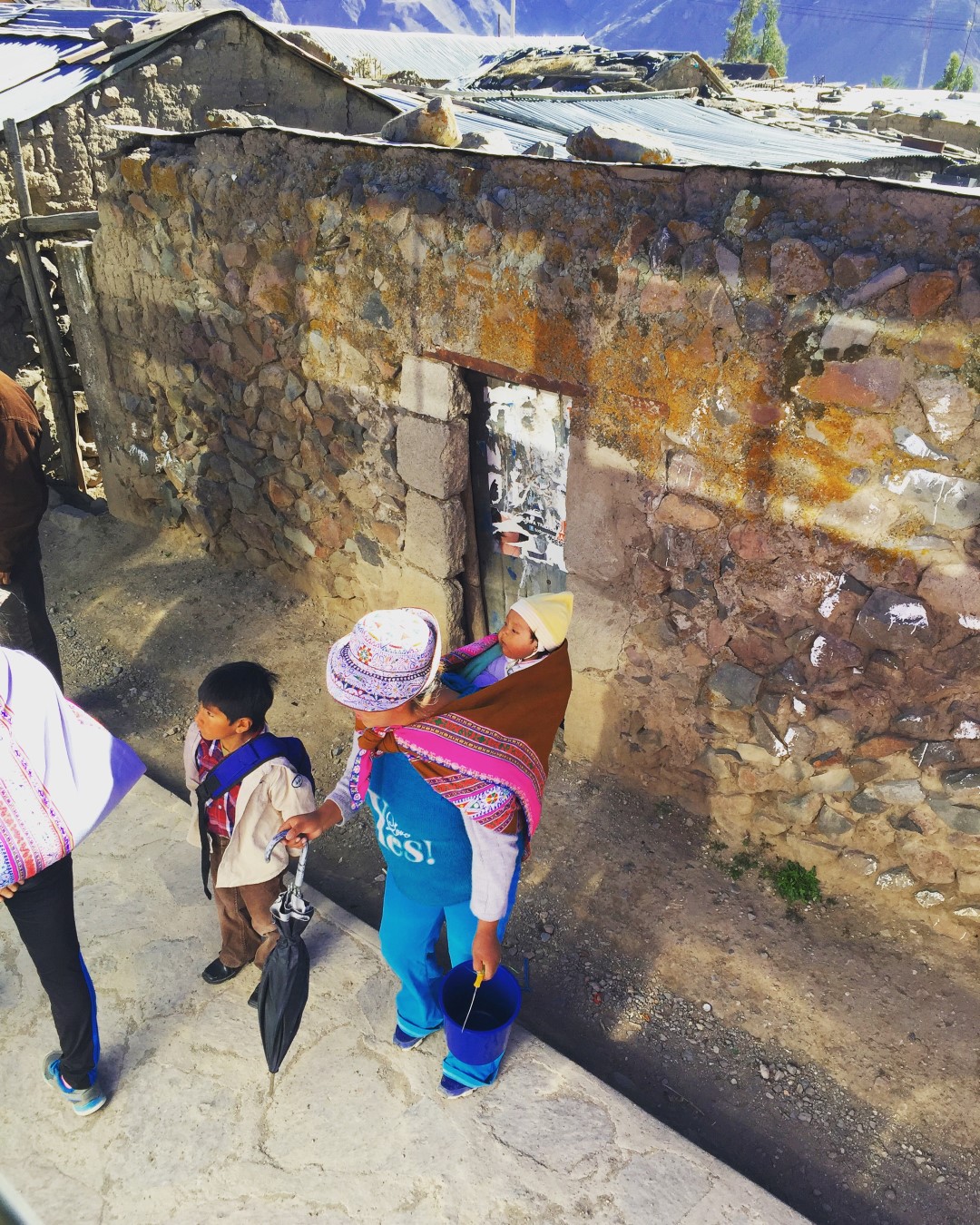
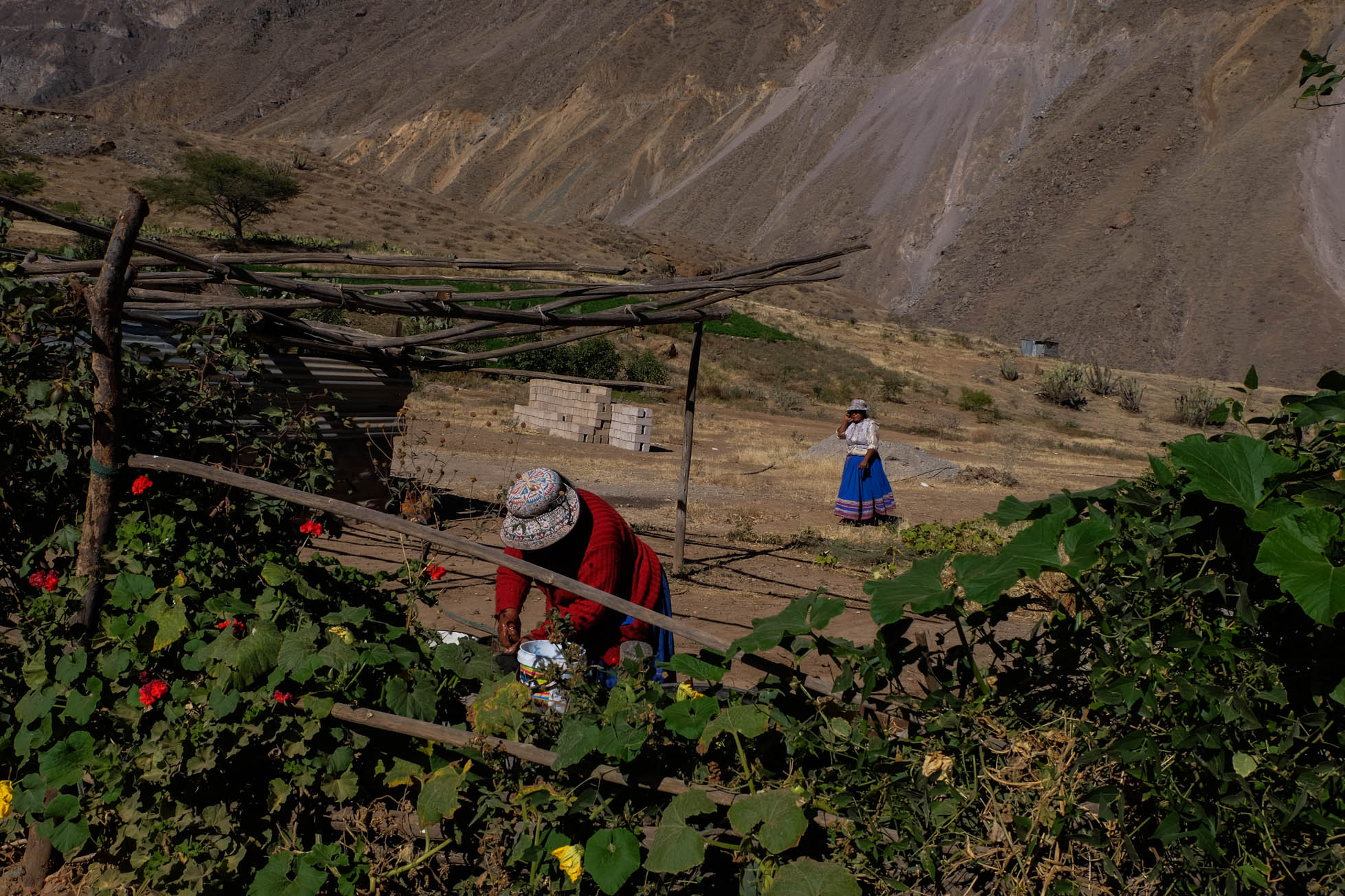
I notice that women on the bus wear two types of hat, indicating which ethnic group they belong to. The white hat is characteristic of the Collagua, who live in villages in the lower part of Colca Canyon, while the flower-embroidered hat belongs to the Cabana of the upper canyon. Intriguingly, before the Spanish conquest and interference in local culture, intermarriage between the Collagua and Cabana was forbidden. To distinguish the groups, each culture practised a different form of cranial deformation. One elongated the skull; the other flattened it. Sticks were tied to an infant’s head until its skull was permanently reshaped. Before learning this, I examined a mummy in an Arequipa museum and could not understand why its skull was so long, almost stretched upwards. When the Spanish arrived, they declared cranial deformation unacceptable and prohibited it. Clothing—specifically the hats still worn today—became the distinguishing sign instead. The two cultures may now intermarry. A child becomes Cabana or Collagua according to the mother’s ancestry, and little girls continue wearing the magnificent hats of their mothers and grandmothers.
Cabanaconde and Colca Canyon—Day 1
At last, we reach Cabanaconde. We eat a quick breakfast in a hostel café staffed, like several others we have seen, by volunteers from different European countries. In my opinion, it is a wonderful opportunity for budget travellers.
We begin the hike. Our chosen three-day route spends the first night in Llahuar and the second in Sangalle. We selected it because we will see a geyser and hot springs along the way, and because it is less popular. The route in the opposite direction attracts more people, probably because organised groups use it. Every Peruvian town has countless tour companies offering excursions. The prices are reasonable and the convenience valuable to people with limited travel time or no desire to plan for themselves. For this hike, however, I believe we gain by walking independently, at our own pace and with complete freedom over where to go—especially when route maps are available.
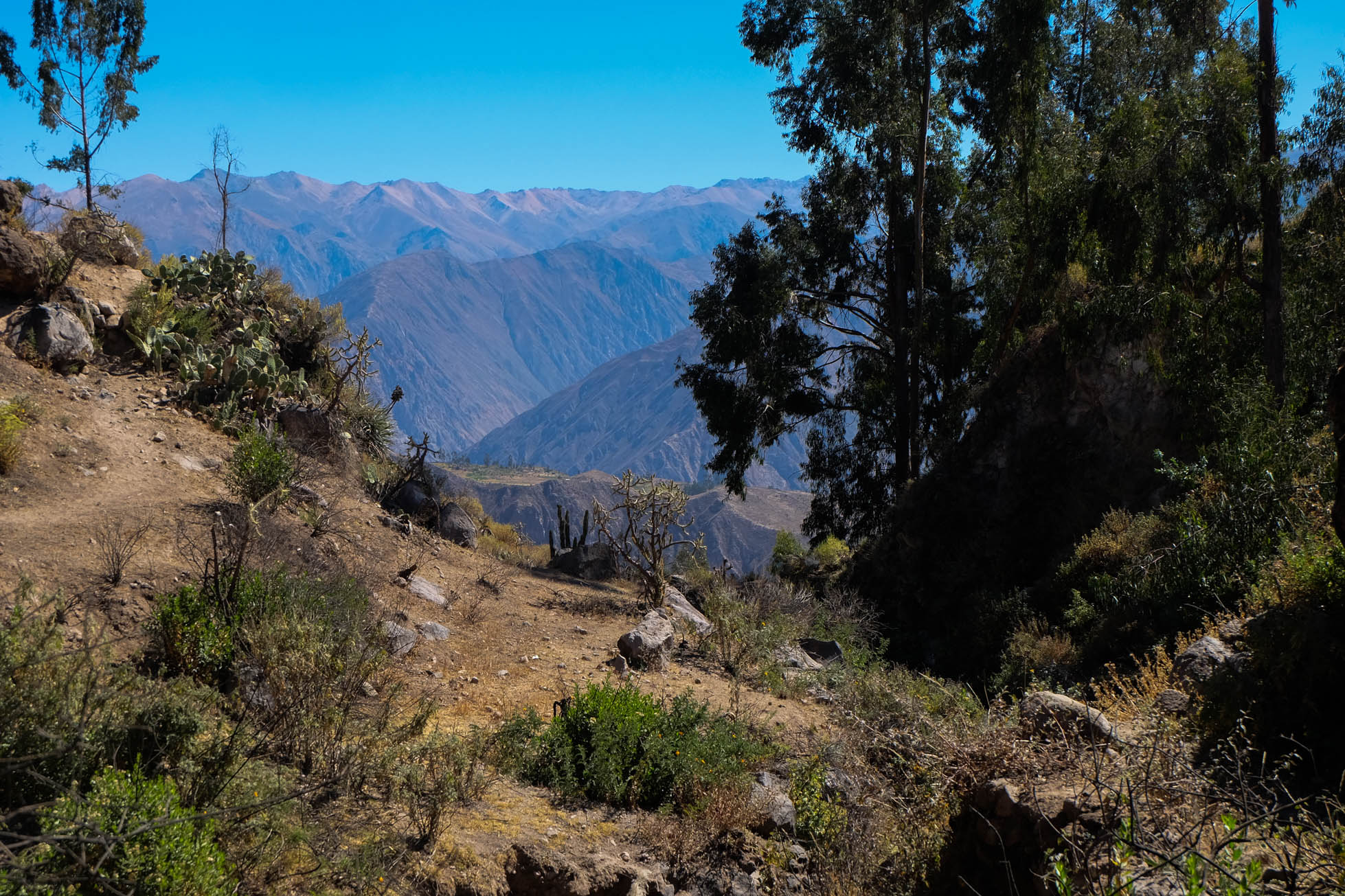
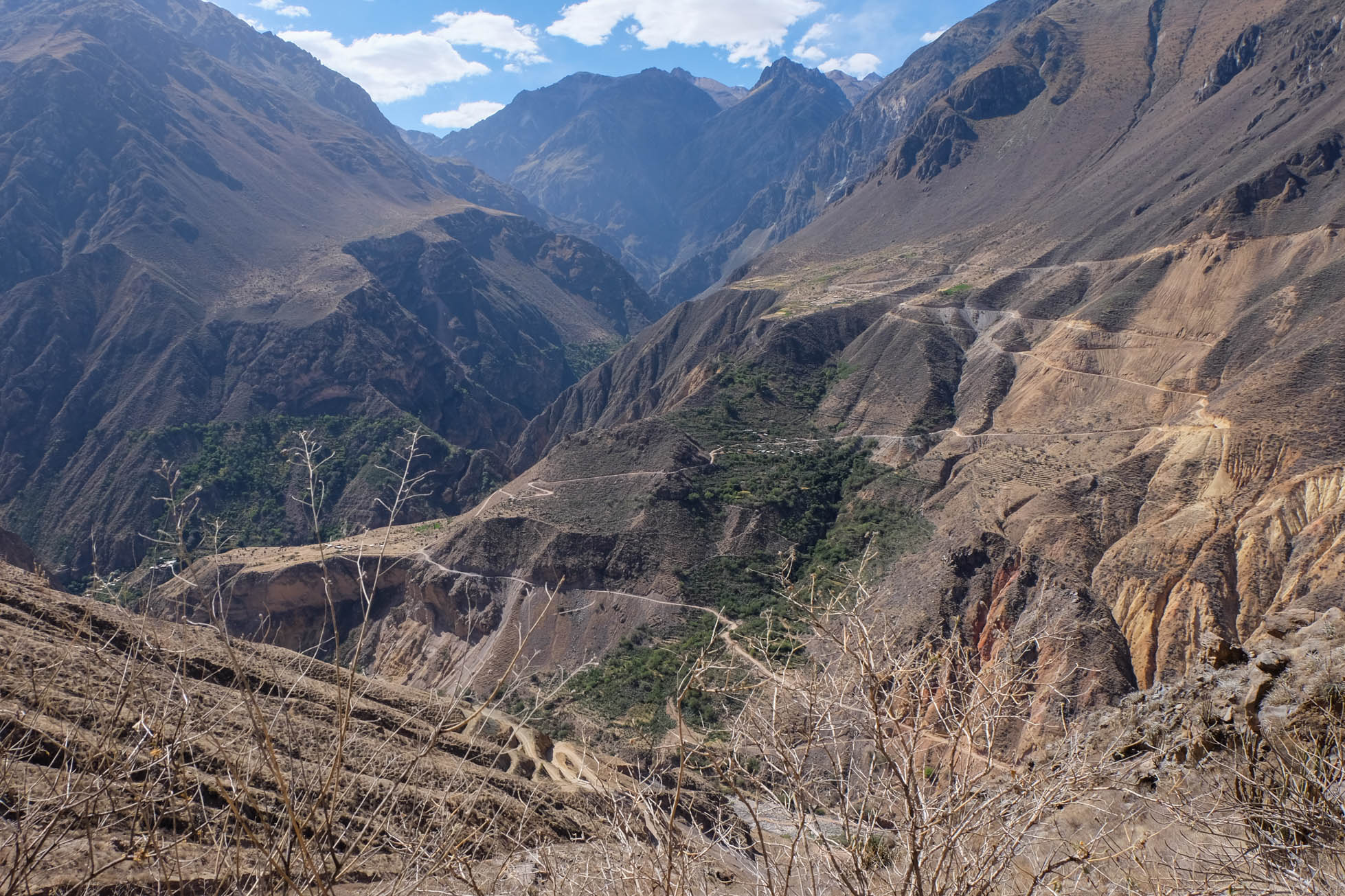
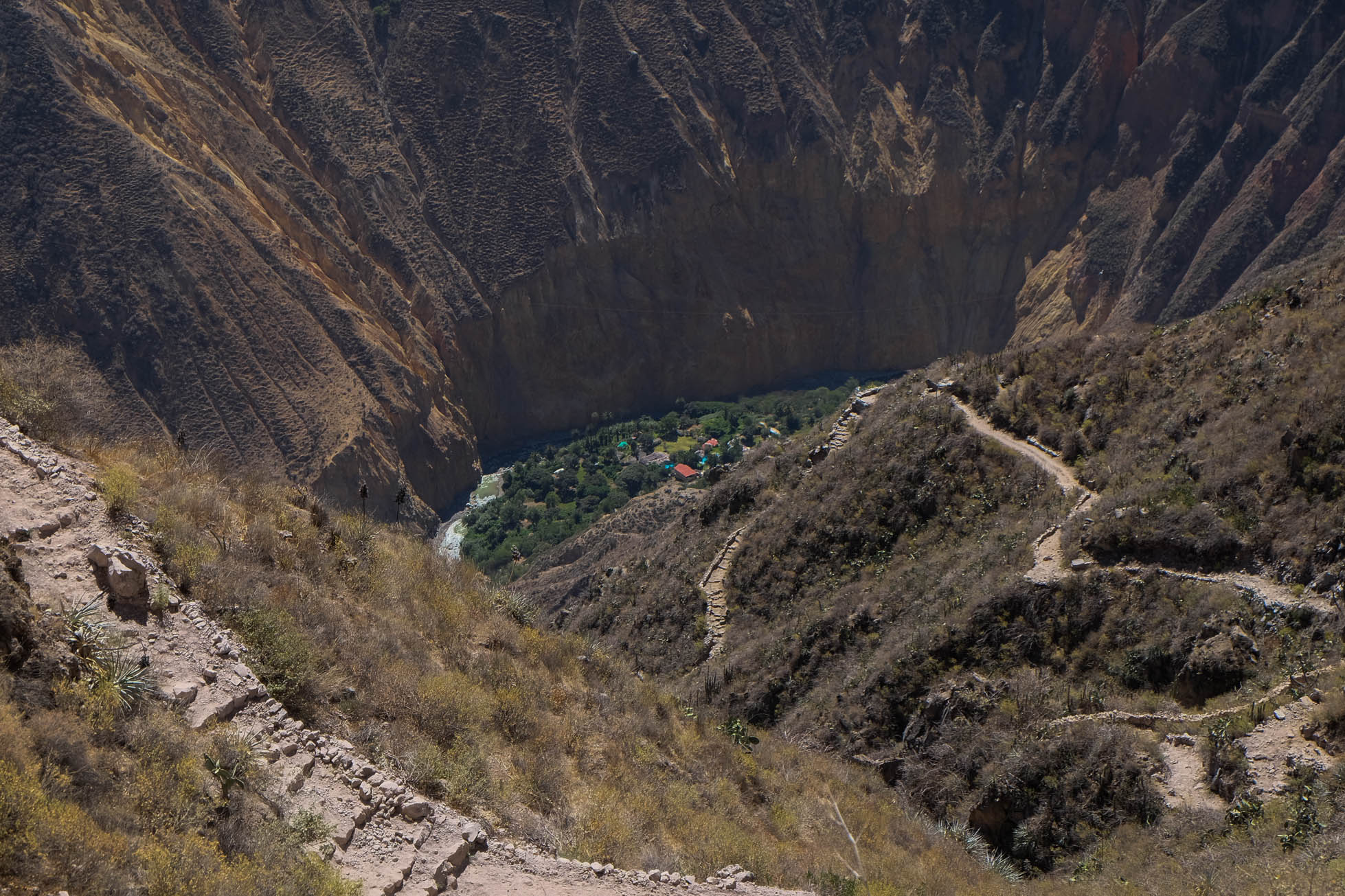
At first, the trail follows the top of the canyon, and our only companions are lizards and untethered cows. We then reach the first viewpoint, Mirador Achachiwa, which reveals the canyon’s impressive depth. From above, we can see today’s path winding down, making orientation very easy.
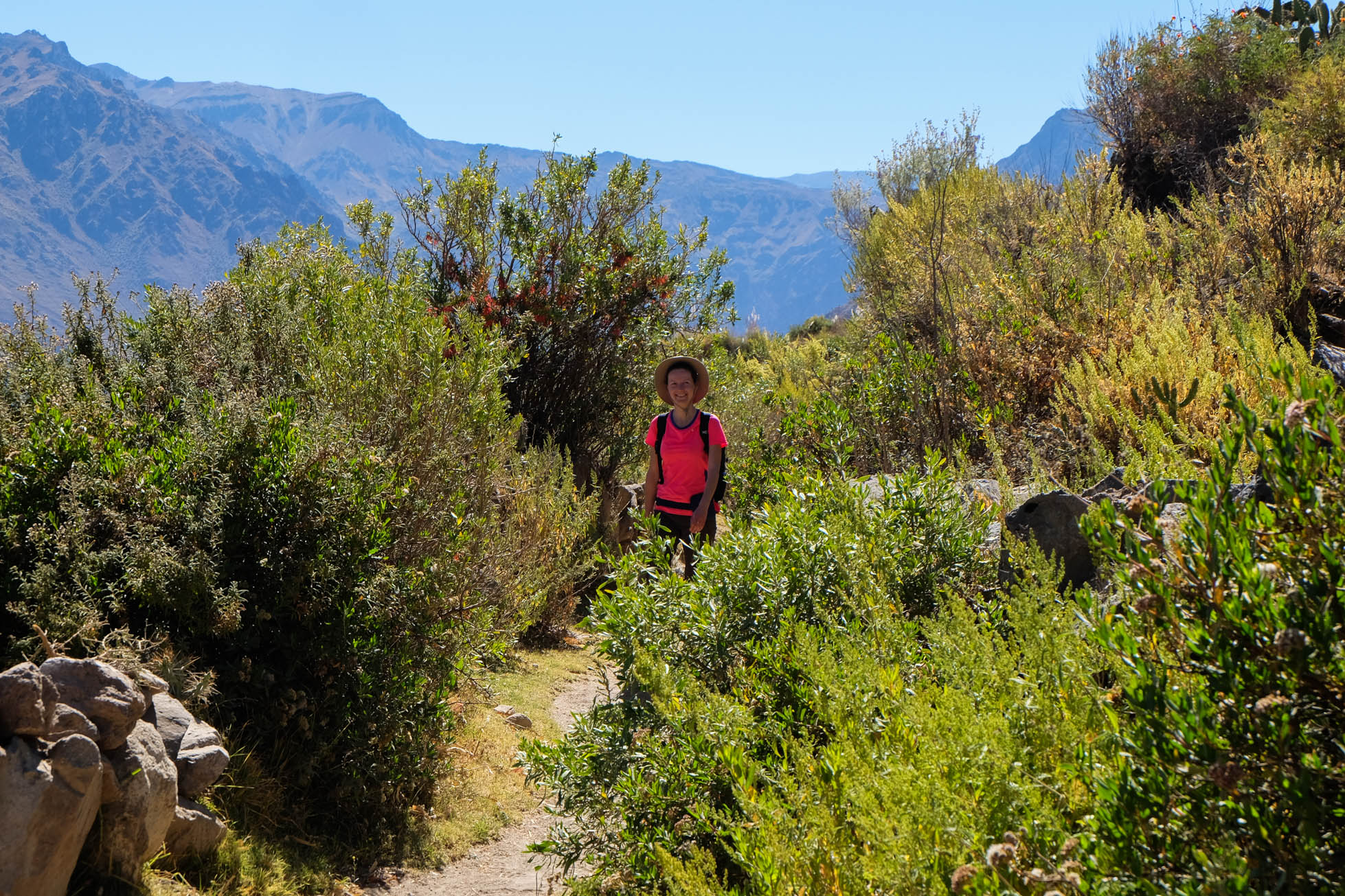
The walk that follows is relatively simple: theoretically, it is all downhill, although our feet periodically slip on the steep trail and the sun bakes us fiercely. We greet and pass other travellers sitting down to rest. A local elderly man is explaining something to them intently. Along the way, I look for plants that could be used in Jānis’s celebratory wreath, but I do not want to choose anything poisonous. Before the hike, I read a warning to avoid touching a plant whose name I cannot remember; there was no photograph. I observe the vegetation and identify one common shrub that looks suspicious. After hearing this, Jānis releases me from my wreath-making duty, because he has no more confidence in my knowledge of Peruvian plants than I do. He says I may weave one only from cactus—there are plenty here—but that would be too complicated. Yes, once again comes the travelling moment when every day reminds you how much there is to learn and how little we know. Perhaps moments like these are one of the principal forces driving travellers to keep striving, exploring, and discovering.
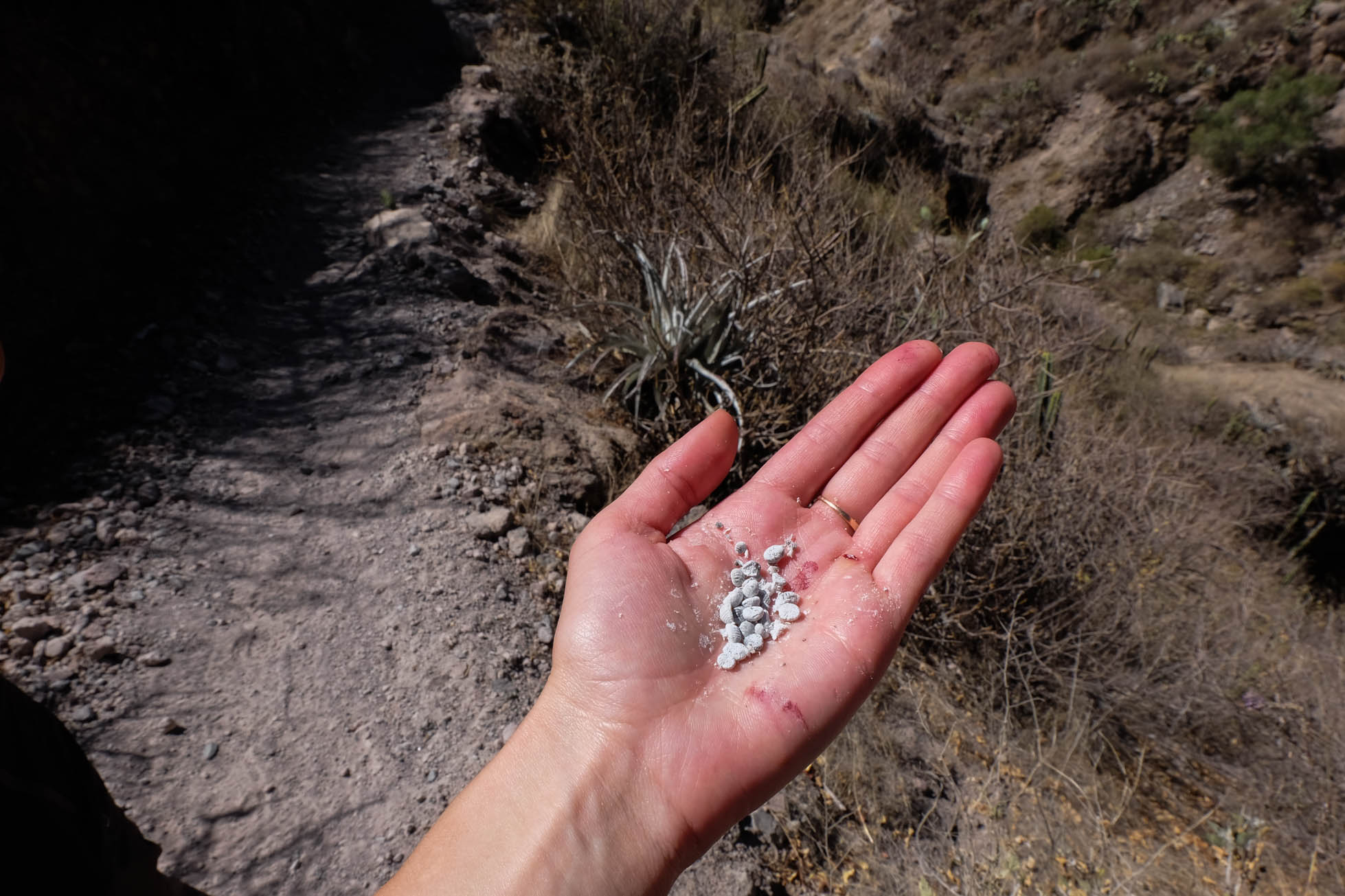
Jānis does not remain entirely without a festive decoration. I spot a cactus hosting cochineal, the scale insect used to make red dye for cosmetics and textiles. (Yes, ladies, if you own red lipstick, there is a fair chance that its colour came from cochineal.) I collect several dots and draw red stripes on Jānis’s cheeks, a Latvian flag on mine, and a sizeable pattern along my arm. Cochineal is valuable, so Latin Americans have devoted themselves seriously to cultivating it. Terraces throughout Colca Canyon contain cactus plantations bearing these insects.
At some point, the elderly man catches up with us. Exactly: local people know how to move efficiently along these paths. He greets us and begins talking in rapid Spanish. We walk together for a while. He explains how to find the geyser, then points out the plant we should not touch. Its milky sap must never enter the mouth. He even demonstrates the plant’s “milk” by striking a branch with his stick until it breaks. Incidentally, I correctly identified the poisonous shrub earlier. He also points to a cliff where a condor nests. Every so often, he looks up towards it; each time, I follow his example, hoping to see the majestic bird. The man stops and gestures into the distance with his stick. “There, the canyon is shaped like a corazón—a heart.” We look, and it truly does resemble one. Neither words nor photographs can describe the view. He also points out a gold mine and shares more wisdom, but at this stage, our Spanish is not sufficient to understand everything. We continue on the main path, while the man turns onto his personal shortcut. Soon, he is many zigzags ahead. We are grateful for everything he taught us. One thing I greatly respect in Peruvians, as in Latvians, is their reverence and admiration for nature, their knowledge of plants, and the way they pass it to their children.
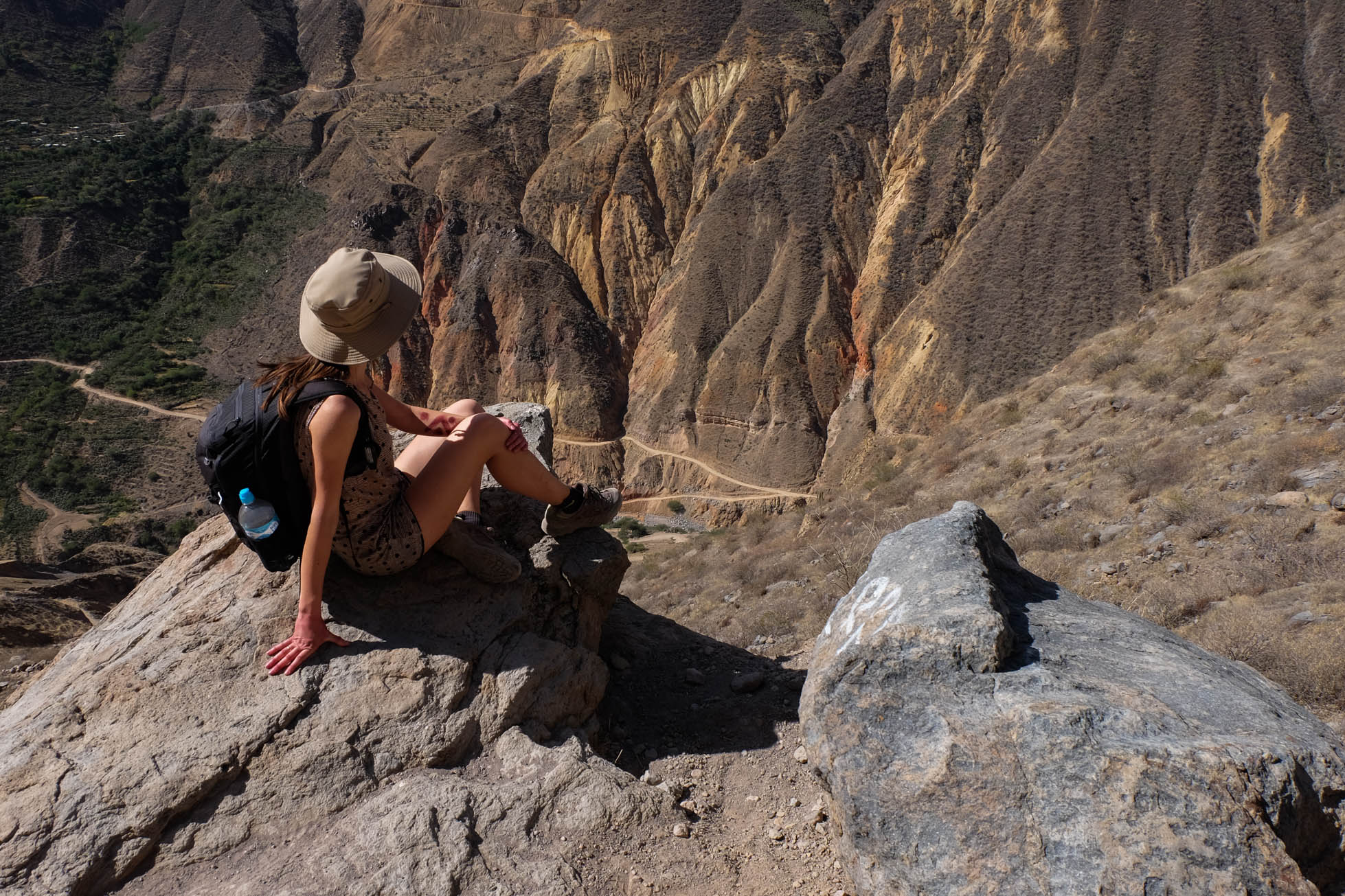
We cross several landslides that destroyed parts of the trail and reach the canyon bottom beside the Colca River, one of the waterways that carved it over millennia. We search for the geyser until we see steam rising from the ground near the riverbank. Looking carefully, we see it emerging at several points. I would like to touch the river and discover whether the water is warm, but the bank is too steep.
How happy it feels when dry surroundings become green and lush—combined with the knowledge that our destination, dinner, and hot springs are close. Walking is entirely different now!
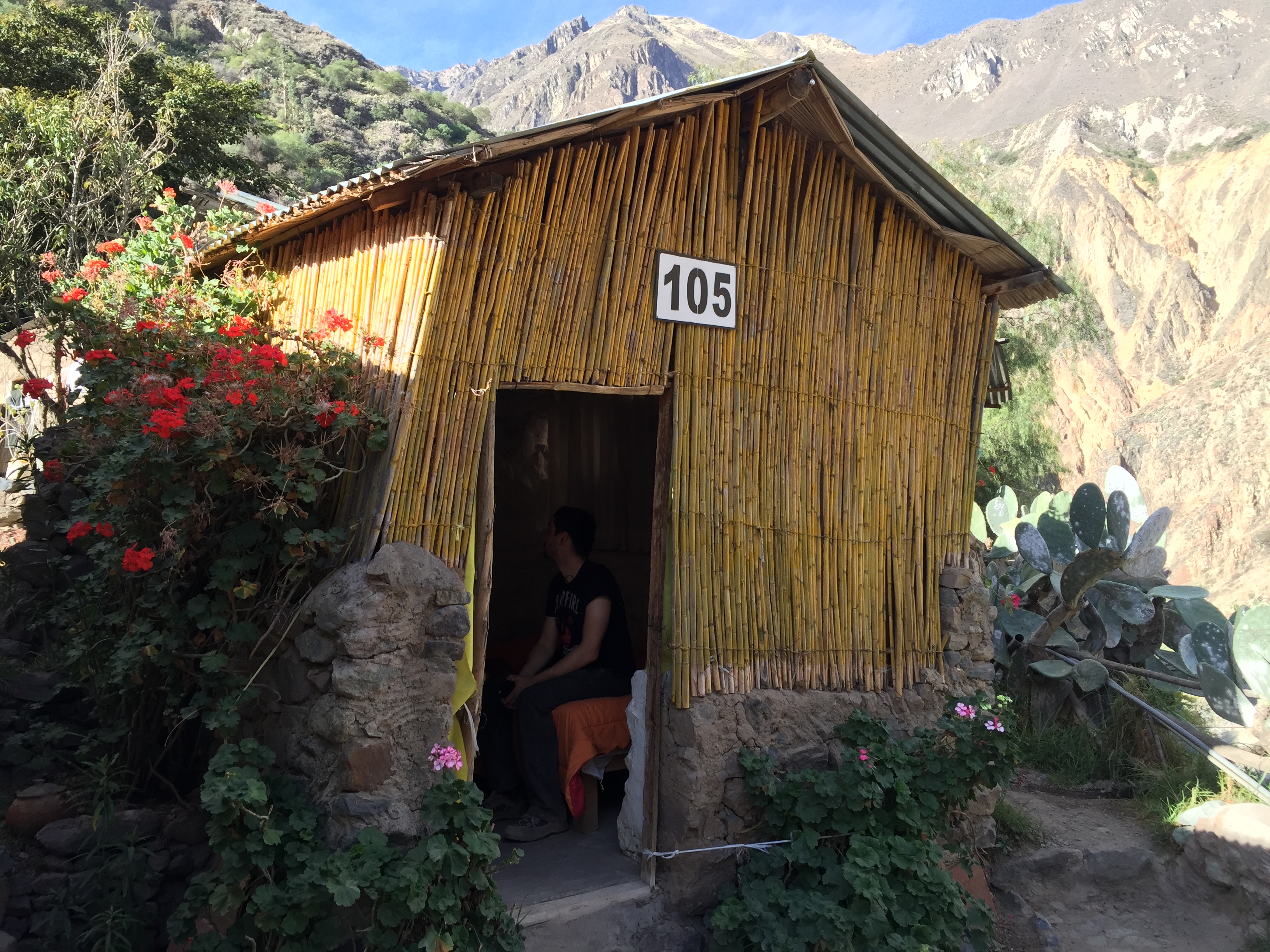
We cross another bridge over the Huaruro River and enter Llahuar. Today’s walk took four hours, entirely downhill. At the trail’s end, a woman invites us to stay at Llahuar Lodge. We agree, since the village contains only two accommodation businesses. Our lodge stands on a cliff above the canyon and river. The huts are simple—masonry walls, a thatched roof, and a bed—but they look so beautiful that I am delighted. Electricity comes on only after dark and powers nothing but the light. There are no sockets for charging electronics. This is no problem for us because yesterday, we bought a portable battery with a built-in solar panel. The toilet and shower are communal and occupy another thatched hut.
We look for something to eat. Nothing is available because dinner will be served at 18:30. Since it is Midsummer, we at least buy a beer, which tastes extraordinarily good after the hike, and enjoy the exclusive view. Jānis begins browsing the guest book. Most visitors came from the United States, France, Germany, or other South American countries. Then we suddenly see “Latvia”—it must be Kārlis! I take a photograph and later send it to him. He also travelled through South America, including Peru, that winter. What a coincidence: we are the only three Latvians who stayed here, and we know one another.
Later, we descend steep steps towards the river and the thermal pools. Two are lukewarm and two hot. The sun no longer reaches the canyon floor by late afternoon and the air is cooling, so we choose a hot pool. What a view and feeling! The two of us sit in hot water beside a wild, turbulent, turquoise river, while an occasional waterbird flies or swims past. We are at the bottom of an insanely beautiful canyon.
The water changes continuously. It emerges hot from the earth and flows through a pipe into the pool; another pipe drains it into the river so the level does not rise. Soon, five people join us: three women and two men, the same group we passed near the start of the trail. “Yes, we walked very slowly and rested much too often,” one woman says ironically. One is Spanish, while the others are Portuguese. We sit in the pool with these excellent people and talk. The subject turns to language. The Portuguese travellers confirm that the similarities between Portuguese and Spanish make the former quite sufficient for travel in Peru. One man says he cannot discuss languages objectively because he speaks Portuguese, Spanish, and French fluently, with excellent English and Italian. What wealth that is! Knowing at least one Latin-derived language fluently is a great advantage because learning the others becomes easier.
Once our fingers are thoroughly wrinkled and we have moved repeatedly between hot and cool pools and the river, we climb back up for dinner. A British man and woman join our table, followed later by a German trio and then the Portuguese. We continue waiting over beer and explain that Latvia is celebrating Jāņi during these days. The Portuguese are surprised: they have a similar holiday now, the São João Festival. We describe celebrating in nature, lighting a bonfire, and weaving flower wreaths. They explain that people fill the streets for concerts and dancing and, in one curious tradition, hit each other over the head with garlic flowers or inflatable hammers. At São João, they eat grilled sardines and meat and drink wine. Like us, the Portuguese jump over bonfires and traditionally celebrate the solstice until dawn.
Meanwhile, the British and German women discover when tomorrow’s minibus arrives. They found the descent too difficult and have no intention of continuing the hike.
After vegetarian soup and stew, sleep arrives, and everyone disperses to their huts. We switch on the light in ours, which barely illuminates the room. Prompted by some unexplained anxiety, I take the small torch and inspect beneath the bed and across the ceiling. Yes, just before sleep was not the best time for this... Large and small spiders cover the thatch. I am not frightened by their presence, only by not knowing which specimens are venomous. Nor is it pleasant that a sizeable one sits directly above my pillow. There is nothing to do but imagine I never saw them and go to bed. I turn off the light, settle down, and think of my friend who is terrified of spiders. At this unsuitable moment, I recall the statistic her husband once quoted: a person swallows so many spiders during their lifetime because the creatures fall into open mouths at night or hide in food. (“Thank you,” Gints!) I cover my mouth with the blanket and fall asleep.
Day 2
We wake. Neither Jānis nor I has transformed into Spider-Man. At breakfast, the Portuguese man sadly shows us an upper lip that has swollen dramatically and hangs down by at least half a lip’s width. A bite or perhaps sting is visible above it. Maybe a spider?
We set off. Today, we must climb the opposite side of the canyon, then descend again to the river and the Sangalle oasis, where we will spend the night. The ascent begins the moment we leave the village. After around forty minutes, we reach Paclla, which at first resembles an abandoned farmstead, although later we see several more houses. A man and woman are working in a yard. We recognise yesterday’s elderly gentleman, who greets us with a smile. A little beyond the village, I notice a tree whose leaves and fruits resemble figs. When I pick one, milky sap emerges, and Jānis grabs a wet wipe to remove it from my skin. I never discover whether it was a real fig. After leaving the village, we lose the trail. Jānis is completely certain that the road is “up there”, so we begin climbing a half-vanished path. It soon ends, requiring us to jump a small ravine formed by a landslide. Although walking straight uphill may seem to save time, I do not recommend it in terrain like this. First, it can trigger landslides. Second, on the steepest sections, you begin sliding down and sometimes have to drop onto all fours. I would not want to roll from this mountain: within the first metre, I would be full of cactus spines.
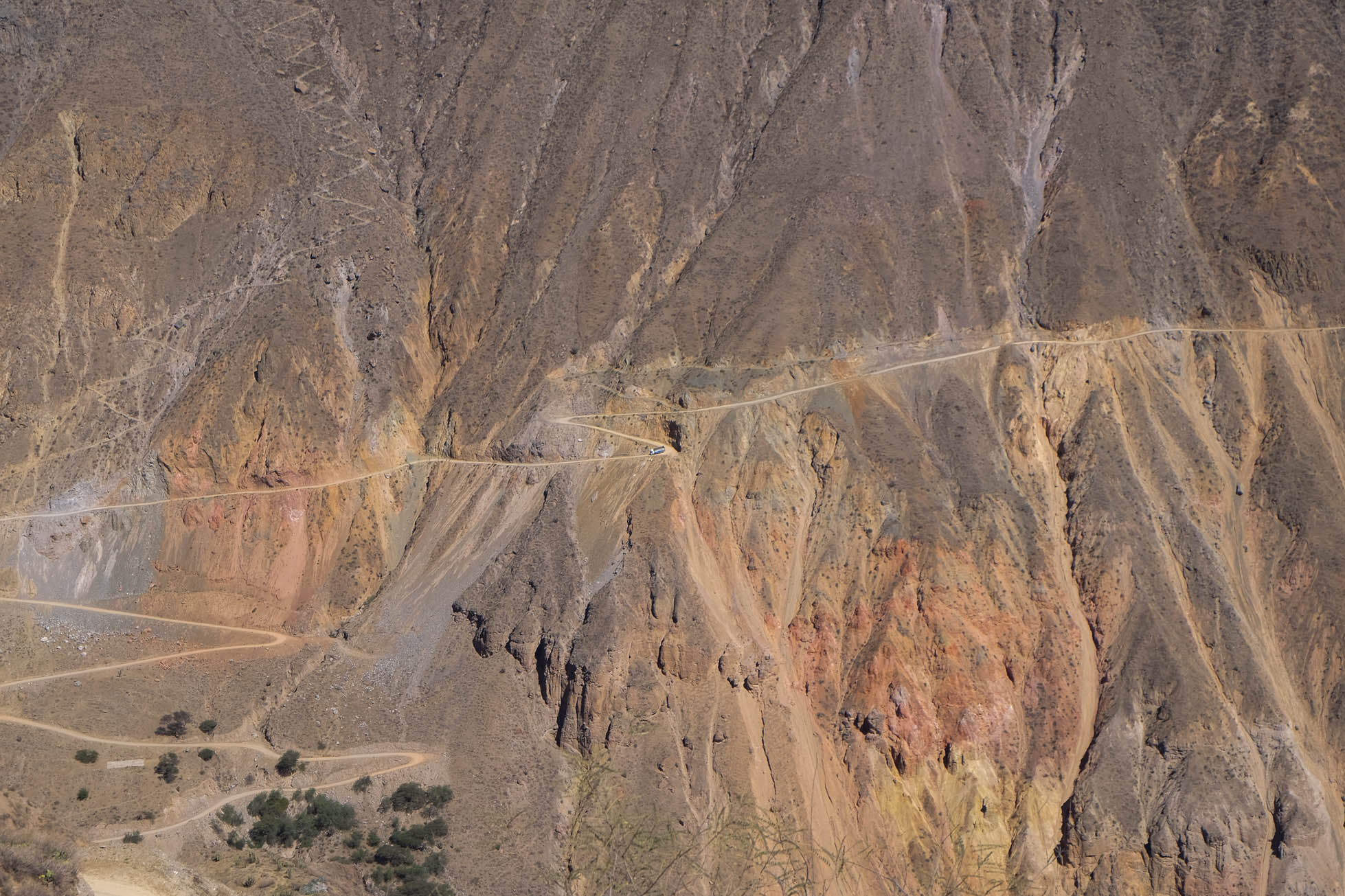
We reach the gravel road. I realise that the women waiting for the minibus will have to climb to this exact point, hardly easier than a four-hour descent into the canyon. The route continues along the road. A minibus passes carrying the Spanish woman and Portuguese man. Perhaps something urgent is needed for his lip, since yesterday he planned to follow the difficult route towards waterfalls at around 5,400 metres. Apart from several jeeps and a dead snake, we meet nobody else on this section. At last, from above, we see the green oasis where we will sleep. We turn onto a descending trail, and the happy walk begins with the knowledge that we are nearly there. The zigzag path reveals the oasis from different angles, each new view inspiring. Lower down, a waterfall appears in the distance, emerging directly from the canyon wall.
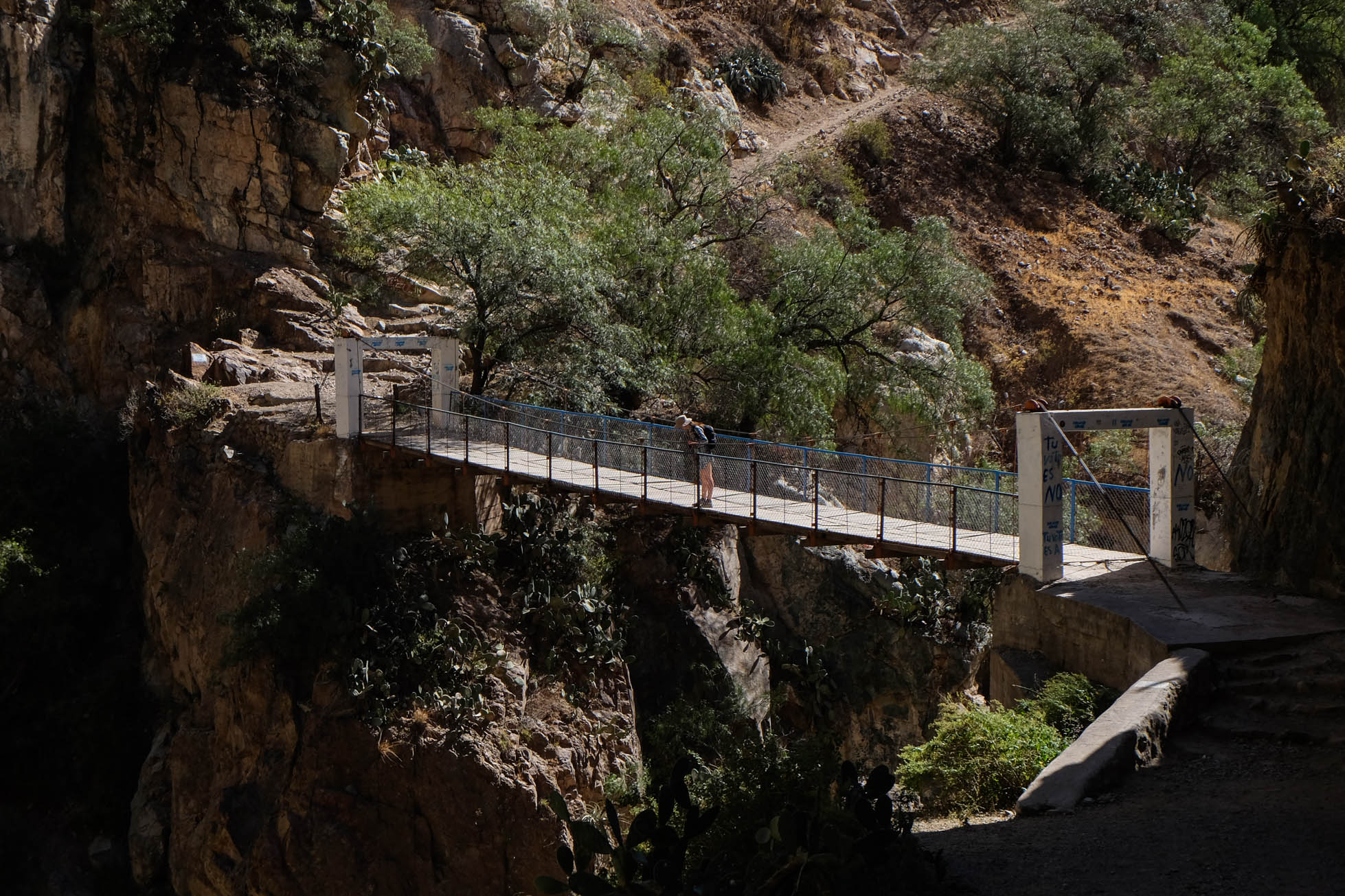
Yes! We finally reach the Colca River, cross the bridge, and enter the oasis. The journey took five hours, including around forty minutes lost and a short snack break. Everything is green, bright flowers bloom in carefully tended gardens, and countless small streams run through the village. Sangalle consists entirely of accommodation for travellers. It is the closest village to the canyon rim and therefore the most popular. We choose Oasis Paraíso Ecolodge. We leave our belongings in a hut whose walls are much denser than those of last night’s room, and Jānis immediately hurries to the pool. I never get to swim because after our late lunch at around 16:00, the sun slips behind the canyon “wall” and the air cools. We nap and rest our legs until dinnertime. With torches, we walk to eat. While the meal is being prepared, we meet José, a Peruvian who grew up and now studies in the United States. His family lives in Lima, and he knows the capital and its surroundings well. Realising that he had not seen most of what Peru offers, he is now travelling to learn more deeply about his country. After dinner, we continue talking with José over beer beside the bonfire. He is extremely communicative and delighted to share his knowledge of Peruvian culture. The feeling at this moment is beyond comprehension: millions of brilliant stars cover the canyon while we sit at a fire on its deepest floor. José and his friends also plan to visit Puno soon and suggest that we all travel together for more fun. Unfortunately, once back in civilisation, we cannot find him on Facebook, because dozens of people share his two first names and surname. Lesson for the future: give people my contact details, because my full name returns only one search result.
On this hut’s ceiling, I notice only a few spiders, and they no longer trouble me. I remove my flip-flops and begin climbing into bed when I see something on the rough floor. A scorpion! In the torchlight, I notice that the tail section is flattened. The little creature crawled into and remained within the one square metre between the bed and shelf where I moved most before sleep. I accidentally stepped on it.
Day 3
Ah, today we must climb out, and the sun will shine directly onto this canyon wall throughout the ascent. Before leaving, I check beside the bed in case the little scorpion survived. No, it remains in the same place. In connection with this, Jānis gives me the name Blunt Sting.
We climb, rest, and drink water, then climb again—perhaps ten times. After three hours, we reach the canyon rim and return to the same eatery we visited on our first day for lunch. All its volunteers are currently eating together at a large table. At 14:00, we board the bus and return to Arequipa that evening.
Summary
Because Colca Canyon is a popular destination among travellers in Peru, here is a summary of our route and costs that may help others. As I mentioned, once you understand the basic route information, this hike can be completed independently, reducing costs and providing greater freedom of choice and action.
Three-day hiking route: Cabanaconde–Llahuar (4 h)–Sangalle (5 h)–Cabanaconde (3 h).
Costs per person:
Bus from Arequipa: S/18.50
Night at Llahuar Lodge with thermal pools: S/20
Dinner at Llahuar Lodge (the same meal for everyone): S/10
Breakfast at Llahuar Lodge: S/10
Night at Oasis Paraíso Ecolodge: S/20
Lunch at the Ecolodge: S/10
Dinner at the Ecolodge: S/10
Breakfast at the Ecolodge: S/10
Bus to Arequipa: S/17
Colca Canyon regional tourist ticket: S/70
Total: S/195.50 per person, or EUR 54. (Ours cost EUR 35 because we never met anyone from whom to buy the tourist ticket.)
Bring a day backpack containing:
warm clothes for the night;
a torch (villages may have no electricity);
insect repellent for evenings in the oasis;
swimwear and a towel;
water for one day (more can be bought in the villages);
energy snacks;
coca leaves or altitude-sickness medication (Cabanaconde is 3,287 metres high, and the road there crosses higher ground);
SPF 50+ sunscreen and a hat.